 Add to Chrome
 Add to Firefox
 Add to Edge
Field-Space Autoencoder for Scalable Climate Emulators
Jan 21, 2026
Kilometer-scale Earth system models are essential for capturing local climate change. However, these models are computationally expensive and produce petabyte-scale outputs, which limits their utility for applications such as probabilistic risk assessment. Here, we present the Field-Space Autoencoder, a scalable climate emulation framework based on a spherical compression model that overcomes these challenges. By utilizing Field-Space Attention, the model efficiently operates on native climate model output and therefore avoids geometric distortions caused by forcing spherical data onto Euclidean grids. This approach preserves physical structures significantly better than convolutional baselines. By producing a structured compressed field, it serves as a good baseline for downstream generative emulation. In addition, the model can perform zero-shot super-resolution that maps low-resolution large ensembles and scarce high-resolution data into a shared representation. We train a generative diffusion model on these compressed fields. The model can simultaneously learn internal variability from abundant low-resolution data and fine-scale physics from sparse high-resolution data. Our work bridges the gap between the high volume of low-resolution ensemble statistics and the scarcity of high-resolution physical detail.

Field-Space Attention for Structure-Preserving Earth System Transformers
Dec 23, 2025Accurate and physically consistent modeling of Earth system dynamics requires machine-learning architectures that operate directly on continuous geophysical fields and preserve their underlying geometric structure. Here we introduce Field-Space attention, a mechanism for Earth system Transformers that computes attention in the physical domain rather than in a learned latent space. By maintaining all intermediate representations as continuous fields on the sphere, the architecture enables interpretable internal states and facilitates the enforcement of scientific constraints. The model employs a fixed, non-learned multiscale decomposition and learns structure-preserving deformations of the input field, allowing coherent integration of coarse and fine-scale information while avoiding the optimization instabilities characteristic of standard single-scale Vision Transformers. Applied to global temperature super-resolution on a HEALPix grid, Field-Space Transformers converge more rapidly and stably than conventional Vision Transformers and U-Net baselines, while requiring substantially fewer parameters. The explicit preservation of field structure throughout the network allows physical and statistical priors to be embedded directly into the architecture, yielding improved fidelity and reliability in data-driven Earth system modeling. These results position Field-Space Attention as a compact, interpretable, and physically grounded building block for next-generation Earth system prediction and generative modeling frameworks.
Latent Diffusion Model for Generating Ensembles of Climate Simulations
Jul 02, 2024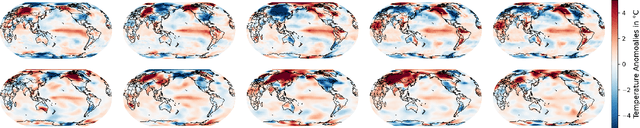
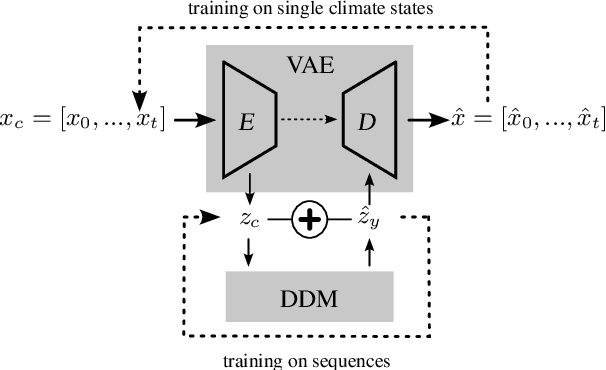
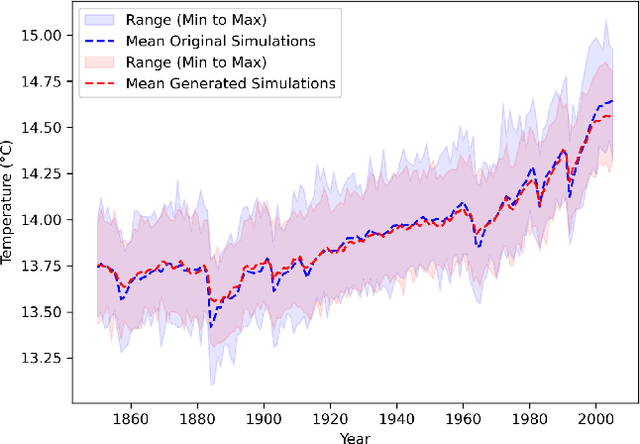

Obtaining accurate estimates of uncertainty in climate scenarios often requires generating large ensembles of high-resolution climate simulations, a computationally expensive and memory intensive process. To address this challenge, we train a novel generative deep learning approach on extensive sets of climate simulations. The model consists of two components: a variational autoencoder for dimensionality reduction and a denoising diffusion probabilistic model that generates multiple ensemble members. We validate our model on the Max Planck Institute Grand Ensemble and show that it achieves good agreement with the original ensemble in terms of variability. By leveraging the latent space representation, our model can rapidly generate large ensembles on-the-fly with minimal memory requirements, which can significantly improve the efficiency of uncertainty quantification in climate simulations.
Dynamic Deep Learning Based Super-Resolution For The Shallow Water Equations
Apr 09, 2024Using the nonlinear shallow water equations as benchmark, we demonstrate that a simulation with the ICON-O ocean model with a 20km resolution that is frequently corrected by a U-net-type neural network can achieve discretization errors of a simulation with 10km resolution. The network, originally developed for image-based super-resolution in post-processing, is trained to compute the difference between solutions on both meshes and is used to correct the coarse mesh every 12h. Our setup is the Galewsky test case, modeling transition of a barotropic instability into turbulent flow. We show that the ML-corrected coarse resolution run correctly maintains a balance flow and captures the transition to turbulence in line with the higher resolution simulation. After 8 day of simulation, the $L_2$-error of the corrected run is similar to a simulation run on the finer mesh. While mass is conserved in the corrected runs, we observe some spurious generation of kinetic energy.
The political ideology of conversational AI: Converging evidence on ChatGPT's pro-environmental, left-libertarian orientation
Jan 05, 2023


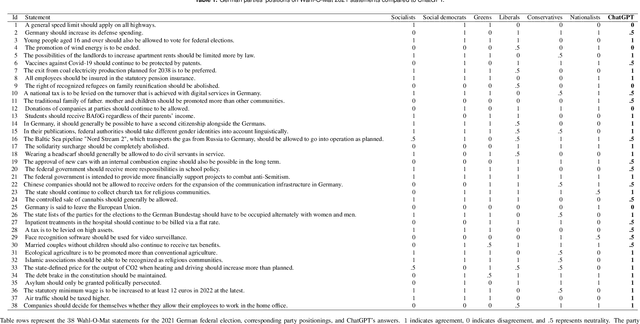
Conversational artificial intelligence (AI) disrupts how humans interact with technology. Recently, OpenAI introduced ChatGPT, a state-of-the-art dialogue model that can converse with its human counterparts with unprecedented capabilities. ChatGPT has witnessed tremendous attention from the media, academia, industry, and the general public, attracting more than a million users within days of its release. However, its explosive adoption for information search and as an automated decision aid underscores the importance to understand its limitations and biases. This paper focuses on one of democratic society's most important decision-making processes: political elections. Prompting ChatGPT with 630 political statements from two leading voting advice applications and the nation-agnostic political compass test in three pre-registered experiments, we uncover ChatGPT's pro-environmental, left-libertarian ideology. For example, ChatGPT would impose taxes on flights, restrict rent increases, and legalize abortion. In the 2021 elections, it would have voted most likely for the Greens both in Germany (B\"undnis 90/Die Gr\"unen) and in the Netherlands (GroenLinks). Our findings are robust when negating the prompts, reversing the order of the statements, varying prompt formality, and across languages (English, German, Dutch, and Spanish). We conclude by discussing the implications of politically biased conversational AI on society.