 Add to Chrome
 Add to Firefox
 Add to Edge
Does generative AI supersede supervised XMLC? A Benchmark Study on Automated Subject Indexing with German Scientific Literature
Jul 16, 2026
With a large controlled vocabulary as the label set, the task of automated subject indexing in a library can be understood as a multi-label classification task. If the set of subject terms is large, the problem fits the Extreme Multi-Label Classification (XMLC) objective. In this study, we apply a selection of specialised supervised XMLC methods to the test case of subject indexing contemporary German scientific literature, collected at the German National Library (DNB). We contrast these results by including a classical lexical matching baseline and three of our own recently developed LLM-based methods into the benchmark. Algorithms are evaluated and compared in several metrics. This includes binary relevance comparisons with previously indexed material, as well as graded relevance ratings by professional subject librarians. A challenge for all methods is to reliably make suggestions from the long tail of the subject vocabulary. We find that supervised XMLC algorithms relying on transformer-based dense features give best results in terms of overall binary relevance metrics. However, focusing on graded relevance and performance in the long tail of our subject vocabulary, the LLM-based generative methods give better results, making them a promising alternative for future productive use.

An Extreme Multi-label Text Classification (XMTC) Library Dataset: What if we took "Use of Practical AI in Digital Libraries" seriously?
Mar 11, 2026Subject indexing is vital for discovery but hard to sustain at scale and across languages. We release a large bilingual (English/German) corpus of catalog records annotated with the Integrated Authority File (GND), plus a machine-actionable GND taxonomy. The resource enables ontology-aware multi-label classification, mapping text to authority terms, and agent-assisted cataloging with reproducible, authority-grounded evaluation. We provide a brief statistical profile and qualitative error analyses of three systems. We invite the community to assess not only accuracy but usefulness and transparency, toward authority-anchored AI co-pilots that amplify catalogers' work.
DNB-AI-Project at SemEval-2025 Task 5: An LLM-Ensemble Approach for Automated Subject Indexing
Apr 30, 2025
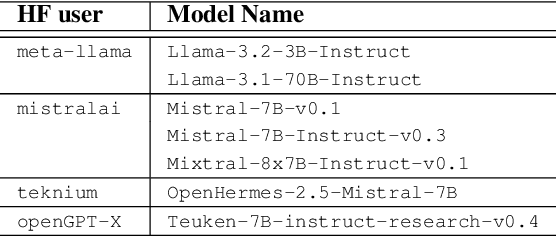
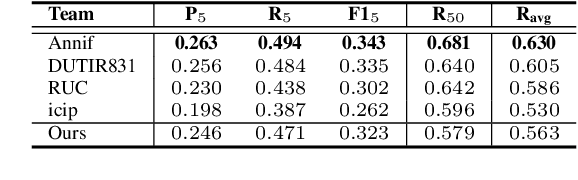

This paper presents our system developed for the SemEval-2025 Task 5: LLMs4Subjects: LLM-based Automated Subject Tagging for a National Technical Library's Open-Access Catalog. Our system relies on prompting a selection of LLMs with varying examples of intellectually annotated records and asking the LLMs to similarly suggest keywords for new records. This few-shot prompting technique is combined with a series of post-processing steps that map the generated keywords to the target vocabulary, aggregate the resulting subject terms to an ensemble vote and, finally, rank them as to their relevance to the record. Our system is fourth in the quantitative ranking in the all-subjects track, but achieves the best result in the qualitative ranking conducted by subject indexing experts.