 Add to Chrome
 Add to Firefox
 Add to Edge
Deep Learning for BioImaging: What Are We Learning?
Mar 10, 2026
Representation learning has driven major advances in natural image analysis by enabling models to acquire high-level semantic features. In microscopy imaging, however, it remains unclear what current representation learning methods actually learn. In this work, we conduct a systematic study of representation learning for the two most widely used and broadly available microscopy data types, representing critical scales in biology: cell culture and tissue imaging. To this end, we introduce a set of simple yet revealing baselines on curated benchmarks, including untrained models and simple structural representations of cellular tissue. Our results show that, surprisingly, state-of-the-art methods perform comparably to these baselines. We further show that, in contrast to natural images, existing models fail to consistently acquire high-level, biologically meaningful features. Moreover, we demonstrate that commonly used benchmark metrics are insufficient to assess representation quality and often mask this limitation. In addition, we investigate how detailed comparisons with these benchmarks provide ways to interpret the strengths and weaknesses of models for further improvements. Together, our results suggest that progress in microscopy image representation learning requires not only stronger models, but also more diagnostic benchmarks that measure what is actually learned.

ChAda-ViT : Channel Adaptive Attention for Joint Representation Learning of Heterogeneous Microscopy Images
Nov 26, 2023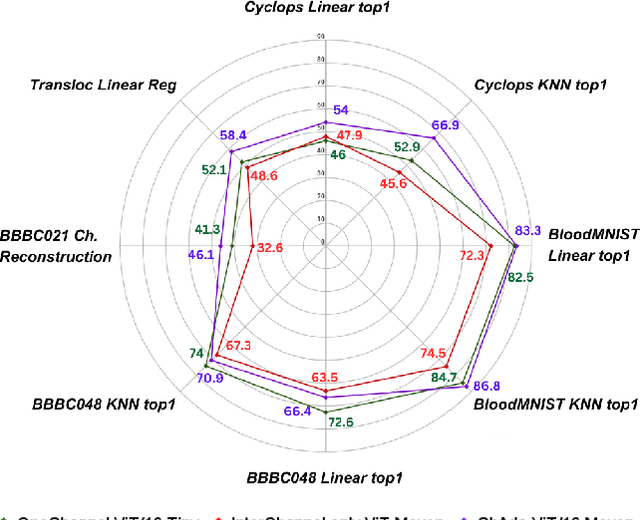

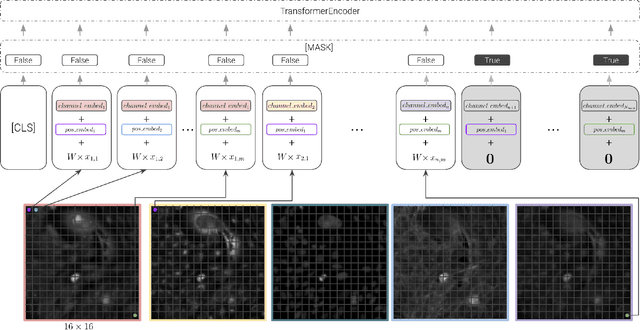
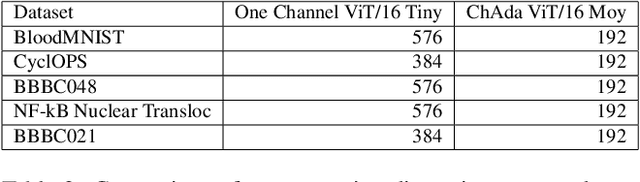
Unlike color photography images, which are consistently encoded into RGB channels, biological images encompass various modalities, where the type of microscopy and the meaning of each channel varies with each experiment. Importantly, the number of channels can range from one to a dozen and their correlation is often comparatively much lower than RGB, as each of them brings specific information content. This aspect is largely overlooked by methods designed out of the bioimage field, and current solutions mostly focus on intra-channel spatial attention, often ignoring the relationship between channels, yet crucial in most biological applications. Importantly, the variable channel type and count prevent the projection of several experiments to a unified representation for large scale pre-training. In this study, we propose ChAda-ViT, a novel Channel Adaptive Vision Transformer architecture employing an Inter-Channel Attention mechanism on images with an arbitrary number, order and type of channels. We also introduce IDRCell100k, a bioimage dataset with a rich set of 79 experiments covering 7 microscope modalities, with a multitude of channel types, and channel counts varying from 1 to 10 per experiment. Our proposed architecture, trained in a self-supervised manner, outperforms existing approaches in several biologically relevant downstream tasks. Additionally, it can be used to bridge the gap for the first time between assays with different microscopes, channel numbers or types by embedding various image and experimental modalities into a unified biological image representation. The latter should facilitate interdisciplinary studies and pave the way for better adoption of deep learning in biological image-based analyses. Code and Data to be released soon.