 Add to Chrome
 Add to Firefox
 Add to Edge
Sequential RC-TGAN: Generating Relational Time Series with Spectral Envelope Loss
Jun 30, 2026
The generation of synthetic relational databases often involves modeling complex temporal dynamics, such as transaction logs or event sequences. A significant challenge in this domain is the handling of categorical time series (e.g., status codes), where standard encoding methods like one-hot encoding fail to capture intrinsic frequency-domain features such as seasonality and cyclicity. In this paper, we introduce Sequential RC-TGAN (Seq. RC-TGAN), a temporal extension of the RC-TGAN framework, equipped with a novel integrated loss function based on the \textit{Spectral Envelope Theory}. This differentiable loss allows the generator to directly optimize the preservation of latent periodic structures via backpropagation. While spectral envelope theory is inherently designed for categorical sequences, we extend this frequency-domain regularization to continuous time series by employing a Variational Gaussian Mixture Model (VGM) discretization strategy. To establish a mathematically rigorous evaluation standard, we simulate categorical time series governed by a parameter $α$, with exactly known theoretical spectral envelopes. Integrating these dynamic sequences into the child tables of a relational database yields a robust ground-truth benchmark for evaluating the frequency-domain fidelity of our generative framework. Furthermore, we address the lack of robust evaluation standards for relational time series by proposing two new metrics: Spectral Density Divergence and Spectral Envelope Divergence. Experimental results on real-world datasets, as well as our simulated benchmarks, demonstrate that our end-to-end approach significantly outperforms state-of-the-art systems in reproducing cyclic patterns and long-term seasonality across both categorical and continuous features.

Row Conditional-TGAN for generating synthetic relational databases
Nov 14, 2022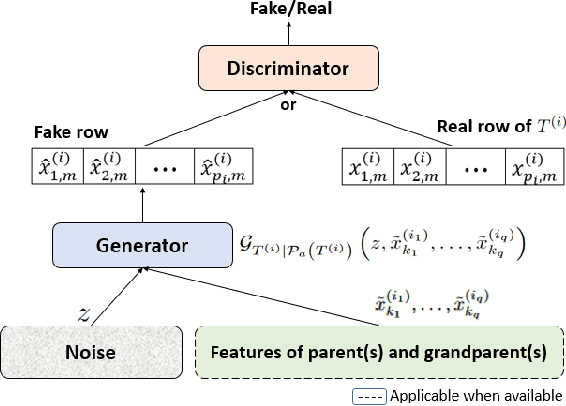
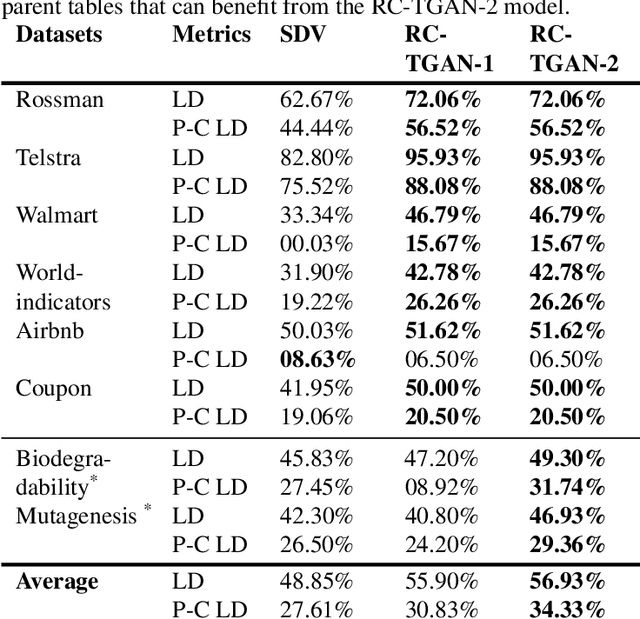
Besides reproducing tabular data properties of standalone tables, synthetic relational databases also require modeling the relationships between related tables. In this paper, we propose the Row Conditional-Tabular Generative Adversarial Network (RC-TGAN), a novel generative adversarial network (GAN) model that extends the tabular GAN to support modeling and synthesizing relational databases. The RC-TGAN models relationship information between tables by incorporating conditional data of parent rows into the design of the child table's GAN. We further extend the RC-TGAN to model the influence that grandparent table rows may have on their grandchild rows, in order to prevent the loss of this connection when the rows of the parent table fail to transfer this relationship information. The experimental results, using eight real relational databases, show significant improvements in the quality of the synthesized relational databases when compared to the benchmark system, demonstrating the effectiveness of the RC-TGAN in preserving relationships between tables of the original database.