 Add to Chrome
 Add to Firefox
 Add to Edge
Database Querying under Missing Values Governed by Missingness Mechanisms
Apr 07, 2026
We address the problems of giving a semantics to- and doing query answering (QA) on a relational database (RDB) that has missing values (MVs). The causes for the latter are governed by a Missingness Mechanism that is modelled as a Bayesian Network, which represents a Missingness Graph (MG) and involves the DB attributes. Our approach considerable departs from the treatment of RDBs with NULL (values). The MG together with the observed DB allow to build a block-independent probabilistic DB, on which basis we propose two QA techniques that jointly capture probabilistic uncertainty and statistical plausibility of the implicit imputation of MVs. We obtain complexity results that characterize the computational feasibility of those approaches.

Parallelisable Existential Rules: a Story of Pieces
Jul 13, 2021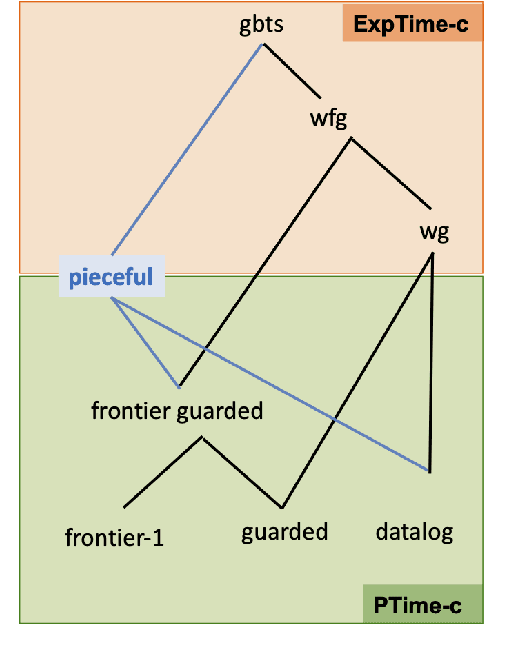
In this paper, we consider existential rules, an expressive formalism well suited to the representation of ontological knowledge and data-to-ontology mappings in the context of ontology-based data integration. The chase is a fundamental tool to do reasoning with existential rules as it computes all the facts entailed by the rules from a database instance. We introduce parallelisable sets of existential rules, for which the chase can be computed in a single breadth-first step from any instance. The question we investigate is the characterization of such rule sets. We show that parallelisable rule sets are exactly those rule sets both bounded for the chase and belonging to a novel class of rules, called pieceful. The pieceful class includes in particular frontier-guarded existential rules and (plain) datalog. We also give another characterization of parallelisable rule sets in terms of rule composition based on rewriting.