 Add to Chrome
 Add to Firefox
 Add to Edge
When Absolute State Fails: Evaluating Proprioceptive Encodings for Robust Manipulation
May 13, 2026
As end-to-end robotic policies are progressively deployed in the real world to solve real tasks, they face a gap between the training and inference conditions. Scaling the amount and diversity of the training data has shown some success in improving zero-shot generalization, yet robots still fail when faced with new, unseen test conditions. For instance, while robots with fixed frames of reference are common, those with moving frames pose a greater challenge for deployment. To address this specific instance of the issue, we present a study of strategies for encoding the robot's proprioceptive state to improve both in- and out-of-distribution performance at test time. Through a systematic study of joint representations, we find that a simple episode-wise relative frame provides the best trade-off between task performance and robustness, outperforming the baselines in extensive real-robot experiments conducted in a realistic test environment. The results suggest a practical path to leveraging data collected by robots with varying frames of reference and deployment to unseen test configurations.

A Revealing Large-Scale Evaluation of Unsupervised Anomaly Detection Algorithms
Apr 21, 2022
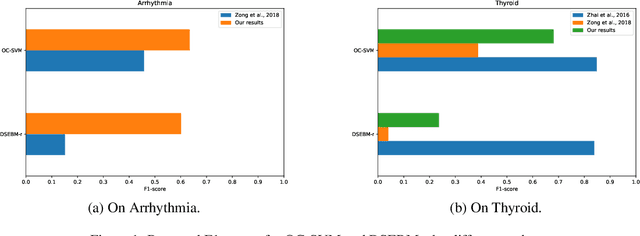
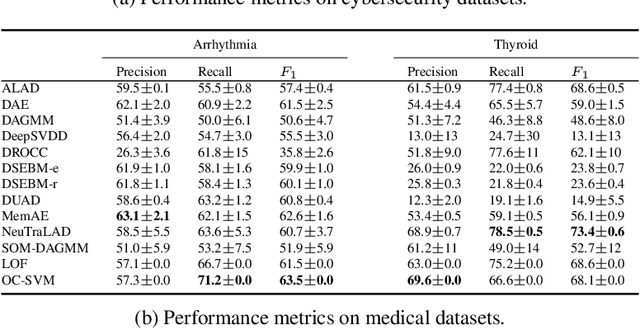
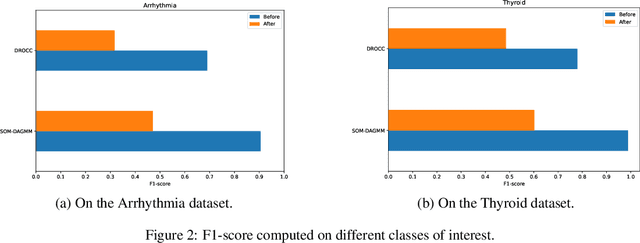
Anomaly detection has many applications ranging from bank-fraud detection and cyber-threat detection to equipment maintenance and health monitoring. However, choosing a suitable algorithm for a given application remains a challenging design decision, often informed by the literature on anomaly detection algorithms. We extensively reviewed twelve of the most popular unsupervised anomaly detection methods. We observed that, so far, they have been compared using inconsistent protocols - the choice of the class of interest or the positive class, the split of training and test data, and the choice of hyperparameters - leading to ambiguous evaluations. This observation led us to define a coherent evaluation protocol which we then used to produce an updated and more precise picture of the relative performance of the twelve methods on five widely used tabular datasets. While our evaluation cannot pinpoint a method that outperforms all the others on all datasets, it identifies those that stand out and revise misconceived knowledge about their relative performances.