 Add to Chrome
 Add to Firefox
 Add to Edge
ASAP: Amortized Doubly-Stochastic Attention via Sliced Dual Projection
May 13, 2026
Doubly-stochastic attention has emerged as a transport-based alternative to row-softmax attention, with recent Transformer variants using it to reduce attention sinks and rank collapse while improving performance. In this family, the standard approach is Sinkhorn scaling, which trains more efficiently but still repeats matrix scaling in every inference forward pass. Sliced-transport attention removes the online iteration, but its soft sorting approximation materializes dense tensors for each slice, requiring substantially more training resources than Sinkhorn attention. We introduce ASAP: Amortized Doubly-Stochastic Attention via Sliced Dual Projection, a train-then-compile method that trains the doubly-stochastic layer with Sinkhorn, then replaces the iterative scaling loop at inference with a fixed sliced-dual operator. It learns a lightweight parametric map from exact one-dimensional Kantorovich potentials to the Sinkhorn query-side dual, then reconstructs the attention plan with a two-sided entropic c-transform. Across language and vision benchmarks, ASAP keeps the cheaper training setup and remains highly competitive with recent baselines. In the main frozen-layer benchmark, ASAP is 5.3 faster than the trained Sinkhorn teacher while matching its accuracy; in downstream replacements, ASAP recovers most of the teacher performance without any retraining.

A trainable manifold for accurate approximation with ReLU Networks
Nov 29, 2023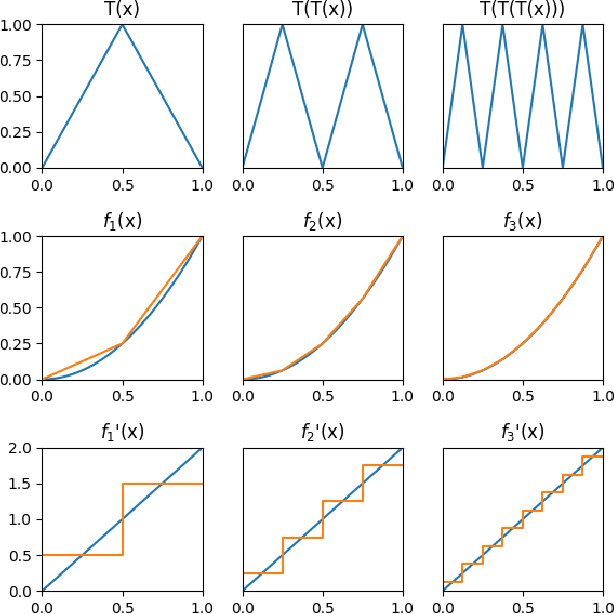
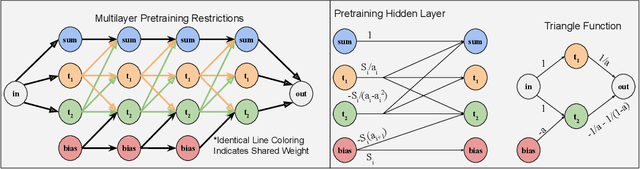
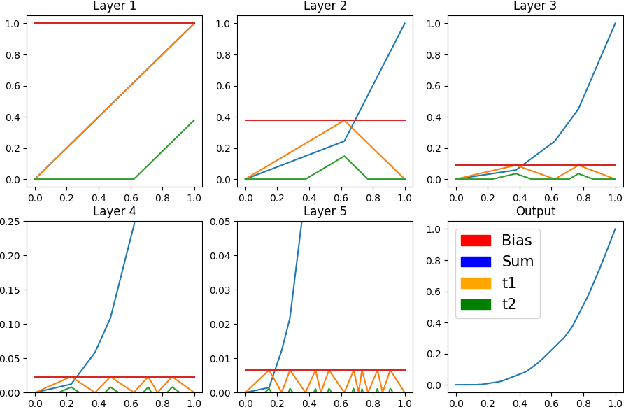

We present a novel technique for exercising greater control of the weights of ReLU activated neural networks to produce more accurate function approximations. Many theoretical works encode complex operations into ReLU networks using smaller base components. In these works, a common base component is a constant width approximation to x^2, which has exponentially decaying error with respect to depth. We extend this block to represent a greater range of convex one-dimensional functions. We derive a manifold of weights such that the output of these new networks utilizes exponentially many piecewise-linear segments. This manifold guides their training process to overcome drawbacks associated with random initialization and unassisted gradient descent. We train these networks to approximate functions which do not necessarily lie on the manifold, showing a significant reduction of error values over conventional approaches.