 Add to Chrome
 Add to Firefox
 Add to Edge
Impartial Selection with Predictions
Oct 21, 2025
We study the selection of agents based on mutual nominations, a theoretical problem with many applications from committee selection to AI alignment. As agents both select and are selected, they may be incentivized to misrepresent their true opinion about the eligibility of others to influence their own chances of selection. Impartial mechanisms circumvent this issue by guaranteeing that the selection of an agent is independent of the nominations cast by that agent. Previous research has established strong bounds on the performance of impartial mechanisms, measured by their ability to approximate the number of nominations for the most highly nominated agents. We study to what extent the performance of impartial mechanisms can be improved if they are given a prediction of a set of agents receiving a maximum number of nominations. Specifically, we provide bounds on the consistency and robustness of such mechanisms, where consistency measures the performance of the mechanisms when the prediction is accurate and robustness its performance when the prediction is inaccurate. For the general setting where up to $k$ agents are to be selected and agents nominate any number of other agents, we give a mechanism with consistency $1-O\big(\frac{1}{k}\big)$ and robustness $1-\frac{1}{e}-O\big(\frac{1}{k}\big)$. For the special case of selecting a single agent based on a single nomination per agent, we prove that $1$-consistency can be achieved while guaranteeing $\frac{1}{2}$-robustness. A close comparison with previous results shows that (asymptotically) optimal consistency can be achieved with little to no sacrifice in terms of robustness.

Multi-Leader Congestion Games with an Adversary
Dec 14, 2021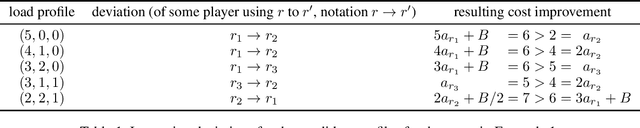
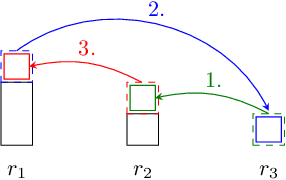
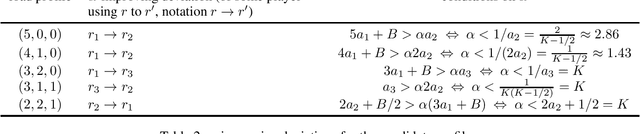
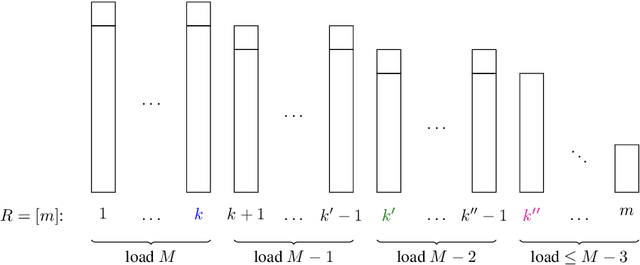
We study a multi-leader single-follower congestion game where multiple users (leaders) choose one resource out of a set of resources and, after observing the realized loads, an adversary (single-follower) attacks the resources with maximum loads, causing additional costs for the leaders. For the resulting strategic game among the leaders, we show that pure Nash equilibria may fail to exist and therefore, we consider approximate equilibria instead. As our first main result, we show that the existence of a $K$-approximate equilibrium can always be guaranteed, where $K \approx 1.1974$ is the unique solution of a cubic polynomial equation. To this end, we give a polynomial time combinatorial algorithm which computes a $K$-approximate equilibrium. The factor $K$ is tight, meaning that there is an instance that does not admit an $\alpha$-approximate equilibrium for any $\alpha<K$. Thus $\alpha=K$ is the smallest possible value of $\alpha$ such that the existence of an $\alpha$-approximate equilibrium can be guaranteed for any instance of the considered game. Secondly, we focus on approximate equilibria of a given fixed instance. We show how to compute efficiently a best approximate equilibrium, that is, with smallest possible $\alpha$ among all $\alpha$-approximate equilibria of the given instance.