 Add to Chrome
 Add to Firefox
 Add to Edge
Broken neural scaling laws in materials science
Feb 05, 2026
In materials science, data are scarce and expensive to generate, whether computationally or experimentally. Therefore, it is crucial to identify how model performance scales with dataset size and model capacity to distinguish between data- and model-limited regimes. Neural scaling laws provide a framework for quantifying this behavior and guide the design of materials datasets and machine learning architectures. Here, we investigate neural scaling laws for a paradigmatic materials science task: predicting the dielectric function of metals, a high-dimensional response that governs how solids interact with light. Using over 200,000 dielectric functions from high-throughput ab initio calculations, we study two multi-objective graph neural networks trained to predict the frequency-dependent complex interband dielectric function and the Drude frequency. We observe broken neural scaling laws with respect to dataset size, whereas scaling with the number of model parameters follows a simple power law that rapidly saturates.

Discovery of sustainable energy materials via the machine-learned material space
Jan 10, 2025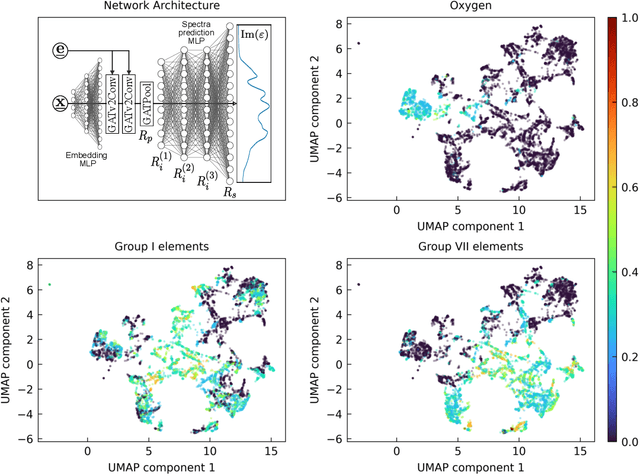
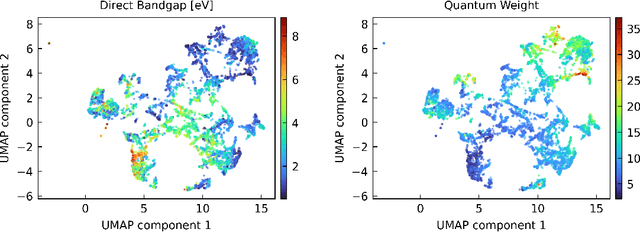
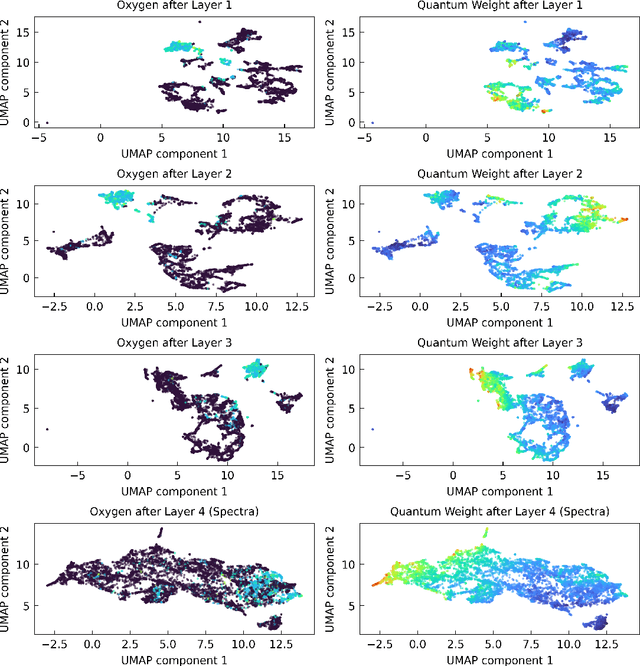
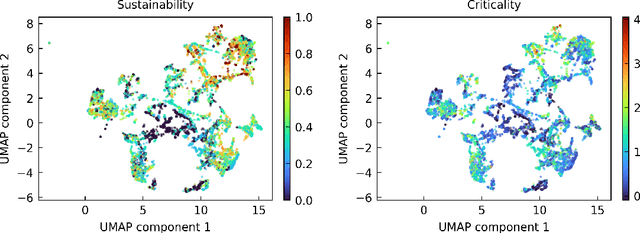
Does a machine learning model actually gain an understanding of the material space? We answer this question in the affirmative on the example of the OptiMate model, a graph attention network trained to predict the optical properties of semiconductors and insulators. By applying the UMAP dimensionality reduction technique to its latent embeddings, we demonstrate that the model captures a nuanced and interpretable representation of the materials space, reflecting chemical and physical principles, without any user-induced bias. This enables clustering of almost 10,000 materials based on optical properties and chemical similarities. Beyond this understanding, we demonstrate how the learned material space can be used to identify more sustainable alternatives to critical materials in energy-related technologies, such as photovoltaics. These findings demonstrate the dual utility of machine learning models in materials science: Accurately predicting material properties while providing insights into the underlying materials space. The approach demonstrates the broader potential of leveraging learned materials spaces for the discovery and design of materials for diverse applications, and is easily applicable to any state-of-the-art machine learning model.