 Add to Chrome
 Add to Firefox
 Add to Edge
Large Electron Model: A Universal Ground State Predictor
Mar 02, 2026
We introduce Large Electron Model, a single neural network model that produces variational wavefunctions of interacting electrons over the entire Hamiltonian parameter manifold. Our model employs the Fermi Sets architecture, a universal representation of many-body fermionic wavefunctions, which is further conditioned on Hamiltonian parameter and particle number. On interacting electrons in a two-dimensional harmonic potential, a single trained model accurately predicts the ground state wavefunction while generalizing across unseen coupling strengths and particle-number sectors, producing both accurate real-space charge densities and ground state energies, even up to $50$ particles. Our results establish a foundation model method for material discovery that is grounded in the variational principle, while accurately treating strong electron correlation beyond the capacity of density functional theory.

Predicting magnetism with first-principles AI
Feb 09, 2026Computational discovery of magnetic materials remains challenging because magnetism arises from the competition between kinetic energy and Coulomb interaction that is often beyond the reach of standard electronic-structure methods. Here we tackle this challenge by directly solving the many-electron Schrödinger equation with neural-network variational Monte Carlo, which provides a highly expressive variational wavefunction for strongly correlated systems. Applying this technique to transition metal dichalcogenide moiré semicondutors, we predict itinerant ferromagnetism in WSe$_2$/WS$_2$ and an antiferromagnetic insulator in twisted $Γ$-valley homobilayer, using the same neural network without any physics input beyond the microscopic Hamiltonian. Crucially, both types of magnetic states are obtained from a single calculation within the $S_z=0$ sector, removing the need to compute and compare multiple $S_z$ sectors. This significantly reduces computational cost and paves the way for faster and more reliable magnetic material design.
Is attention all you need to solve the correlated electron problem?
Feb 07, 2025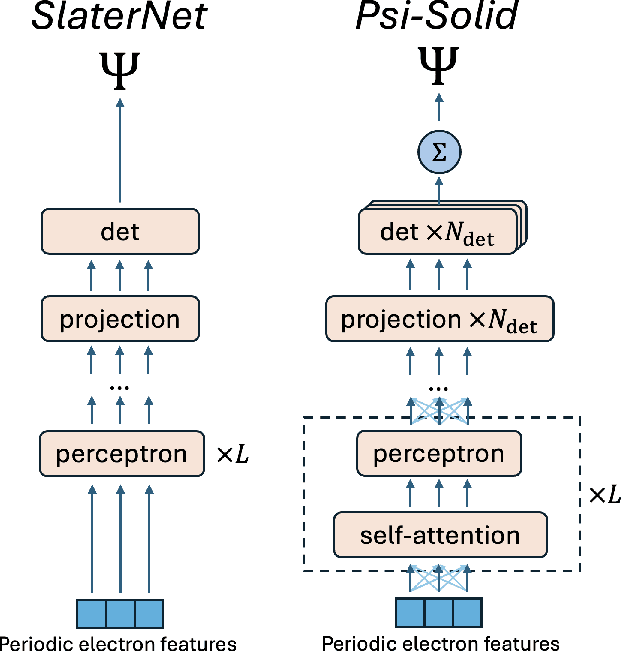
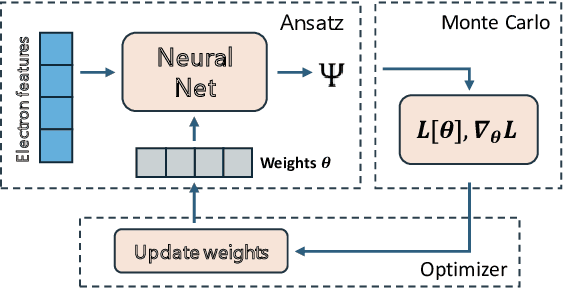
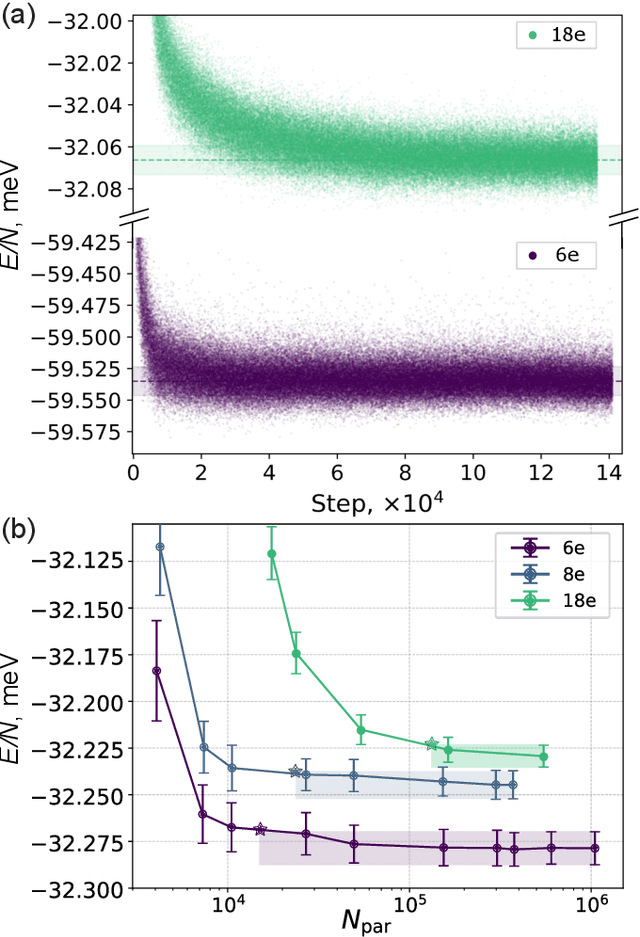
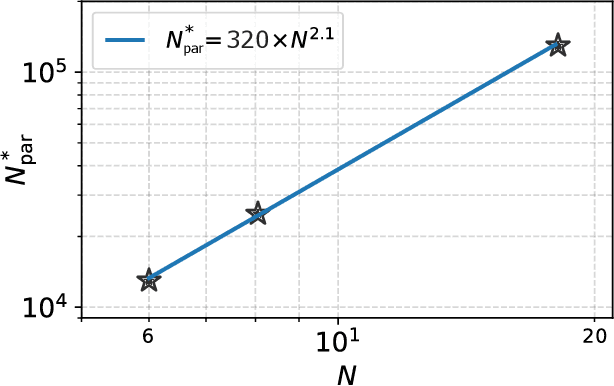
The attention mechanism has transformed artificial intelligence research by its ability to learn relations between objects. In this work, we explore how a many-body wavefunction ansatz constructed from a large-parameter self-attention neural network can be used to solve the interacting electron problem in solids. By a systematic neural-network variational Monte Carlo study on a moir\'e quantum material, we demonstrate that the self-attention ansatz provides an accurate, efficient, and unbiased solution. Moreover, our numerical study finds that the required number of variational parameters scales roughly as $N^2$ with the number of electrons, which opens a path towards efficient large-scale simulations.