 Add to Chrome
 Add to Firefox
 Add to Edge
Comparative Study of Out-of-the-Box Technology for Automatic Target Detection and Recognition
Aug 18, 2026
Automatic Target Detection and Recognition (ATD/R) is critical for military decision support and (semi-)autonomous operations. Recent advances in object detection and artificial intelligence (AI) significantly boosted the potential performance of ATD/R. However, the scarcity of publicly available military datasets limits the application of these systems. As a solution, this paper explores the use of publicly available models and civilian datasets to achieve reasonable performance in military contexts. We benchmark several state-of-the-art models, including six iterations of the YOLO series and two variations on the DETR framework, on a newly acquired military relevant dataset. This dataset features military vehicles and challenging circumstances, including various degrees of occlusions and small targets. The out-of-the-box version of each model is validated alongside a version finetuned on the VisDrone dataset. This dataset features small objects, an Air-to-Ground (A2G) perspective and relevant classes, potentially generalizing to our military ATD/R task. We compare the performance of the models using mAP@0.5 and mAP@0.5:0.95, across A2G and Ground-to-Ground (G2G) perspective, target size and model size, giving insight into the real-time capabilities of models. Our main findings are: (1) bigger models outperform smaller models, (2) DETR-based models show promising results compared to the YOLO series,(3) fine-tuning models on an out-of-domain A2G dataset, improves their A2G performance and slightly improves their performance on small objects, but (4) all models still struggle with detecting small objects in an A2G scenario. We conclude that, despite recent advances in object detection, in-domain training is still crucial for creating capable ATD/R systems.
* This paper was originally presented at the International Conference on Military Communication and Information Systems, organized by the Information Systems Technology Scientific and Technical Committee, IST-224-RSY - the ICMCIS, held in Bath, United Kingdom, 12-13 May 2026

OSSA: Unsupervised One-Shot Style Adaptation
Oct 01, 2024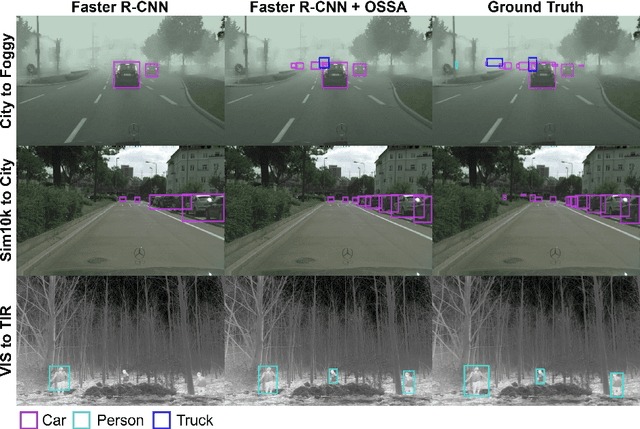
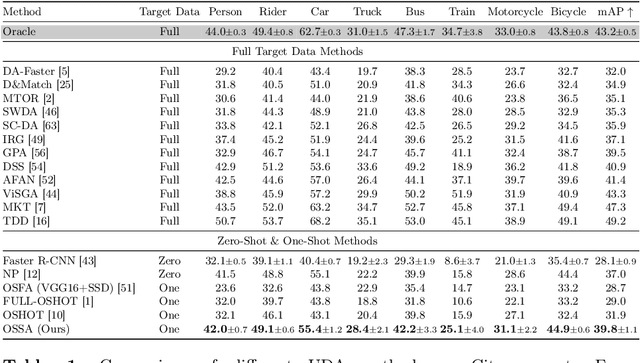
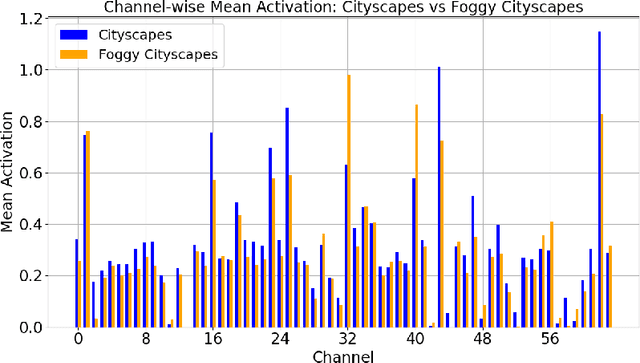

Despite their success in various vision tasks, deep neural network architectures often underperform in out-of-distribution scenarios due to the difference between training and target domain style. To address this limitation, we introduce One-Shot Style Adaptation (OSSA), a novel unsupervised domain adaptation method for object detection that utilizes a single, unlabeled target image to approximate the target domain style. Specifically, OSSA generates diverse target styles by perturbing the style statistics derived from a single target image and then applies these styles to a labeled source dataset at the feature level using Adaptive Instance Normalization (AdaIN). Extensive experiments show that OSSA establishes a new state-of-the-art among one-shot domain adaptation methods by a significant margin, and in some cases, even outperforms strong baselines that use thousands of unlabeled target images. By applying OSSA in various scenarios, including weather, simulated-to-real (sim2real), and visual-to-thermal adaptations, our study explores the overarching significance of the style gap in these contexts. OSSA's simplicity and efficiency allow easy integration into existing frameworks, providing a potentially viable solution for practical applications with limited data availability. Code is available at https://github.com/RobinGerster7/OSSA
Efficient Dictionary Learning with Sparseness-Enforcing Projections
Apr 16, 2016


Learning dictionaries suitable for sparse coding instead of using engineered bases has proven effective in a variety of image processing tasks. This paper studies the optimization of dictionaries on image data where the representation is enforced to be explicitly sparse with respect to a smooth, normalized sparseness measure. This involves the computation of Euclidean projections onto level sets of the sparseness measure. While previous algorithms for this optimization problem had at least quasi-linear time complexity, here the first algorithm with linear time complexity and constant space complexity is proposed. The key for this is the mathematically rigorous derivation of a characterization of the projection's result based on a soft-shrinkage function. This theory is applied in an original algorithm called Easy Dictionary Learning (EZDL), which learns dictionaries with a simple and fast-to-compute Hebbian-like learning rule. The new algorithm is efficient, expressive and particularly simple to implement. It is demonstrated that despite its simplicity, the proposed learning algorithm is able to generate a rich variety of dictionaries, in particular a topographic organization of atoms or separable atoms. Further, the dictionaries are as expressive as those of benchmark learning algorithms in terms of the reproduction quality on entire images, and result in an equivalent denoising performance. EZDL learns approximately 30 % faster than the already very efficient Online Dictionary Learning algorithm, and is therefore eligible for rapid data set analysis and problems with vast quantities of learning samples.
* The final publication is available at Springer via http://dx.doi.org/10.1007/s11263-015-0799-8