 Add to Chrome
 Add to Firefox
 Add to Edge
Single-View Tomographic Reconstruction Using Learned Primal Dual
Dec 18, 2025
The Learned Primal Dual (LPD) method has shown promising results in various tomographic reconstruction modalities, particularly under challenging acquisition restrictions such as limited viewing angles or a limited number of views. We investigate the performance of LPD in a more extreme case: single-view tomographic reconstructions of axially-symmetric targets. This study considers two modalities: the first assumes low-divergence or parallel X-rays. The second models a cone-beam X-ray imaging testbed. For both modalities, training data is generated using closed-form integral transforms, or physics-based ray-tracing software, then corrupted with blur and noise. Our results are then compared against common numerical inversion methodologies.

OrthoNets: Orthogonal Channel Attention Networks
Nov 07, 2023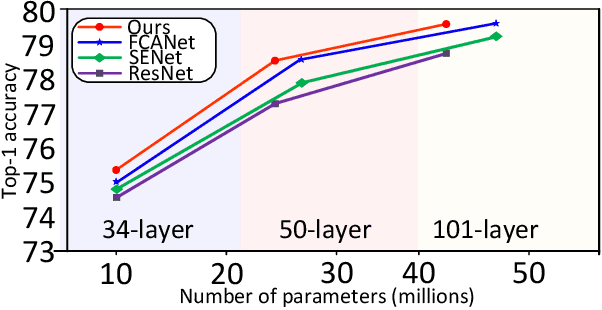
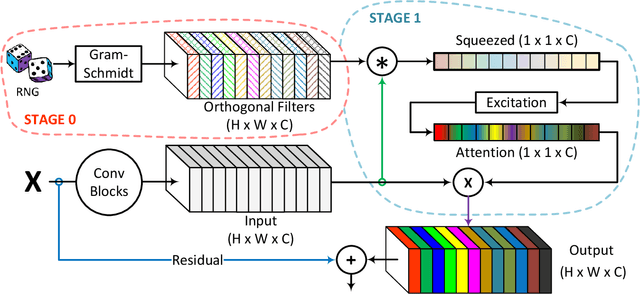
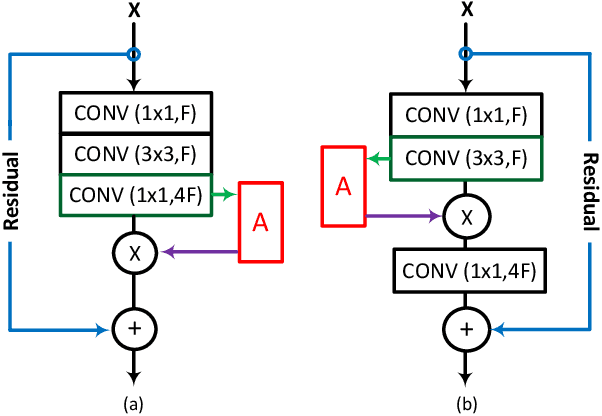
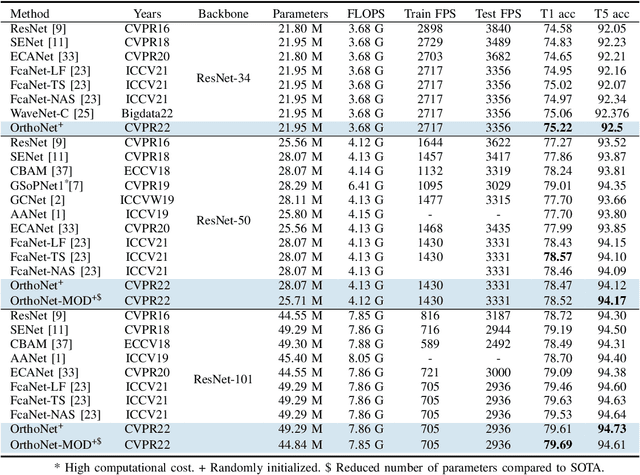
Designing an effective channel attention mechanism implores one to find a lossy-compression method allowing for optimal feature representation. Despite recent progress in the area, it remains an open problem. FcaNet, the current state-of-the-art channel attention mechanism, attempted to find such an information-rich compression using Discrete Cosine Transforms (DCTs). One drawback of FcaNet is that there is no natural choice of the DCT frequencies. To circumvent this issue, FcaNet experimented on ImageNet to find optimal frequencies. We hypothesize that the choice of frequency plays only a supporting role and the primary driving force for the effectiveness of their attention filters is the orthogonality of the DCT kernels. To test this hypothesis, we construct an attention mechanism using randomly initialized orthogonal filters. Integrating this mechanism into ResNet, we create OrthoNet. We compare OrthoNet to FcaNet (and other attention mechanisms) on Birds, MS-COCO, and Places356 and show superior performance. On the ImageNet dataset, our method competes with or surpasses the current state-of-the-art. Our results imply that an optimal choice of filter is elusive and generalization can be achieved with a sufficiently large number of orthogonal filters. We further investigate other general principles for implementing channel attention, such as its position in the network and channel groupings. Our code is publicly available at https://github.com/hady1011/OrthoNets/
* IEEE BigData 2023