 Add to Chrome
 Add to Firefox
 Add to Edge
Single-Cell Cross-Modal Transfer by Adversarial Fine-Tuning of Foundation Models
Jun 04, 2026
Spatial transcriptomics (ST) is a powerful tool for exploring biological properties dependent on structure, proximity, and interaction in tissue. The methods underpinning ST are developing rapidly but are limited in their ability to profile many thousands of genes at a subcellular scale. Although dissociated from tissue, it is known that the whole-transcriptome readouts of cells in single-cell RNA sequencing (scRNA-seq) retain information about their former in situ neighbourhoods, motivating computational methods to recover it. While paired ST and scRNA-seq datasets are scarce, each modality in its own right is abundantly available. We therefore propose to perform cross-modal translation between unpaired ST and scRNA-seq data. In this work we show that a single-cell foundation model can perform this translation via adversarial fine-tuning. We demonstrate that our method performs favourably against methods built for multi-omics translation.

Spatio-Angular Convolutions for Super-resolution in Diffusion MRI
Jun 01, 2023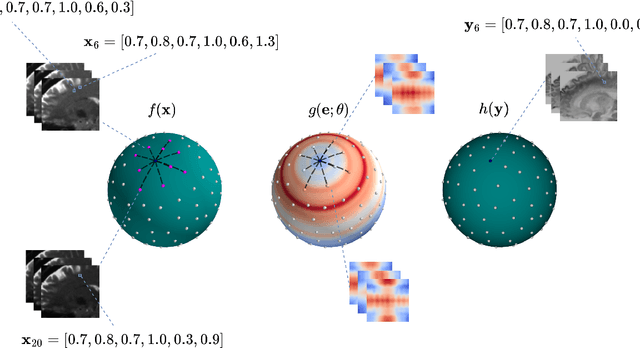
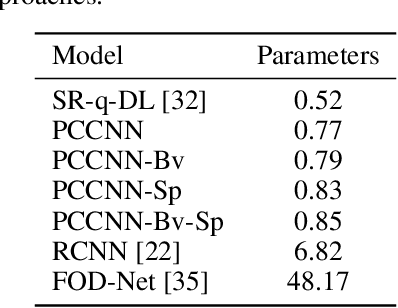
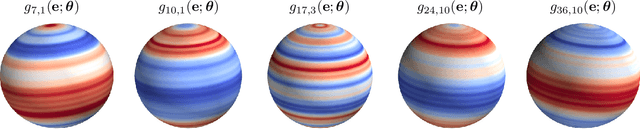
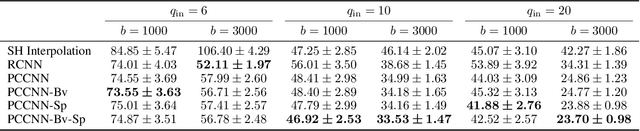
Diffusion MRI (dMRI) is a widely used imaging modality, but requires long scanning times to acquire high resolution datasets. By leveraging the unique geometry present within this domain, we present a novel approach to dMRI angular super-resolution that extends upon the parametric continuous convolution (PCConv) framework. We introduce several additions to the operation including a Fourier feature mapping, global coordinates, and domain specific context. Using this framework, we build a fully parametric continuous convolution network (PCCNN) and compare against existing models. We demonstrate the PCCNN performs competitively while using significantly less parameters. Moreover, we show that this formulation generalises well to clinically relevant downstream analyses such as fixel-based analysis, and neurite orientation dispersion and density imaging.
Angular Super-Resolution in Diffusion MRI with a 3D Recurrent Convolutional Autoencoder
Mar 29, 2022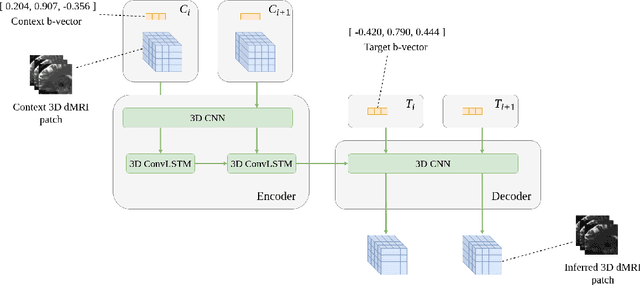


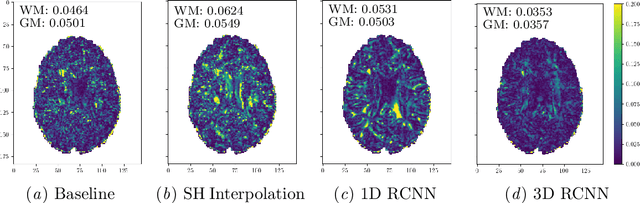
High resolution diffusion MRI (dMRI) data is often constrained by limited scanning time in clinical settings, thus restricting the use of downstream analysis techniques that would otherwise be available. In this work we develop a 3D recurrent convolutional neural network (RCNN) capable of super-resolving dMRI volumes in the angular (q-space) domain. Our approach formulates the task of angular super-resolution as a patch-wise regression using a 3D autoencoder conditioned on target b-vectors. Within the network we use a convolutional long short term memory (ConvLSTM) cell to model the relationship between q-space samples. We compare model performance against a baseline spherical harmonic interpolation and a 1D variant of the model architecture. We show that the 3D model has the lowest error rates across different subsampling schemes and b-values. The relative performance of the 3D RCNN is greatest in the very low angular resolution domain. Code for this project is available at https://github.com/m-lyon/dMRI-RCNN.