 Add to Chrome
 Add to Firefox
 Add to Edge
Pure and Physics-Guided Deep Learning Solutions for Spatio-Temporal Groundwater Level Prediction at Arbitrary Locations
Mar 26, 2026
Groundwater represents a key element of the water cycle, yet it exhibits intricate and context-dependent relationships that make its modeling a challenging task. Theory-based models have been the cornerstone of scientific understanding. However, their computational demands, simplifying assumptions, and calibration requirements limit their use. In recent years, data-driven models have emerged as powerful alternatives. In particular, deep learning has proven to be a leading approach for its design flexibility and ability to learn complex relationships. We proposed an attention-based pure deep learning model, named STAINet, to predict weekly groundwater levels at an arbitrary and variable number of locations, leveraging both spatially sparse groundwater measurements and spatially dense weather information. Then, to enhance the model's trustworthiness and generalization ability, we considered different physics-guided strategies to inject the groundwater flow equation into the model. Firstly, in the STAINet-IB, by introducing an inductive bias, we also estimated the governing equation components. Then, by adopting a learning bias strategy, we proposed the STAINet-ILB, trained with additional loss terms adding supervision on the estimated equation components. Lastly, we developed the STAINet-ILRB, leveraging the groundwater body recharge zone information estimated by domain experts. The STAINet-ILB performed the best, achieving overwhelming test performances in a rollout setting (median MAPE 0.16%, KGE 0.58). Furthermore, it predicted sensible equation components, providing insights into the model's physical soundness. Physics-guided approaches represent a promising opportunity to enhance both the generalization ability and the trustworthiness, thereby paving the way to a new generation of disruptive hybrid deep learning Earth system models.

Deep Learning tools to support deforestation monitoring in the Ivory Coast using SAR and Optical satellite imagery
Sep 16, 2024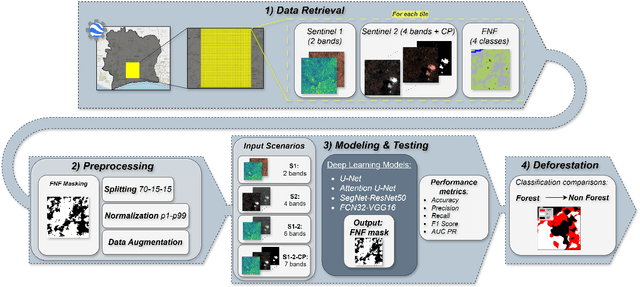

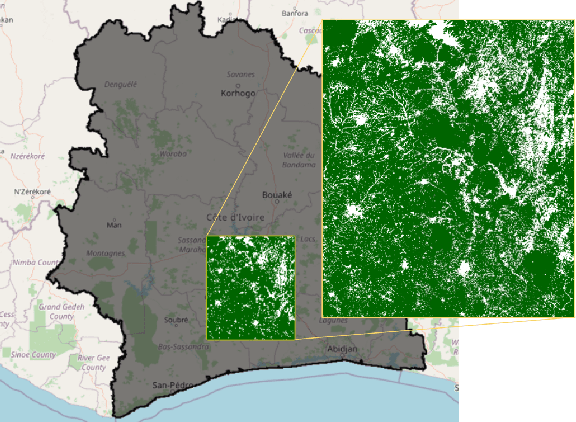

Deforestation is gaining an increasingly importance due to its strong influence on the sorrounding environment, especially in developing countries where population has a disadvantaged economic condition and agriculture is the main source of income. In Ivory Coast, for instance, where the cocoa production is the most remunerative activity, it is not rare to assist to the replacement of portion of ancient forests with new cocoa plantations. In order to monitor this type of deleterious activities, satellites can be employed to recognize the disappearance of the forest to prevent it from expand its area of interest. In this study, Forest-Non-Forest map (FNF) has been used as ground truth for models based on Sentinel images input. State-of-the-art models U-Net, Attention U-Net, Segnet and FCN32 are compared over different years combining Sentinel-1, Sentinel-2 and cloud probability to create forest/non-forest segmentation. Although Ivory Coast lacks of forest coverage datasets and is partially covered by Sentinel images, it is demonstrated the feasibility to create models classifying forest and non-forests pixels over the area using open datasets to predict where deforestation could have occurred. Although a significant portion of the deforestation research is carried out on visible bands, SAR acquisitions are employed to overcome the limits of RGB images over areas often covered by clouds. Finally, the most promising model is employed to estimate the hectares of forest has been cut between 2019 and 2020.