 Add to Chrome
 Add to Firefox
 Add to Edge
A Multi-Plant Machine Learning Framework for Emission Prediction, Forecasting, and Control in Cement Manufacturing
Apr 21, 2026
Cement production is among the largest contributors to industrial air pollution, emitting ~3 Mt NOx/year. The industry-standard mitigation approach, selective non-catalytic reduction (SNCR), exhibits low NH3 utilization efficiency, resulting in operational inefficiencies and increased reagent costs. Here, we develop a data-driven framework for emission control using large-scale operational data from four cement plants worldwide. Benchmarking nine machine learning architectures, we observe that prediction error varies ~3-5x across plants due to variation in data richness. Incorporating short-term process history nearly triples NOx prediction accuracy, revealing that NOx formation carries substantial process memory, a timescale dependence that is absent in CO and CO2. Further, we develop models that forecast NOx overshoots as early as nine minutes, providing a buffer for operational adjustments. The developed framework controls NOx formation at the source, reducing NH3 consumption in downstream SNCR. Surrogate model projections estimate a ~34-64% reduction in NOx while preserving clinker quality, corresponding to a reduction of ~290 t NOx/year and ~58,000 USD/year in NH3 savings. This work establishes a generalizable framework for data-driven emission control, offering a pathway toward low-emission operation without structural modifications or additional hardware, with potential applicability to other hard-to-abate industries such as steel, glass, and lime.

Industrial-scale Prediction of Cement Clinker Phases using Machine Learning
Dec 16, 2024
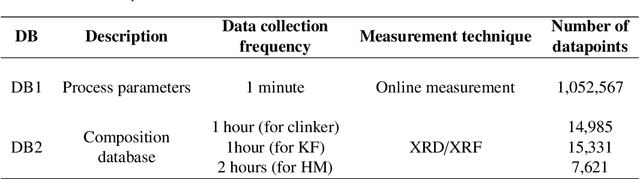

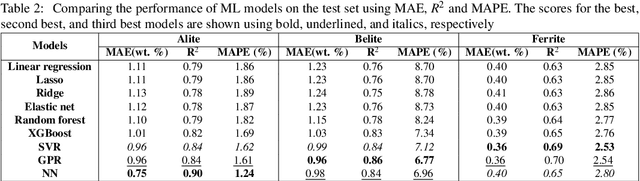
Cement production, exceeding 4.1 billion tonnes and contributing 2.4 tonnes of CO2 annually, faces critical challenges in quality control and process optimization. While traditional process models for cement manufacturing are confined to steady-state conditions with limited predictive capability for mineralogical phases, modern plants operate under dynamic conditions that demand real-time quality assessment. Here, exploiting a comprehensive two-year operational dataset from an industrial cement plant, we present a machine learning framework that accurately predicts clinker mineralogy from process data. Our model achieves unprecedented prediction accuracy for major clinker phases while requiring minimal input parameters, demonstrating robust performance under varying operating conditions. Through post-hoc explainable algorithms, we interpret the hierarchical relationships between clinker oxides and phase formation, providing insights into the functioning of an otherwise black-box model. This digital twin framework can potentially enable real-time optimization of cement production, thereby providing a route toward reducing material waste and ensuring quality while reducing the associated emissions under real plant conditions. Our approach represents a significant advancement in industrial process control, offering a scalable solution for sustainable cement manufacturing.