 Add to Chrome
 Add to Firefox
 Add to Edge
Neuro-Symbolic Injection of LTLf Constraints in Autoregressive Reinforcement Learning Policies
Jun 06, 2026
In this work we study offline reinforcement learning (RL) under temporally extended task constraints expressed in Linear Temporal Logic over finite traces (LTLf). Recently, transformer-based approaches such as Trajectory Transformers and Decision Transformers have been adopted to address RL as a sequence modeling problem. However, these methods optimize purely for reward and do not account for high-level temporal requirements. Here, we introduce a neurosymbolic framework that injects LTLf background knowledge into such transformer-based RL policies. Our approach compiles LTLf formulas into deterministic finite automata (DFAs) and integrates them into the learning process through a differentiable representation and a logic-based loss function. In particular, we derive differentiable satisfaction signals from DFA progression and use them as a regularization term during training. The resulting method is architecture-agnostic across different models. We evaluate the proposed framework on navigation environments with specification suites covering combinations of safety and reachability temporal properties. Experimental results show that incorporating background knowledge not only improves constraint satisfaction, but also maintains competitive return compared to vanilla baselines.

PHYDI: Initializing Parameterized Hypercomplex Neural Networks as Identity Functions
Oct 11, 2023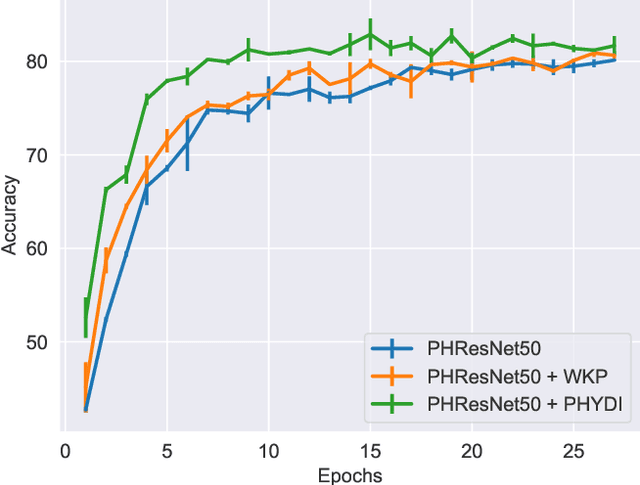
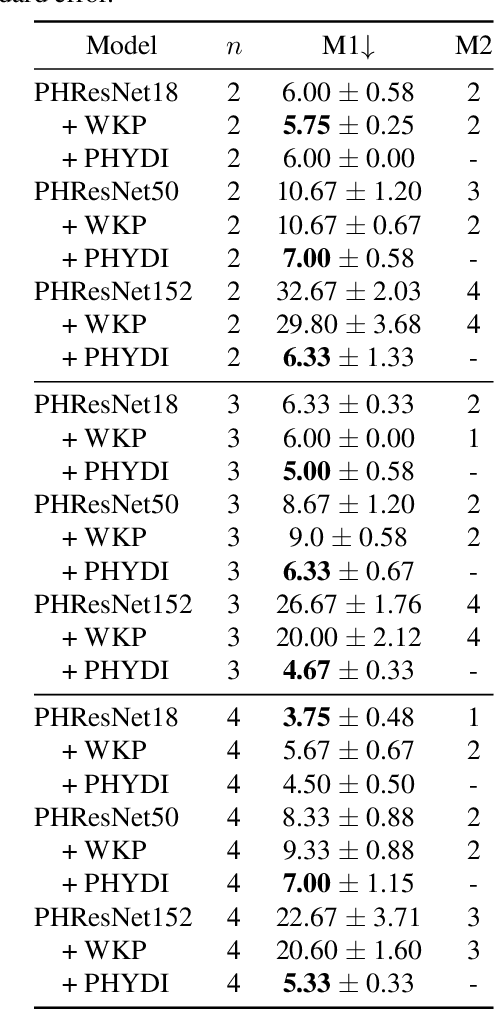
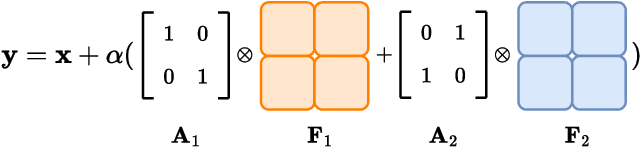
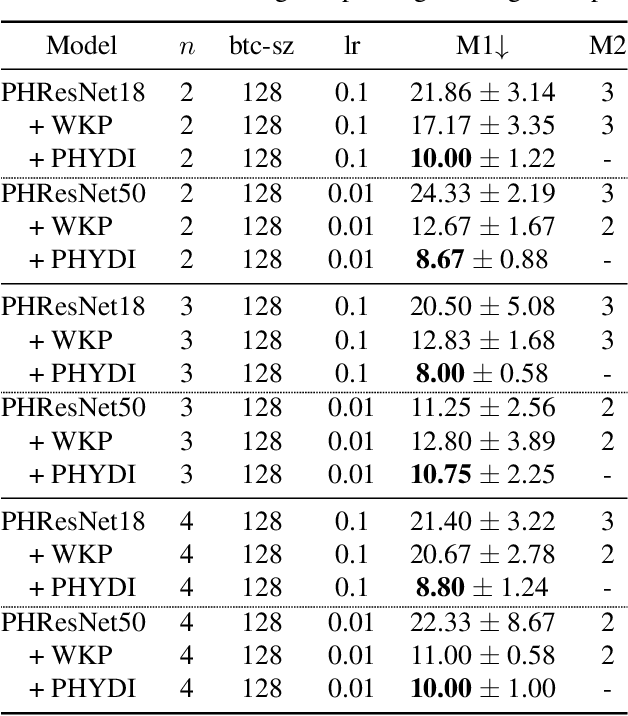
Neural models based on hypercomplex algebra systems are growing and prolificating for a plethora of applications, ranging from computer vision to natural language processing. Hand in hand with their adoption, parameterized hypercomplex neural networks (PHNNs) are growing in size and no techniques have been adopted so far to control their convergence at a large scale. In this paper, we study PHNNs convergence and propose parameterized hypercomplex identity initialization (PHYDI), a method to improve their convergence at different scales, leading to more robust performance when the number of layers scales up, while also reaching the same performance with fewer iterations. We show the effectiveness of this approach in different benchmarks and with common PHNNs with ResNets- and Transformer-based architecture. The code is available at https://github.com/ispamm/PHYDI.