 Add to Chrome
 Add to Firefox
 Add to Edge
Agentic Design of Compositional Descriptors via Autoresearch for Materials Science Applications
May 14, 2026
Autoresearch offers a flexible paradigm for automating scientific tasks, in which an AI agent proposes, implements, evaluates, and refines candidate solutions against a quantitative objective. Here, we use composition-based materials-property prediction to test whether such agents can perform a task beyond model selection and hyperparameter optimization: the design of input descriptors. We introduce Automat, an autoresearch framework where a coding agent based on a large language model generates composition-only descriptors for chemical compounds and evaluates them using a random forest workflow. The agent is restricted to information derivable from chemical formulas and iteratively proposes, implements, and tests chemically motivated descriptor strategies. We apply Automat, with OpenAI Codex using GPT-5.5 as the coding agent, to the prediction of experimental band gaps in inorganic materials and Curie temperatures in ferromagnetic compounds. In both tasks, Automat improves over fractional-composition, Magpie, and combined fractional-composition/Magpie baselines, while producing descriptor families that are chemically interpretable. These results provide a demonstration that autoresearch agents can generate competitive, task-specific materials descriptors without manual feature engineering during the run. They also reveal current limitations, including descriptor redundancy, sensitivity to greedy feature expansion, and the need for explicit complexity control, descriptor pruning, and more sophisticated search strategies.

Sampling Latent Material-Property Information From LLM-Derived Embedding Representations
Sep 18, 2024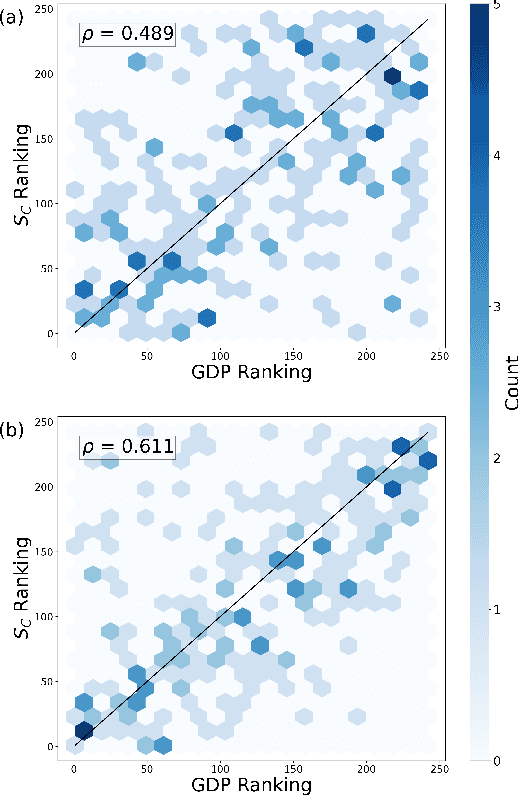
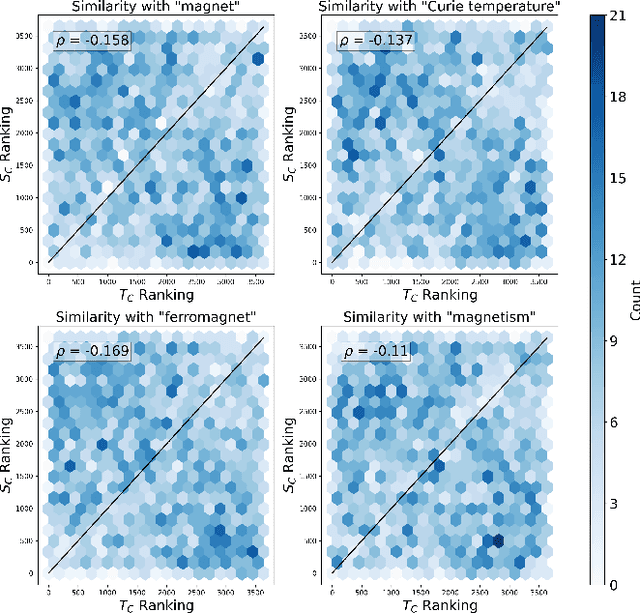
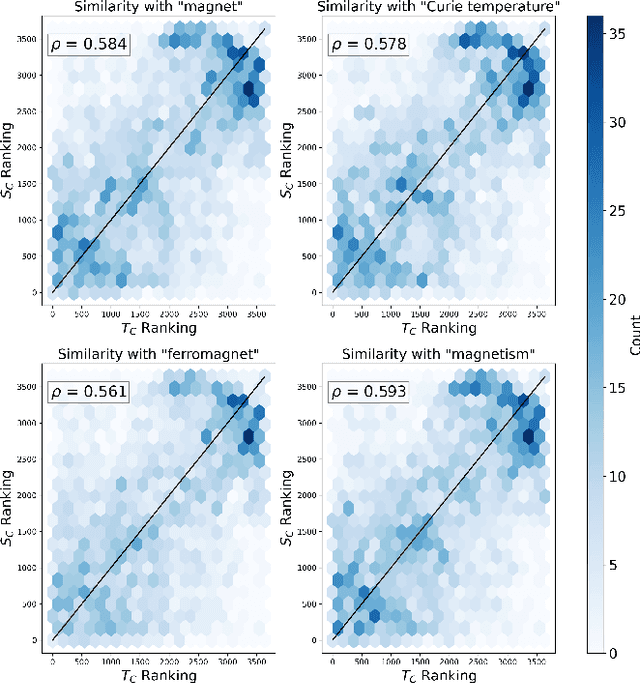
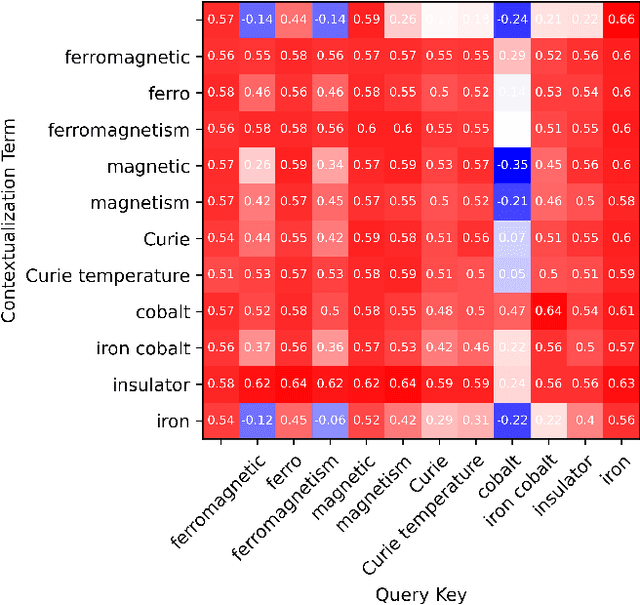
Vector embeddings derived from large language models (LLMs) show promise in capturing latent information from the literature. Interestingly, these can be integrated into material embeddings, potentially useful for data-driven predictions of materials properties. We investigate the extent to which LLM-derived vectors capture the desired information and their potential to provide insights into material properties without additional training. Our findings indicate that, although LLMs can be used to generate representations reflecting certain property information, extracting the embeddings requires identifying the optimal contextual clues and appropriate comparators. Despite this restriction, it appears that LLMs still have the potential to be useful in generating meaningful materials-science representations.