 Add to Chrome
 Add to Firefox
 Add to Edge
Adaptive Beam Selection for Efficient Scanning Probe Tomography
Jun 19, 2026
In X-ray tomography, reconstruction quality generally improves with larger numbers of projections. However, more projections increase experiment costs, acquisition time and the radiation dose imparted to the sample. One mitigation to these trade-offs is to adopt a sequential design of experiments, in which each subsequent measurement is determined as a function of previously acquired data in order to maximize information gain. In practice, a widely used heuristic to maximize information is to align beams with the edges of the sample. A key challenge, however, is that the true sample is unknown, so identifying edge-aligned beams typically requires reconstructing the sample based on available measurements. This work proposes a novel sequential design method that identifies edge-aligned measurements directly from the sinogram, bypassing any reconstruction, thereby improving computational efficiency and reducing the experimental design's susceptibility to reconstruction errors. Our method dynamically selects the next set of measurement beams by maximizing an acquisition function that balances exploration and exploitation over the domain of all possible measurements, improving reconstruction quality while reducing measurement redundancy.

Optimal Generalized Decision Trees via Integer Programming
Jan 14, 2018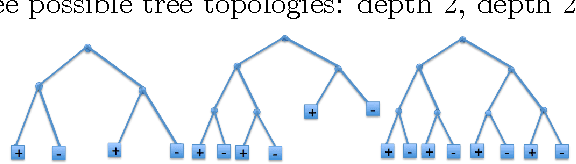
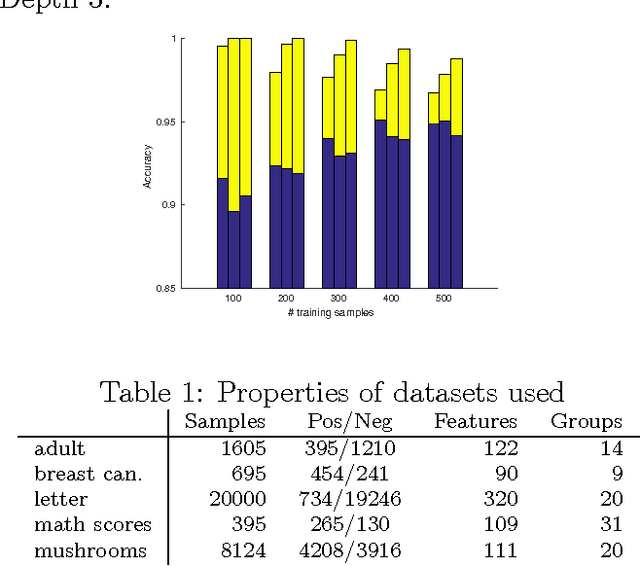
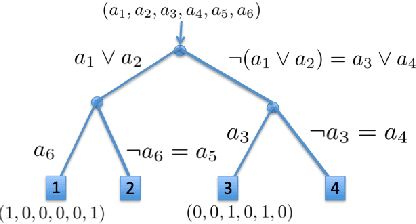

Decision trees have been a very popular class of predictive models for decades due to their interpretability and good performance on categorical features. However, they are not always robust and tend to overfit the data. Additionally, if allowed to grow large, they lose interpretability. In this paper, we present a novel mixed integer programming formulation to construct optimal decision trees of specified size. We take special structure of categorical features into account and allow combinatorial decisions (based on subsets of values of such a feature) at each node. We show that very good accuracy can be achieved with small trees using moderately-sized training sets. The optimization problems we solve are easily tractable with modern solvers.