 Add to Chrome
 Add to Firefox
 Add to Edge
Close to Reality: Interpretable and Feasible Data Augmentation for Imbalanced Learning
Mar 14, 2026
Many machine learning classification tasks involve imbalanced datasets, which are often subject to over-sampling techniques aimed at improving model performance. However, these techniques are prone to generating unrealistic or infeasible samples. Furthermore, they often function as black boxes, lacking interpretability in their procedures. This opacity makes it difficult to track their effectiveness and provide necessary adjustments, and they may ultimately fail to yield significant performance improvements. To bridge this gap, we introduce the Decision Predicate Graphs for Data Augmentation (DPG-da), a framework that extracts interpretable decision predicates from trained models to capture domain rules and enforce them during sample generation. This design ensures that over-sampled data remain diverse, constraint-satisfying, and interpretable. In experiments on synthetic and real-world benchmark datasets, DPG-da consistently improves classification performance over traditional over-sampling methods, while guaranteeing logical validity and offering clear, interpretable explanations of the over-sampled data.

Problem-oriented AutoML in Clustering
Sep 24, 2024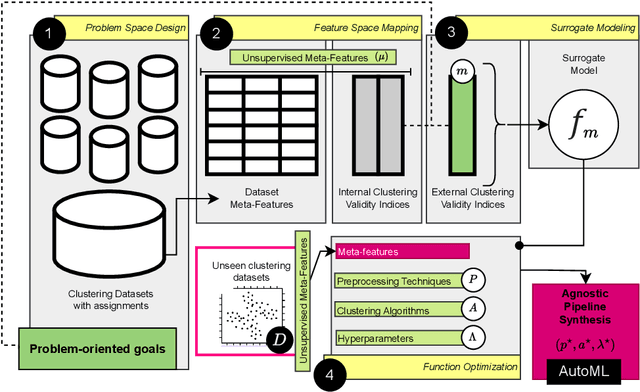
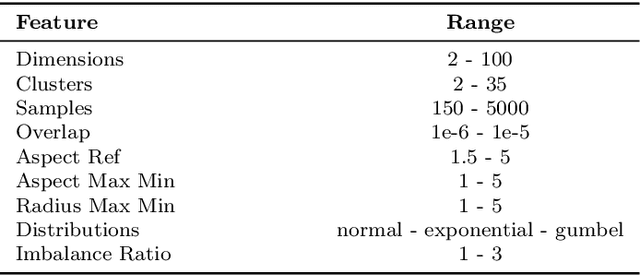
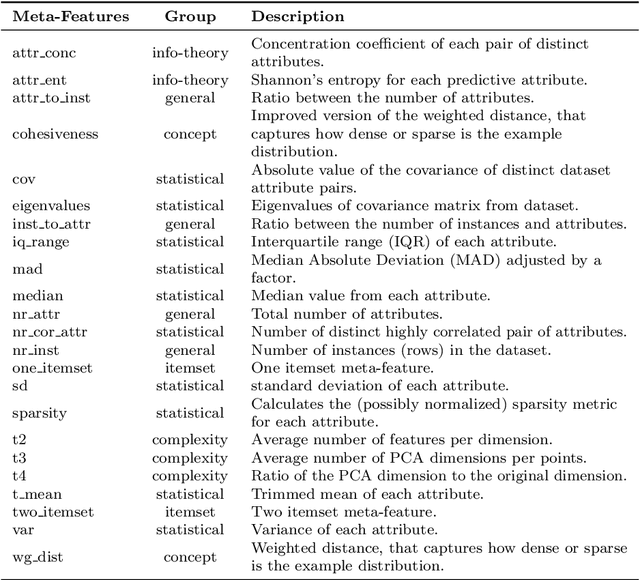
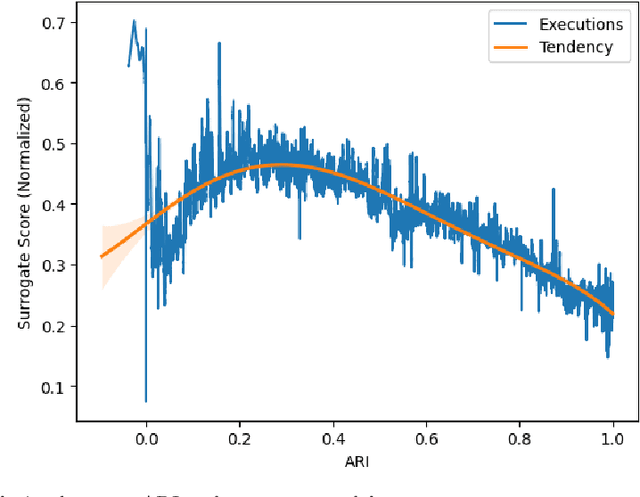
The Problem-oriented AutoML in Clustering (PoAC) framework introduces a novel, flexible approach to automating clustering tasks by addressing the shortcomings of traditional AutoML solutions. Conventional methods often rely on predefined internal Clustering Validity Indexes (CVIs) and static meta-features, limiting their adaptability and effectiveness across diverse clustering tasks. In contrast, PoAC establishes a dynamic connection between the clustering problem, CVIs, and meta-features, allowing users to customize these components based on the specific context and goals of their task. At its core, PoAC employs a surrogate model trained on a large meta-knowledge base of previous clustering datasets and solutions, enabling it to infer the quality of new clustering pipelines and synthesize optimal solutions for unseen datasets. Unlike many AutoML frameworks that are constrained by fixed evaluation metrics and algorithm sets, PoAC is algorithm-agnostic, adapting seamlessly to different clustering problems without requiring additional data or retraining. Experimental results demonstrate that PoAC not only outperforms state-of-the-art frameworks on a variety of datasets but also excels in specific tasks such as data visualization, and highlight its ability to dynamically adjust pipeline configurations based on dataset complexity.