 Add to Chrome
 Add to Firefox
 Add to Edge
Scaling Vision Models Does Not Consistently Improve Localisation-Based Explanation Quality
May 11, 2026
Artificial intelligence models are increasingly scaled to improve predictive accuracy, yet it remains unclear whether scale improves the quality of post-hoc explanations. We investigate this relationship by evaluating 11 computer vision models representing increasing levels of depth and complexity within the ResNet, DenseNet, and Vision Transformer families, trained from scratch or pretrained, across three image datasets with ground-truth segmentation masks. For each model, we generate explanations using five post-hoc explainable AI methods and quantify mask alignment using two localisation metrics: Relevance Rank Accuracy (Arras et al., 2022) and the proposed Dual-Polarity Precision, which measures positive attributions inside the class mask and negative attributions outside it. Across datasets and methods, increasing architectural depth and parameter count does not improve explanation quality in most statistical comparisons, and smaller models often match or exceed deeper variants. While pretraining typically improves predictive performance and increases the dependence of explanations on learned weights, it does not consistently increase localisation scores. We also observe scenarios in which models achieve strong predictive performance while localisation precision is near zero, suggesting that performance metrics alone may not indicate whether predictions are based on the annotated regions. These results indicate that larger models do not reliably provide higher-quality explanations, and that explainability should therefore be assessed explicitly during model selection for safety-sensitive deployments.

On the Importance and Evaluation of Narrativity in Natural Language AI Explanations
Apr 20, 2026Explainable AI (XAI) aims to make the behaviour of machine learning models interpretable, yet many explanation methods remain difficult to understand. The integration of Natural Language Generation into XAI aims to deliver explanations in textual form, making them more accessible to practitioners. Current approaches, however, largely yield static lists of feature importances. Although such explanations indicate what influences the prediction, they do not explain why the prediction occurs. In this study, we draw on insights from social sciences and linguistics, and argue that XAI explanations should be presented in the form of narratives. Narrative explanations support human understanding through four defining properties: continuous structure, cause-effect mechanisms, linguistic fluency, and lexical diversity. We show that standard Natural Language Processing (NLP) metrics based solely on token probability or word frequency fail to capture these properties and can be matched or exceeded by tautological text that conveys no explanatory content. To address this issue, we propose seven automatic metrics that quantify the narrative quality of explanations along the four identified dimensions. We benchmark current state-of-the-art explanation generation methods on six datasets and show that the proposed metrics separate descriptive from narrative explanations more reliably than standard NLP metrics. Finally, to further advance the field, we propose a set of problem-agnostic XAI Narrative generation rules for producing natural language XAI explanations, so that the resulting XAI Narratives exhibit stronger narrative properties and align with the findings from the linguistic and social science literature.
GraphXAIN: Narratives to Explain Graph Neural Networks
Nov 04, 2024
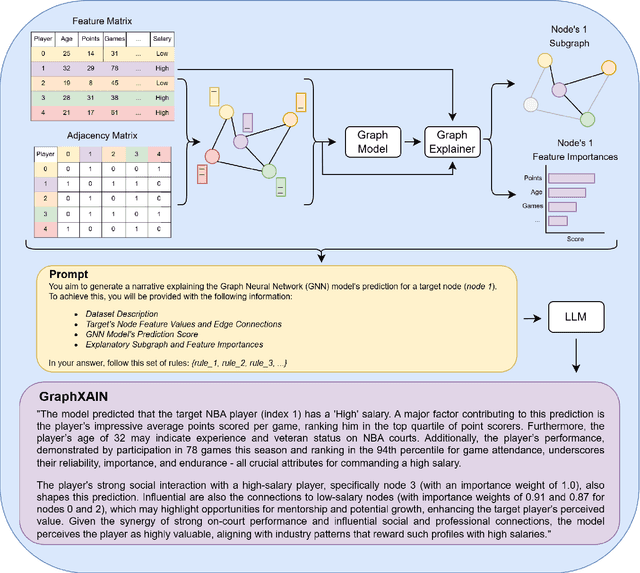
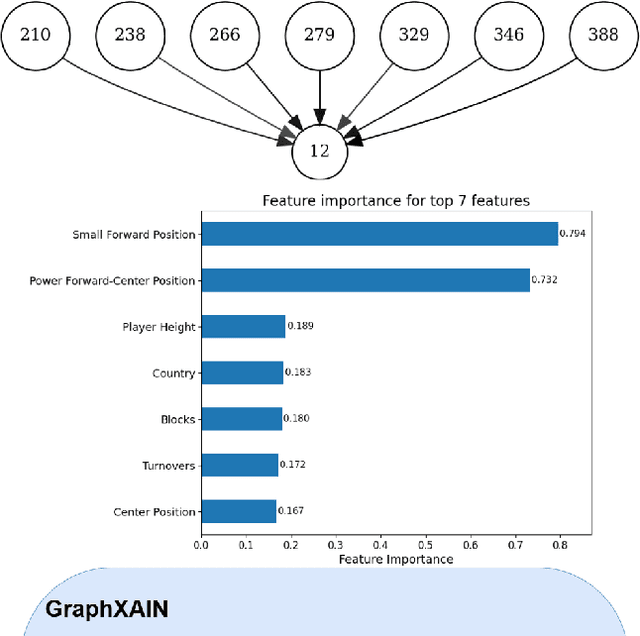
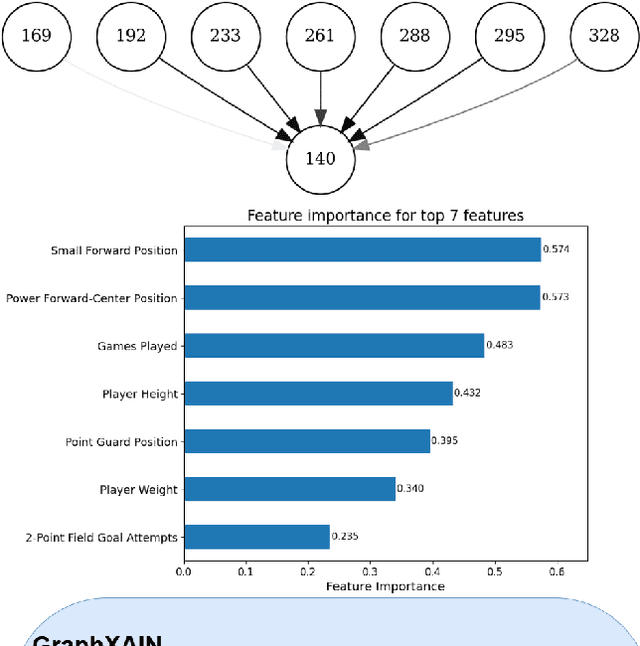
Graph Neural Networks (GNNs) are a powerful technique for machine learning on graph-structured data, yet they pose interpretability challenges, especially for non-expert users. Existing GNN explanation methods often yield technical outputs such as subgraphs and feature importance scores, which are not easily understood. Building on recent insights from social science and other Explainable AI (XAI) methods, we propose GraphXAIN, a natural language narrative that explains individual predictions made by GNNs. We present a model-agnostic and explainer-agnostic XAI approach that complements graph explainers by generating GraphXAINs, using Large Language Models (LLMs) and integrating graph data, individual predictions from GNNs, explanatory subgraphs, and feature importances. We define XAI Narratives and XAI Descriptions, highlighting their distinctions and emphasizing the importance of narrative principles in effective explanations. By incorporating natural language narratives, our approach supports graph practitioners and non-expert users, aligning with social science research on explainability and enhancing user understanding and trust in complex GNN models. We demonstrate GraphXAIN's capabilities on a real-world graph dataset, illustrating how its generated narratives can aid understanding compared to traditional graph explainer outputs or other descriptive explanation methods.
Beyond the Black Box: Do More Complex Models Provide Superior XAI Explanations?
May 14, 2024The increasing complexity of Artificial Intelligence models poses challenges to interpretability, particularly in the healthcare sector. This study investigates the impact of deep learning model complexity and Explainable AI (XAI) efficacy, utilizing four ResNet architectures (ResNet-18, 34, 50, 101). Through methodical experimentation on 4,369 lung X-ray images of COVID-19-infected and healthy patients, the research evaluates models' classification performance and the relevance of corresponding XAI explanations with respect to the ground-truth disease masks. Results indicate that the increase in model complexity is associated with a decrease in classification accuracy and AUC-ROC scores (ResNet-18: 98.4%, 0.997; ResNet-101: 95.9%, 0.988). Notably, in eleven out of twelve statistical tests performed, no statistically significant differences occurred between XAI quantitative metrics - Relevance Rank Accuracy and the proposed Positive Attribution Ratio - across trained models. These results suggest that increased model complexity does not consistently lead to higher performance or relevance of explanations for models' decision-making processes.