 Add to Chrome
 Add to Firefox
 Add to Edge
Koo-Fu CLIP: Closed-Form Adaptation of Vision-Language Models via Fukunaga-Koontz Linear Discriminant Analysis
Feb 01, 2026
Visual-language models such as CLIP provide powerful general-purpose representations, but their raw embeddings are not optimized for supervised classification, often exhibiting limited class separation and excessive dimensionality. We propose Koo-Fu CLIP, a supervised CLIP adaptation method based on Fukunaga-Koontz Linear Discriminant Analysis, which operates in a whitened embedding space to suppress within-class variation and enhance between-class discrimination. The resulting closed-form linear projection reshapes the geometry of CLIP embeddings, improving class separability while performing effective dimensionality reduction, and provides a lightweight and efficient adaptation of CLIP representations. Across large-scale ImageNet benchmarks, nearest visual prototype classification in the Koo-Fu CLIP space improves top-1 accuracy from 75.1% to 79.1% on ImageNet-1K, with consistent gains persisting as the label space expands to 14K and 21K classes. The method supports substantial compression by up to 10-12x with little or no loss in accuracy, enabling efficient large-scale classification and retrieval.

Human Pose-Constrained UV Map Estimation
Jan 15, 2025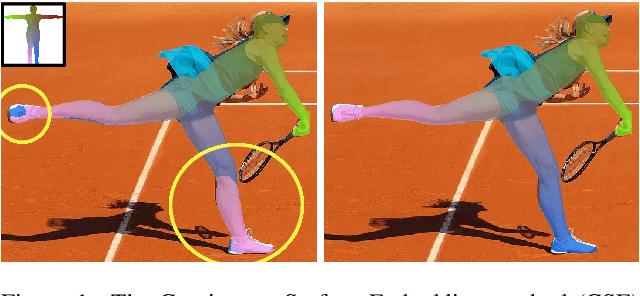
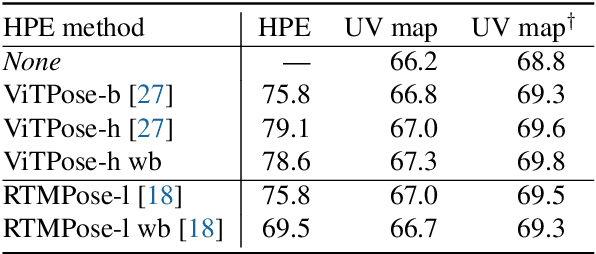
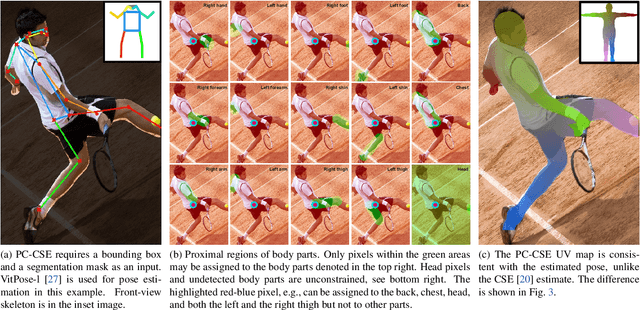
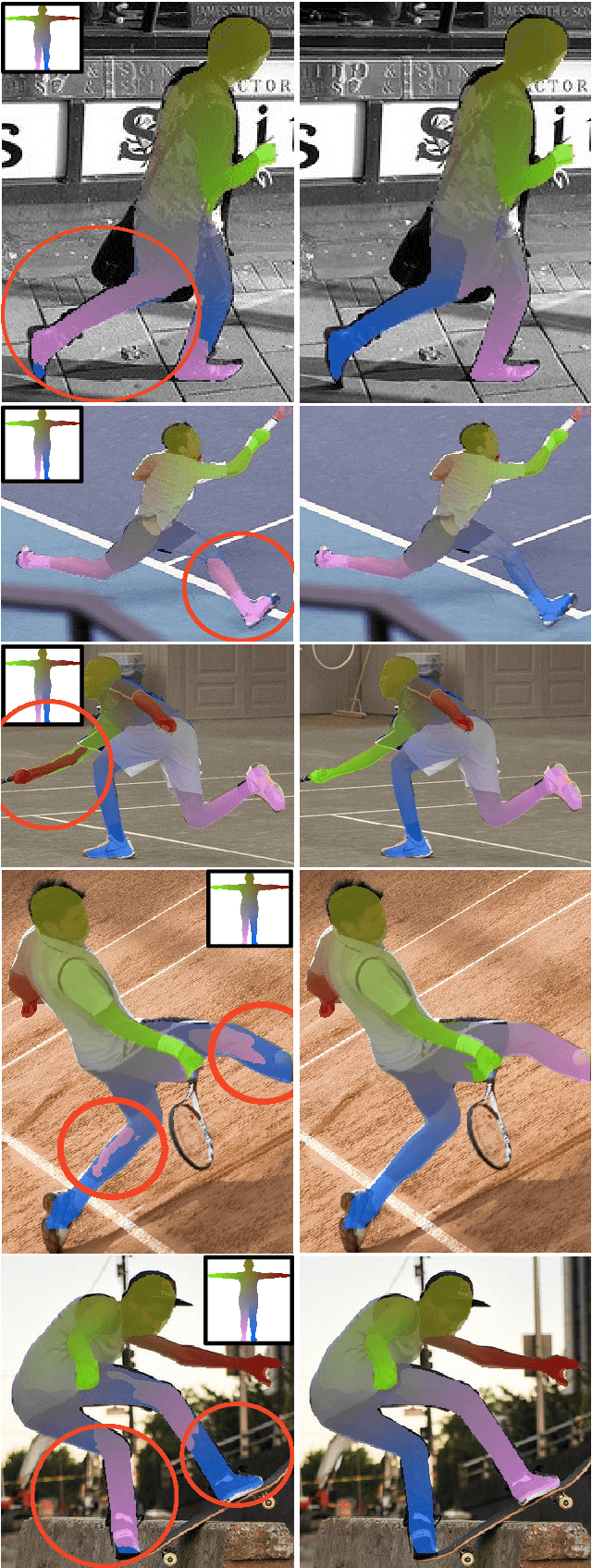
UV map estimation is used in computer vision for detailed analysis of human posture or activity. Previous methods assign pixels to body model vertices by comparing pixel descriptors independently, without enforcing global coherence or plausibility in the UV map. We propose Pose-Constrained Continuous Surface Embeddings (PC-CSE), which integrates estimated 2D human pose into the pixel-to-vertex assignment process. The pose provides global anatomical constraints, ensuring that UV maps remain coherent while preserving local precision. Evaluation on DensePose COCO demonstrates consistent improvement, regardless of the chosen 2D human pose model. Whole-body poses offer better constraints by incorporating additional details about the hands and feet. Conditioning UV maps with human pose reduces invalid mappings and enhances anatomical plausibility. In addition, we highlight inconsistencies in the ground-truth annotations.