 Add to Chrome
 Add to Firefox
 Add to Edge
Planar-SfM: Camera Pose Estimation via Homography Graph Embeddings
Jul 01, 2026
Structure from Motion (SfM) systems traditionally struggle with planar scenes, where standard epipolar geometry-based methods become degenerate. Rather than viewing planar surfaces as a limitation, we propose a unified framework that leverages them as a source of geometric constraints. Our key insight is that each planar surface visible across multiple views provides an independent estimate of relative camera poses through homography decomposition. By aggregating estimates from multiple planes or even from a single dominant plane we achieve robust pose recovery in scenarios where traditional methods fail. We introduce a novel graph-based approach that constructs a pose-graph from homography estimates and employs spectral embedding to identify and filter unreliable edges. Our method maps homography-based pose estimates onto the real line based on their geometric and visual consistency, enabling efficient extraction of a maximally consistent spanning tree for pose recovery. This approach naturally handles both highly planar scenes, such as indoor sports arenas, and general $3$D environments. We demonstrate superior performance on basketball court imagery where existing methods struggle, while matching or exceeding state-of-the-art results on unconstrained outdoor scenes from the IMC Phototourism benchmark.

It's All in the Head: Representation Knowledge Distillation through Classifier Sharing
Jan 18, 2022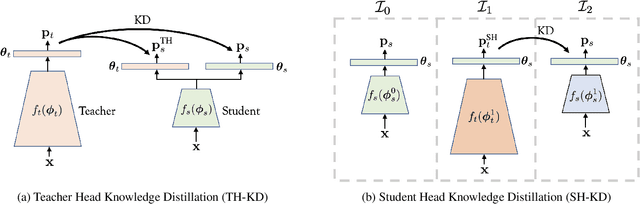
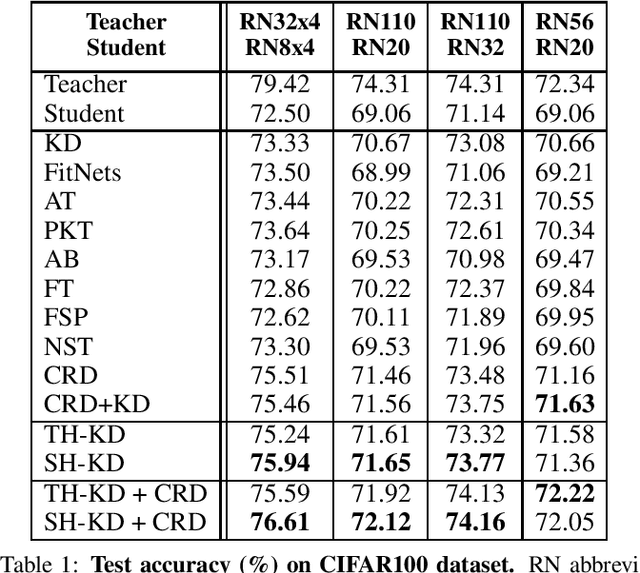
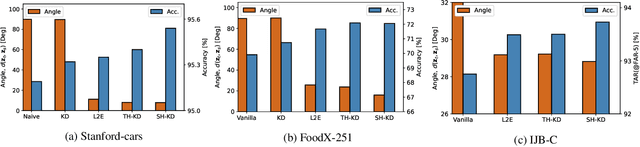
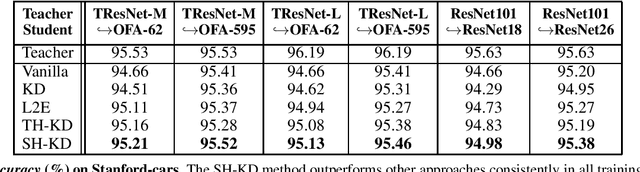
Representation knowledge distillation aims at transferring rich information from one model to another. Current approaches for representation distillation mainly focus on the direct minimization of distance metrics between the models' embedding vectors. Such direct methods may be limited in transferring high-order dependencies embedded in the representation vectors, or in handling the capacity gap between the teacher and student models. In this paper, we introduce two approaches for enhancing representation distillation using classifier sharing between the teacher and student. Specifically, we first show that connecting the teacher's classifier to the student backbone and freezing its parameters is beneficial for the process of representation distillation, yielding consistent improvements. Then, we propose an alternative approach that asks to tailor the teacher model to a student with limited capacity. This approach competes with and in some cases surpasses the first method. Via extensive experiments and analysis, we show the effectiveness of the proposed methods on various datasets and tasks, including image classification, fine-grained classification, and face verification. For example, we achieve state-of-the-art performance for face verification on the IJB-C dataset for a MobileFaceNet model: TAR@(FAR=1e-5)=93.7\%. Code is available at https://github.com/Alibaba-MIIL/HeadSharingKD.