 Add to Chrome
 Add to Firefox
 Add to Edge
Partially-Observable Transmission Control for UAV-Enabled Federated Learning in IoT Networks
Aug 01, 2026
Uncrewed aerial vehicle (UAV)-enabled federated learning (FL) can provide flexible, on-demand edge intelligence for large-scale IoT deployments, but operating in shared unlicensed bands makes uplink update delivery interference-coupled and unreliable. In this paper, we develop a packet-level transmission framework that captures buffer overflow, delay violations, and transmission errors, and uses the resulting packet delivery ratio (PDR) to represent partial-update reception through a packetized, Bernoulli-masked FL aggregation process. We then formulate a fairness-consensus bilevel (FCB) optimization that jointly controls (i) transmission thresholds to maximize the average PDR while reaching consensus under partial observability and (ii) transmission powers to improve the worst PDR and enforce fairness across IoT learners. To solve this problem, we propose an alternating FCB optimizer composed of a consensus-based threshold controller (CTC), which drives the IoT learners toward a PDR-efficient consensus on transmission thresholds, and a fairness-based power controller (FPC), which updates transmission powers to improve the worst PDR and ensure fairness under the resulting consensus thresholds. Numerical results on CNN-based FL tasks show that the FCB optimizer improves FL aggregation and training performance by enhancing packet-level update delivery, consistently outperforming baseline transmission policies.

Exploring the Interplay of Interference and Queues in Unlicensed Spectrum Bands for UAV Networks
Aug 09, 2023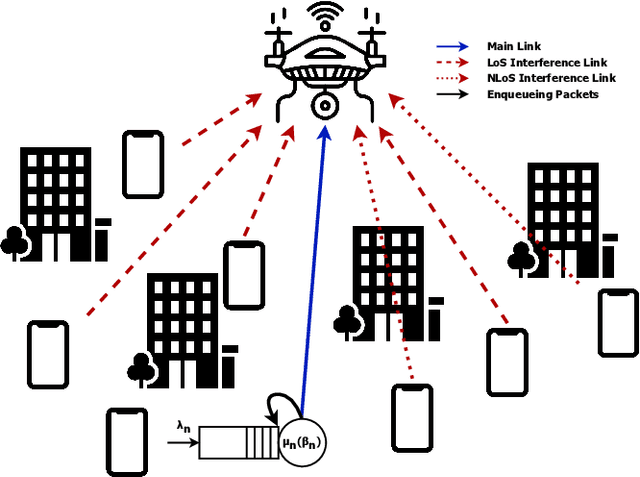
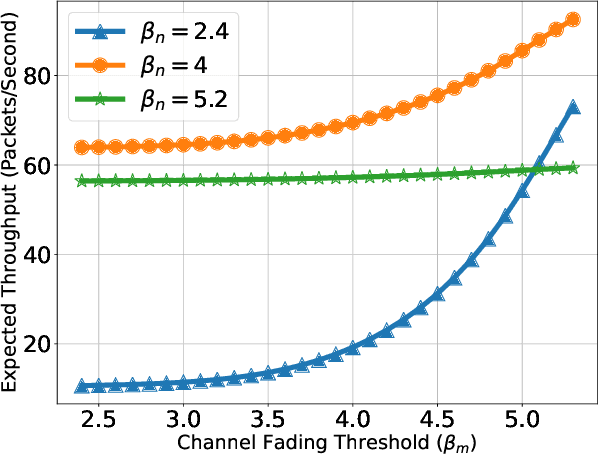
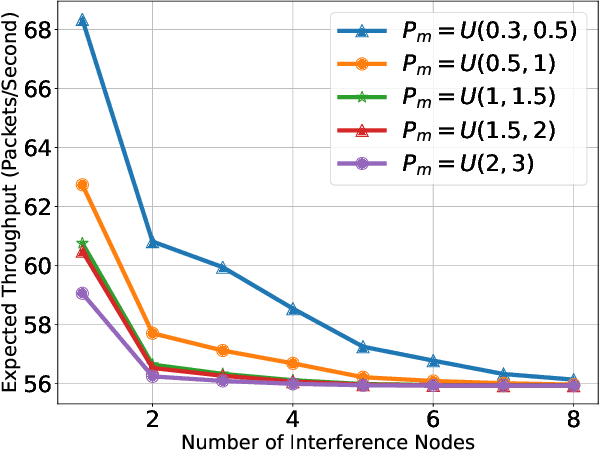
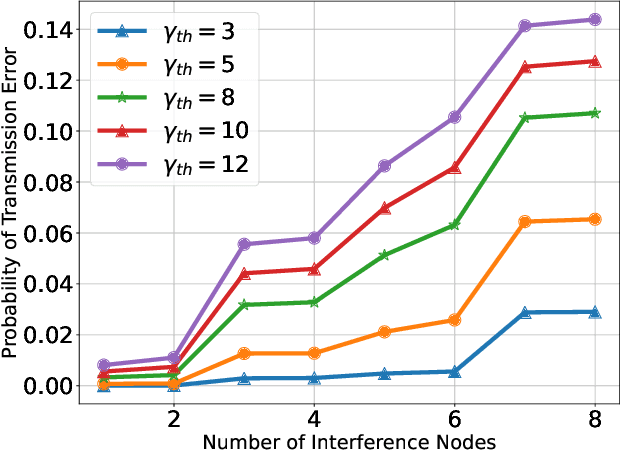
In this paper, we present an analytical framework to explore the interplay of signal interference and transmission queue management, and their impacts on the performance of unmanned aerial vehicles (UAVs) when operating in the unlicensed spectrum bands. In particular, we develop a comprehensive framework to investigate the impact of other interference links on the UAV as it communicates with the ground users. To this end, we provide closed-form expressions for packet drop probabilities in the queue due to buffer overflow or large queuing delay, which are expressed in terms of a transmission policy as a function of the channel fading threshold $\beta$. The overall packet loss caused either by interference signals or queuing packet drop is obtained, which, in turn, yields in obtaining the expected throughput performance. Through extensive numerical results, we investigate the impact of the channel fading threshold $\beta$, which plays an important role in balancing the trade-offs between packet loss due to queue drop or transmission error due to large interference levels.