 Add to Chrome
 Add to Firefox
 Add to Edge
chatter: a Python library for applying information theory and AI/ML models to animal communication
Dec 11, 2025
The study of animal communication often involves categorizing units into types (e.g. syllables in songbirds, or notes in humpback whales). While this approach is useful in many cases, it necessarily flattens the complexity and nuance present in real communication systems. chatter is a new Python library for analyzing animal communication in continuous latent space using information theory and modern machine learning techniques. It is taxonomically agnostic, and has been tested with the vocalizations of birds, bats, whales, and primates. By leveraging a variety of different architectures, including variational autoencoders and vision transformers, chatter represents vocal sequences as trajectories in high-dimensional latent space, bypassing the need for manual or automatic categorization of units. The library provides an end-to-end workflow -- from preprocessing and segmentation to model training and feature extraction -- that enables researchers to quantify the complexity, predictability, similarity, and novelty of vocal sequences.

Conformity bias in the cultural transmission of music sampling traditions
Jun 27, 2019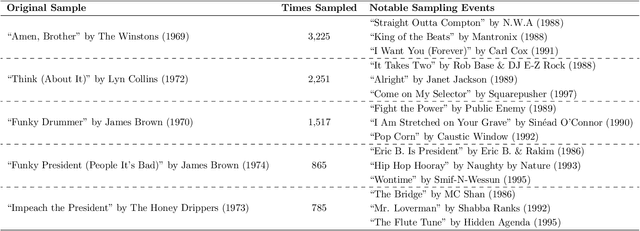
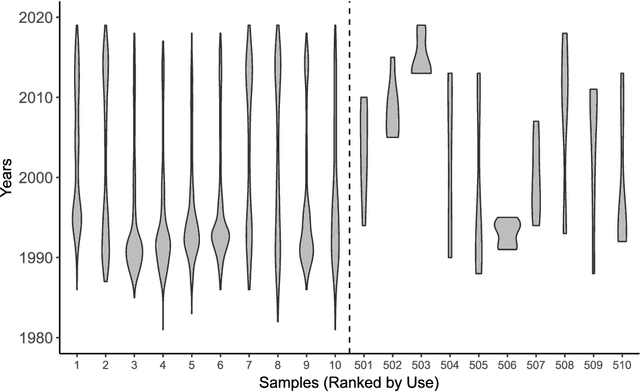
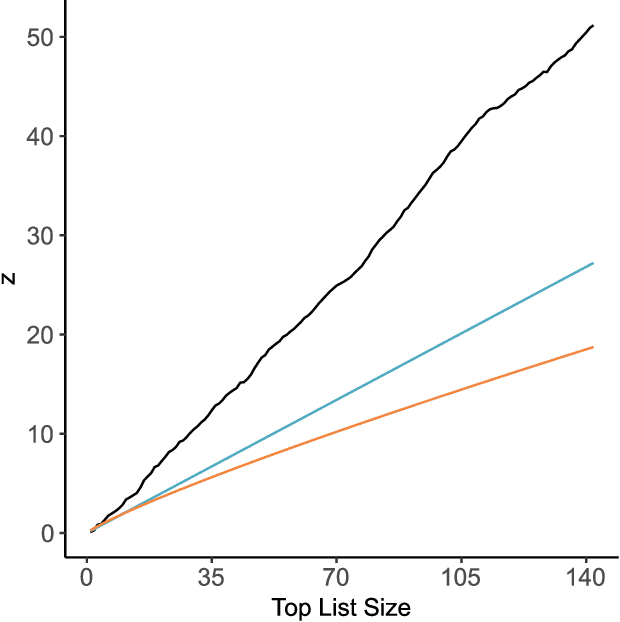

One of the fundamental questions of cultural evolutionary research is how individual-level processes scale up to generate population-level patterns. Previous studies in music have revealed that frequency-based bias (e.g. conformity and novelty) drives large-scale cultural diversity in different ways across domains and levels of analysis. Music sampling is an ideal research model for this process because samples are known to be culturally transmitted between collaborating artists, and sampling events are reliably documented in online databases. The aim of the current study was to determine whether frequency-based bias has played a role in the cultural transmission of music sampling traditions, using a longitudinal dataset of sampling events across three decades. Firstly, we assessed whether turn-over rates of popular samples differ from those expected under neutral evolution. Next, we used agent-based simulations in an approximate Bayesian computation framework to infer what level of frequency-based bias likely generated the observed data. Despite anecdotal evidence of novelty bias, we found that sampling patterns at the population-level are most consistent with conformity bias.