 Add to Chrome
 Add to Firefox
 Add to Edge
Learning from Similarity/Dissimilarity and Pairwise Comparison
Mar 20, 2026
This paper addresses binary classification in scenarios where obtaining explicit instance level labels is impractical, by exploiting multiple weak labels defined on instance pairs. The existing SconfConfDiff classification framework relies on continuous valued probabilistic supervision, including similarity-confidence, the probability of class agreement, and confidence-difference, the difference in positive class probabilities. However, probabilistic labeling requires subjective uncertainty quantification, often leading to unstable supervision. We propose SD-Pcomp classification, a binary judgment based weakly supervised learning framework that relies only on relative judgments, namely class agreement between two instances and pairwise preference toward the positive class. The method employs Similarity/Dissimilarity (SD) labels and Pairwise Comparison (Pcomp) labels, and develops two unbiased risk estimators, (i) a convex combination of SD and Pcomp and (ii) a unified estimator that integrates both labels by modeling their relationship. Theoretical analysis and experimental results show that the proposed approach improves classification performance over methods using a single weak label, and is robust to label noise and uncertainty in class prior estimation.

Pool-based Active Learning as Noisy Lossy Compression: Characterizing Label Complexity via Finite Blocklength Analysis
Feb 05, 2026This paper proposes an information-theoretic framework for analyzing the theoretical limits of pool-based active learning (AL), in which a subset of instances is selectively labeled. The proposed framework reformulates pool-based AL as a noisy lossy compression problem by mapping pool observations to noisy symbol observations, data selection to compression, and learning to decoding. This correspondence enables a unified information-theoretic analysis of data selection and learning in pool-based AL. Applying finite blocklength analysis of noisy lossy compression, we derive information-theoretic lower bounds on label complexity and generalization error that serve as theoretical limits for a given learning algorithm under its associated optimal data selection strategy. Specifically, our bounds include terms that reflect overfitting induced by the learning algorithm and the discrepancy between its inductive bias and the target task, and are closely related to established information-theoretic bounds and stability theory, which have not been previously applied to the analysis of pool-based AL. These properties yield a new theoretical perspective on pool-based AL.
Supervised Learning as Lossy Compression: Characterizing Generalization and Sample Complexity via Finite Blocklength Analysis
Feb 04, 2026This paper presents a novel information-theoretic perspective on generalization in machine learning by framing the learning problem within the context of lossy compression and applying finite blocklength analysis. In our approach, the sampling of training data formally corresponds to an encoding process, and the model construction to a decoding process. By leveraging finite blocklength analysis, we derive lower bounds on sample complexity and generalization error for a fixed randomized learning algorithm and its associated optimal sampling strategy. Our bounds explicitly characterize the degree of overfitting of the learning algorithm and the mismatch between its inductive bias and the task as distinct terms. This separation provides a significant advantage over existing frameworks. Additionally, we decompose the overfitting term to show its theoretical connection to existing metrics found in information-theoretic bounds and stability theory, unifying these perspectives under our proposed framework.
Learning from Similarity-Confidence and Confidence-Difference
Aug 07, 2025In practical machine learning applications, it is often challenging to assign accurate labels to data, and increasing the number of labeled instances is often limited. In such cases, Weakly Supervised Learning (WSL), which enables training with incomplete or imprecise supervision, provides a practical and effective solution. However, most existing WSL methods focus on leveraging a single type of weak supervision. In this paper, we propose a novel WSL framework that leverages complementary weak supervision signals from multiple relational perspectives, which can be especially valuable when labeled data is limited. Specifically, we introduce SconfConfDiff Classification, a method that integrates two distinct forms of weaklabels: similarity-confidence and confidence-difference, which are assigned to unlabeled data pairs. To implement this method, we derive two types of unbiased risk estimators for classification: one based on a convex combination of existing estimators, and another newly designed by modeling the interaction between two weak labels. We prove that both estimators achieve optimal convergence rates with respect to estimation error bounds. Furthermore, we introduce a risk correction approach to mitigate overfitting caused by negative empirical risk, and provide theoretical analysis on the robustness of the proposed method against inaccurate class prior probability and label noise. Experimental results demonstrate that the proposed method consistently outperforms existing baselines across a variety of settings.
Learning from Hard Labels with Additional Supervision on Non-Hard-Labeled Classes
Jul 24, 2025In scenarios where training data is limited due to observation costs or data scarcity, enriching the label information associated with each instance becomes crucial for building high-accuracy classification models. In such contexts, it is often feasible to obtain not only hard labels but also {\it additional supervision}, such as the confidences for the hard labels. This setting naturally raises fundamental questions: {\it What kinds of additional supervision are intrinsically beneficial?} And {\it how do they contribute to improved generalization performance?} To address these questions, we propose a theoretical framework that treats both hard labels and additional supervision as probability distributions, and constructs soft labels through their affine combination. Our theoretical analysis reveals that the essential component of additional supervision is not the confidence score of the assigned hard label, but rather the information of the distribution over the non-hard-labeled classes. Moreover, we demonstrate that the additional supervision and the mixing coefficient contribute to the refinement of soft labels in complementary roles. Intuitively, in the probability simplex, the additional supervision determines the direction in which the deterministic distribution representing the hard label should be adjusted toward the true label distribution, while the mixing coefficient controls the step size along that direction. Through generalization error analysis, we theoretically characterize how the additional supervision and its mixing coefficient affect both the convergence rate and asymptotic value of the error bound. Finally, we experimentally demonstrate that, based on our theory, designing additional supervision can lead to improved classification accuracy, even when utilized in a simple manner.
Decoding the Mind of Large Language Models: A Quantitative Evaluation of Ideology and Biases
May 18, 2025The widespread integration of Large Language Models (LLMs) across various sectors has highlighted the need for empirical research to understand their biases, thought patterns, and societal implications to ensure ethical and effective use. In this study, we propose a novel framework for evaluating LLMs, focusing on uncovering their ideological biases through a quantitative analysis of 436 binary-choice questions, many of which have no definitive answer. By applying our framework to ChatGPT and Gemini, findings revealed that while LLMs generally maintain consistent opinions on many topics, their ideologies differ across models and languages. Notably, ChatGPT exhibits a tendency to change their opinion to match the questioner's opinion. Both models also exhibited problematic biases, unethical or unfair claims, which might have negative societal impacts. These results underscore the importance of addressing both ideological and ethical considerations when evaluating LLMs. The proposed framework offers a flexible, quantitative method for assessing LLM behavior, providing valuable insights for the development of more socially aligned AI systems.
* 23 pages, 5 figures, 17 tables
Learning from Complementary Features
Aug 27, 2024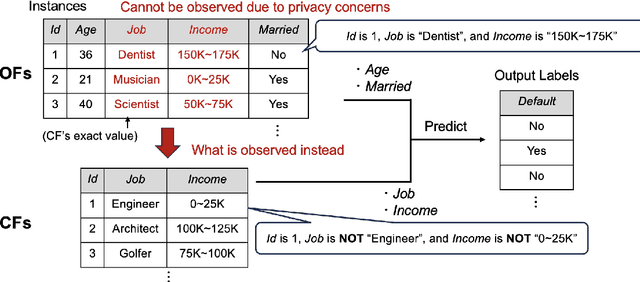
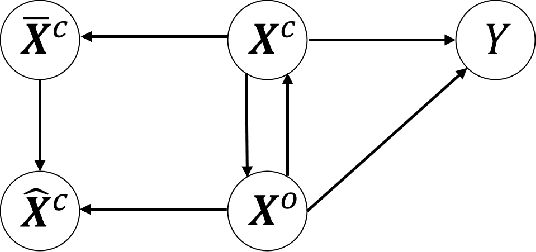
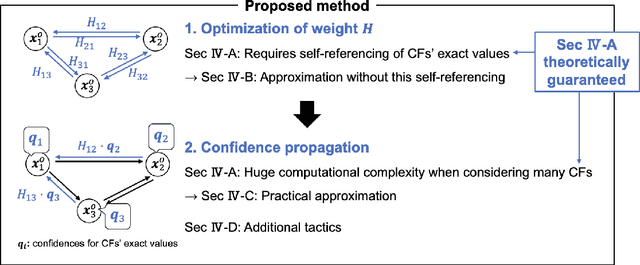
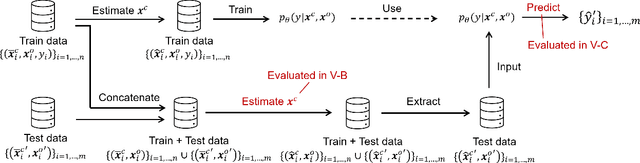
While precise data observation is essential for the learning processes of predictive models, it can be challenging owing to factors such as insufficient observation accuracy, high collection costs, and privacy constraints. In this paper, we examines cases where some qualitative features are unavailable as precise information indicating "what it is," but rather as complementary information indicating "what it is not." We refer to features defined by precise information as ordinary features (OFs) and those defined by complementary information as complementary features (CFs). We then formulate a new learning scenario termed Complementary Feature Learning (CFL), where predictive models are constructed using instances consisting of OFs and CFs. The simplest formalization of CFL applies conventional supervised learning directly using the observed values of CFs. However, this approach does not resolve the ambiguity associated with CFs, making learning challenging and complicating the interpretation of the predictive model's specific predictions. Therefore, we derive an objective function from an information-theoretic perspective to estimate the OF values corresponding to CFs and to predict output labels based on these estimations. Based on this objective function, we propose a theoretically guaranteed graph-based estimation method along with its practical approximation, for estimating OF values corresponding to CFs. The results of numerical experiments conducted with real-world data demonstrate that our proposed method effectively estimates OF values corresponding to CFs and predicts output labels.
Q&A Label Learning
May 08, 2023Assigning labels to instances is crucial for supervised machine learning. In this paper, we proposed a novel annotation method called Q&A labeling, which involves a question generator that asks questions about the labels of the instances to be assigned, and an annotator who answers the questions and assigns the corresponding labels to the instances. We derived a generative model of labels assigned according to two different Q&A labeling procedures that differ in the way questions are asked and answered. We showed that, in both procedures, the derived model is partially consistent with that assumed in previous studies. The main distinction of this study from previous studies lies in the fact that the label generative model was not assumed, but rather derived based on the definition of a specific annotation method, Q&A labeling. We also derived a loss function to evaluate the classification risk of ordinary supervised machine learning using instances assigned Q&A labels and evaluated the upper bound of the classification error. The results indicate statistical consistency in learning with Q&A labels.
Bridging Ordinary-Label Learning and Complementary-Label Learning
Feb 10, 2020


Unlike ordinary supervised pattern recognition, in a newly proposed framework namely complementary-label learning, each label specifies one class that the pattern does not belong to. In this paper, we propose the natural generalization of learning from an ordinary label and a complementary label, specifically focused on one-versus-all and pairwise classification. We assume that annotation with a bag of complementary labels is equivalent to providing the rest of all the labels as the candidates of the one true class. Our derived classification risk is in a comprehensive form that includes those in the literature, and succeeded to explicitly show the relationship between the single and multiple ordinary/complementary labels. We further show both theoretically and experimentally that the classification error bound monotonically decreases corresponding to the number of complementary labels. This is consistent because the more complementary labels are provided, the less supervision becomes ambiguous.