 Add to Chrome
 Add to Firefox
 Add to Edge
Automatic classification of trees using a UAV onboard camera and deep learning
Apr 27, 2018



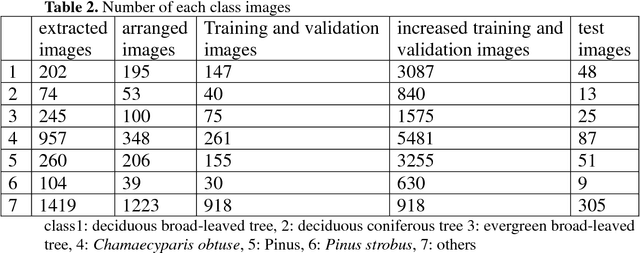
Automatic classification of trees using remotely sensed data has been a dream of many scientists and land use managers. Recently, Unmanned aerial vehicles (UAV) has been expected to be an easy-to-use, cost-effective tool for remote sensing of forests, and deep learning has attracted attention for its ability concerning machine vision. In this study, using a commercially available UAV and a publicly available package for deep learning, we constructed a machine vision system for the automatic classification of trees. In our method, we segmented a UAV photography image of forest into individual tree crowns and carried out object-based deep learning. As a result, the system was able to classify 7 tree types at 89.0% accuracy. This performance is notable because we only used basic RGB images from a standard UAV. In contrast, most of previous studies used expensive hardware such as multispectral imagers to improve the performance. This result means that our method has the potential to classify individual trees in a cost-effective manner. This can be a usable tool for many forest researchers and managements.

Identifying 3 moss species by deep learning, using the "chopped picture" method
Aug 08, 2017


In general, object identification tends not to work well on ambiguous, amorphous objects such as vegetation. In this study, we developed a simple but effective approach to identify ambiguous objects and applied the method to several moss species. As a result, the model correctly classified test images with accuracy more than 90%. Using this approach will help progress in computer vision studies.