 Add to Chrome
 Add to Firefox
 Add to Edge
Spatially-Aligned Chroma from Luma Prediction for Lossless JPEG XS Raw Image Compression
Jul 14, 2026
This study proposes a Chroma from Luma (CfL)-enhanced Star-Tetrix transform (STT), referred to as CfL-STT, for improving raw image compression in JPEG XS. The proposed CfL-STT integrates CfL prediction into the STT to predict chroma components from the luma component in CFA-sampled raw images. Unlike conventional CfL prediction designed for full-color images, the proposed method employs spatially aligned luma samples obtained via linear interpolation along the horizontal and vertical directions to match the chroma sampling grid. This spatial alignment suppresses high-frequency sensor noise while preserving cross-channel correlation, resulting in a more decorrelated Y-Delta-Du-Dv color space. The proposed method was implemented in the JPEG XS reference software and evaluated on raw image datasets. Experimental results demonstrate that a direct application of CfL prediction yields image-dependent performance and may degrade coding efficiency due to the lack of spatial alignment, whereas the proposed CfL-STT consistently improves coding efficiency in lossless raw image compression while preserving exact reversibility.

Fast Singular Value Shrinkage with Chebyshev Polynomial Approximation Based on Signal Sparsity
May 19, 2017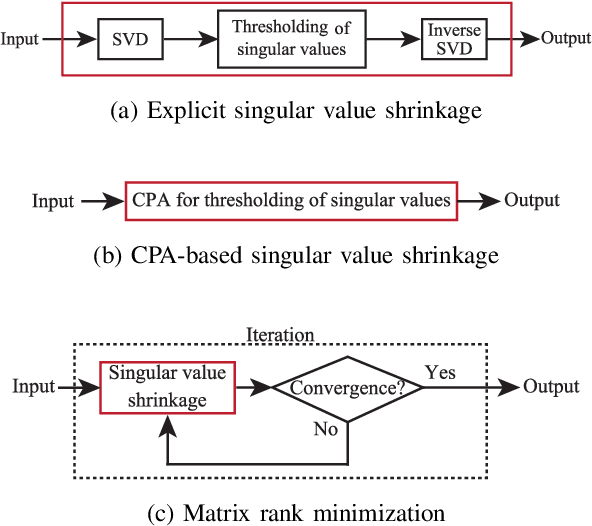
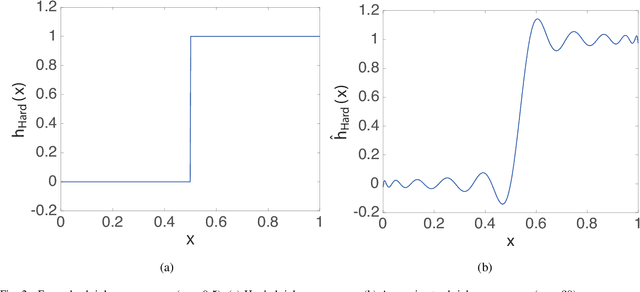
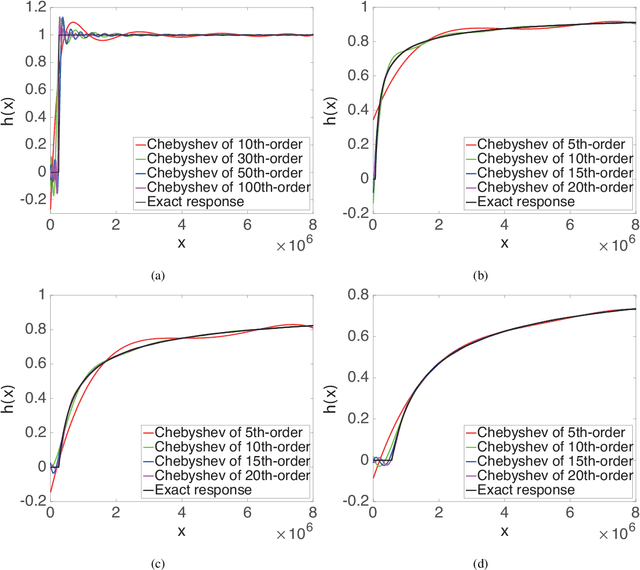
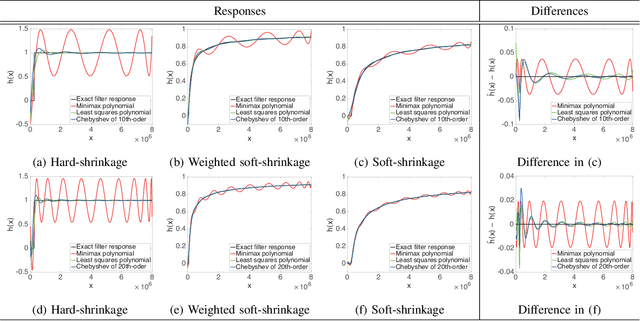
We propose an approximation method for thresholding of singular values using Chebyshev polynomial approximation (CPA). Many signal processing problems require iterative application of singular value decomposition (SVD) for minimizing the rank of a given data matrix with other cost functions and/or constraints, which is called matrix rank minimization. In matrix rank minimization, singular values of a matrix are shrunk by hard-thresholding, soft-thresholding, or weighted soft-thresholding. However, the computational cost of SVD is generally too expensive to handle high dimensional signals such as images; hence, in this case, matrix rank minimization requires enormous computation time. In this paper, we leverage CPA to (approximately) manipulate singular values without computing singular values and vectors. The thresholding of singular values is expressed by a multiplication of certain matrices, which is derived from a characteristic of CPA. The multiplication is also efficiently computed using the sparsity of signals. As a result, the computational cost is significantly reduced. Experimental results suggest the effectiveness of our method through several image processing applications based on matrix rank minimization with nuclear norm relaxation in terms of computation time and approximation precision.