 Add to Chrome
 Add to Firefox
 Add to Edge
Spatially Masked Regression Reveals Local and Distributed Predictability in Electrophysiological Recordings
Jun 09, 2026
Neural recordings are often interpreted as local measurements, yet the signal at any one sensor can also reflect structured activity distributed across the broader network. This raises a basic question: to what extent does an electrode's signal reflect local versus distributed information in the underlying system? More specifically, how much of an electrode's activity is carried by its immediate neighborhood, and how much is embedded more broadly across the array? We address this with a Spatially Masked Regression (SMR) framework that reconstructs each electrode's timeseries from the remaining electrodes while excluding a configurable neighborhood around the target. By progressively increasing this mask, spatial locality becomes an experimental control for quantifying how much predictive information survives after nearby channels are withheld. We apply SMR to intracranial EEG with heterogeneous electrode coverage and to scalp EEG with standardized montages over sensorimotor cortex. Using distance correlation between original and reconstructed signals, we find strong within-subject reconstruction in both modalities, substantial residual predictability even when local neighbors are excluded, and markedly stronger cross-subject transfer in EEG than in iEEG. Masking shows that nearby electrodes contribute strongly to reconstruction but do not account for all of it, indicating that individual channels reflect both local redundancy and broader distributed structure. Surrogates that preserve selected marginal or spectral properties while disrupting phase structure or temporal ordering substantially reduce performance, supporting the conclusion that SMR depends on structured temporal and cross-channel organization rather than on marginal statistics alone. These results position SMR as an interpretable framework for quantifying the balance between local and distributed information in recordings.

A Combined Channel Approach for Decoding Intracranial EEG Signals: Enhancing Accuracy through Spatial Information Integration
Dec 09, 2024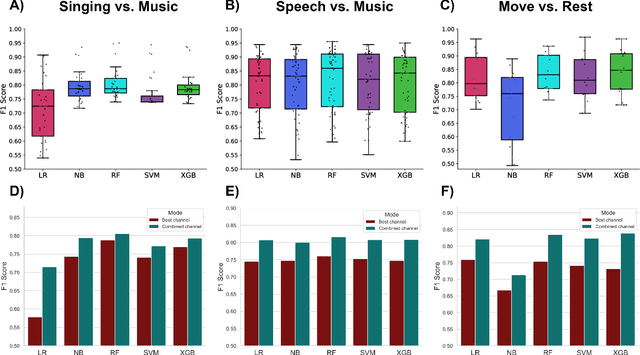
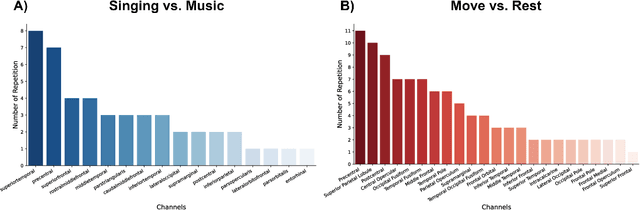
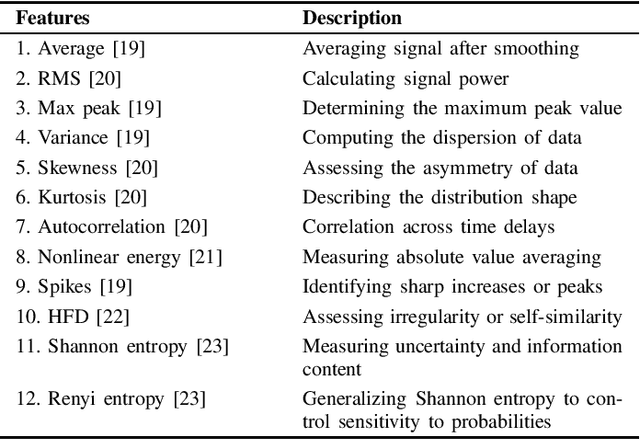
Intracranial EEG (iEEG) recording, characterized by high spatial and temporal resolution and superior signal-to-noise ratio (SNR), enables the development of precise brain-computer interface (BCI) systems for neural decoding. However, the invasive nature of the procedure significantly limits the availability of iEEG datasets in terms of both the number of participants and the duration of recorded sessions. To address this limitation, we propose a single-participant machine learning model optimized for decoding iEEG signals. The model employs 18 key features and operates in two modes: best channel and combined channel. The combined channel mode integrates spatial information from multiple brain regions, leading to superior classification performance. Evaluations across three datasets -- Music Reconstruction, Audio Visual, and AJILE12 -- demonstrate that the combined channel mode consistently outperforms the best channel mode across all classifiers. In the best-performing cases, Random Forest achieved an F1 score of 0.81 +/- 0.05 in the Music Reconstruction dataset and 0.82 +/- 0.10 in the Audio Visual dataset, while XGBoost achieved an F1 score of 0.84 +/- 0.08 in the AJILE12 dataset. Furthermore, the analysis of brain region contributions in the combined channel mode revealed that the model identifies relevant brain regions aligned with physiological expectations for each task and effectively combines data from electrodes in these regions to achieve high performance. These findings highlight the potential of integrating spatial information across brain regions to improve task decoding, offering new avenues for advancing BCI systems and neurotechnological applications.