 Add to Chrome
 Add to Firefox
 Add to Edge
Hey Pentti, We Did (More of) It!: A Vector-Symbolic Lisp With Residue Arithmetic
Nov 11, 2025
Using Frequency-domain Holographic Reduced Representations (FHRRs), we extend a Vector-Symbolic Architecture (VSA) encoding of Lisp 1.5 with primitives for arithmetic operations using Residue Hyperdimensional Computing (RHC). Encoding a Turing-complete syntax over a high-dimensional vector space increases the expressivity of neural network states, enabling network states to contain arbitrarily structured representations that are inherently interpretable. We discuss the potential applications of the VSA encoding in machine learning tasks, as well as the importance of encoding structured representations and designing neural networks whose behavior is sensitive to the structure of their representations in virtue of attaining more general intelligent agents than exist at present.

A Neuro-Mimetic Realization of the Common Model of Cognition via Hebbian Learning and Free Energy Minimization
Oct 14, 2023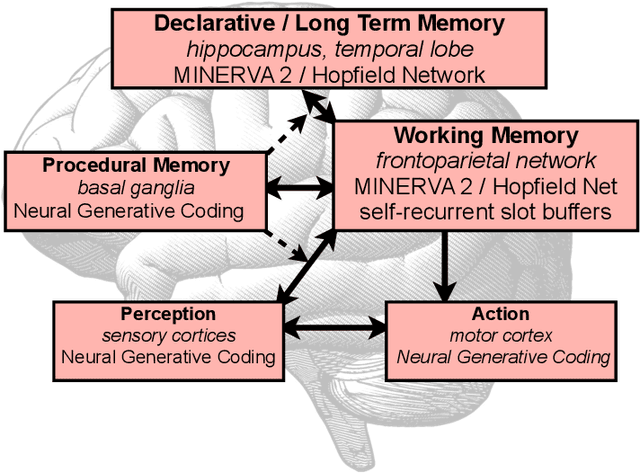
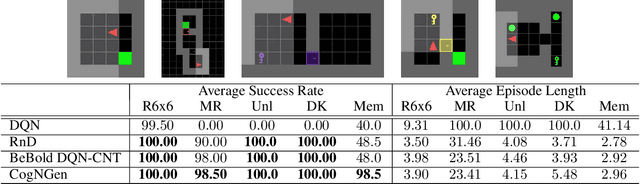
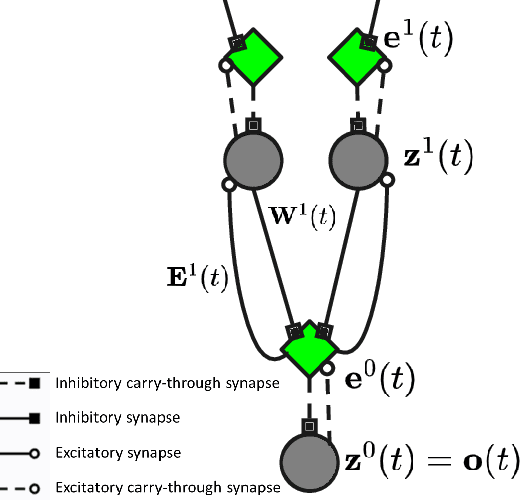
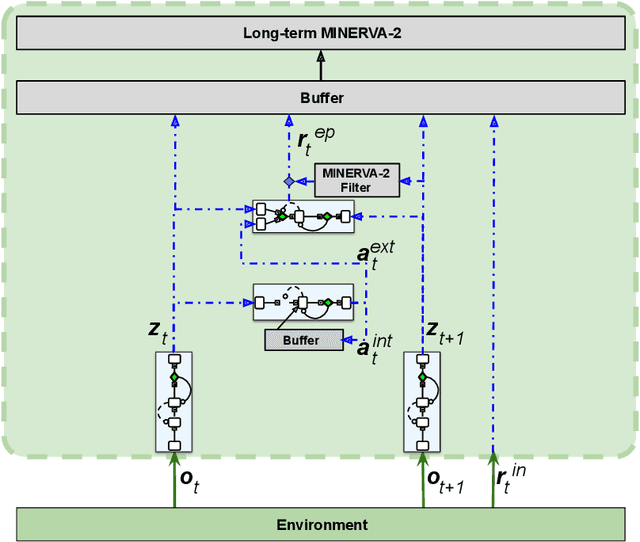
Over the last few years, large neural generative models, capable of synthesizing intricate sequences of words or producing complex image patterns, have recently emerged as a popular representation of what has come to be known as "generative artificial intelligence" (generative AI). Beyond opening the door to new opportunities as well as challenges for the domain of statistical machine learning, the rising popularity of generative AI brings with it interesting questions for Cognitive Science, which seeks to discover the nature of the processes that underpin minds and brains as well as to understand how such functionality might be acquired and instantiated in biological (or artificial) substrate. With this goal in mind, we argue that a promising long-term pathway lies in the crafting of cognitive architectures, a long-standing tradition of the field, cast fundamentally in terms of neuro-mimetic generative building blocks. Concretely, we discuss the COGnitive Neural GENerative system, which is an architecture that casts the Common Model of Cognition in terms of Hebbian adaptation operating in service of optimizing a variational free energy functional.