 Add to Chrome
 Add to Firefox
 Add to Edge
Evaluation of Pipelines for Data Integration into Knowledge Graphs
May 21, 2026
Integrating new data into knowledge graphs (KG) typically involves different tasks that are executed within workflows or pipelines There are many possible pipelines for a specific integration problem but there is not yet a general approach to evaluate the overall quality and performance of such pipelines to be able to determine the best choices. We therefore propose a new benchmark KGI-Bench to evaluate integration pipelines that ingest different kinds of input data into an existing KG. We evaluate pipelines by analyzing their output, i.e., the updated KG, with the three complementary quality metrics coverage, correctness and consistency. We also provide benchmark datasets (seed KG, overlapping input data of three formats, reference KG as a ground truth) for the movie domain. To demonstrate the applicability and usefulness of the proposed benchmark, we comparatively evaluate 12 pipelines and analyze their behavior across different input data formats and design choices.

Graph-based Active Learning for Entity Cluster Repair
Jan 26, 2024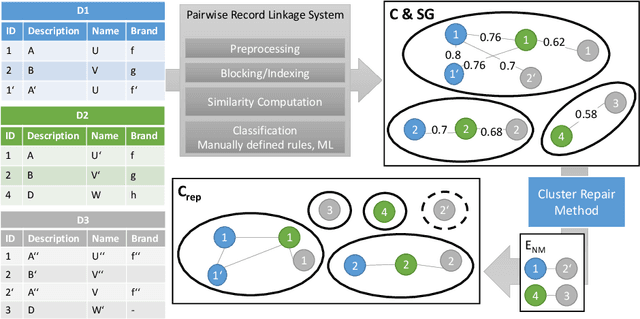
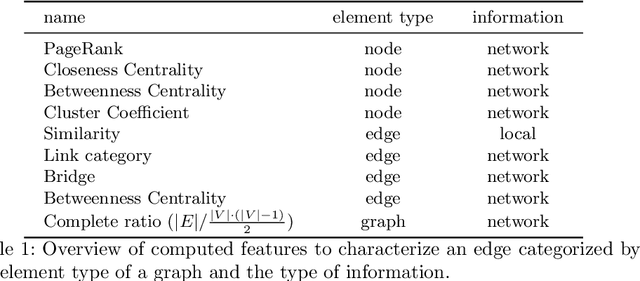
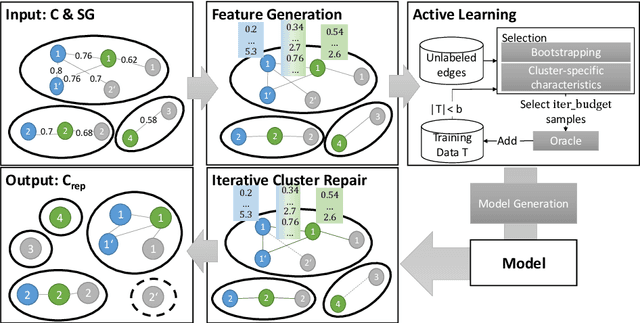
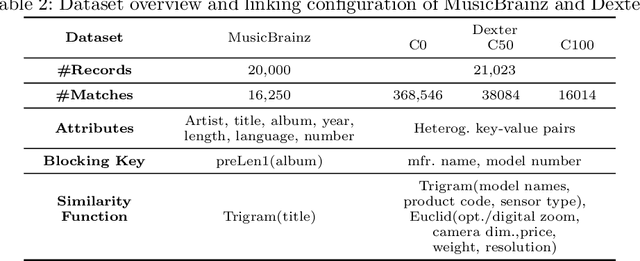
Cluster repair methods aim to determine errors in clusters and modify them so that each cluster consists of records representing the same entity. Current cluster repair methodologies primarily assume duplicate-free data sources, where each record from one source corresponds to a unique record from another. However, real-world data often deviates from this assumption due to quality issues. Recent approaches apply clustering methods in combination with link categorization methods so they can be applied to data sources with duplicates. Nevertheless, the results do not show a clear picture since the quality highly varies depending on the configuration and dataset. In this study, we introduce a novel approach for cluster repair that utilizes graph metrics derived from the underlying similarity graphs. These metrics are pivotal in constructing a classification model to distinguish between correct and incorrect edges. To address the challenge of limited training data, we integrate an active learning mechanism tailored to cluster-specific attributes. The evaluation shows that the method outperforms existing cluster repair methods without distinguishing between duplicate-free or dirty data sources. Notably, our modified active learning strategy exhibits enhanced performance when dealing with datasets containing duplicates, showcasing its effectiveness in such scenarios.
Construction of Knowledge Graphs: State and Challenges
Feb 22, 2023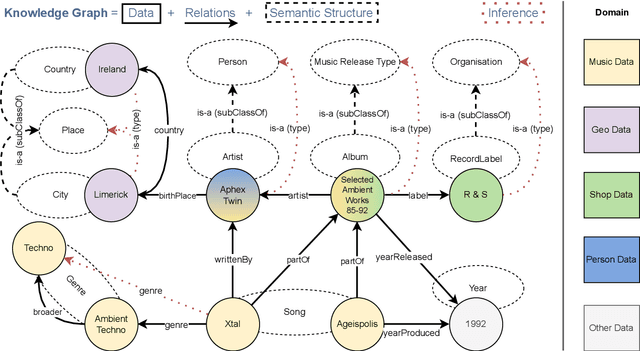
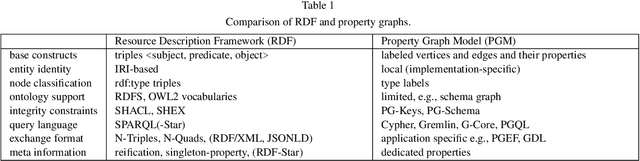

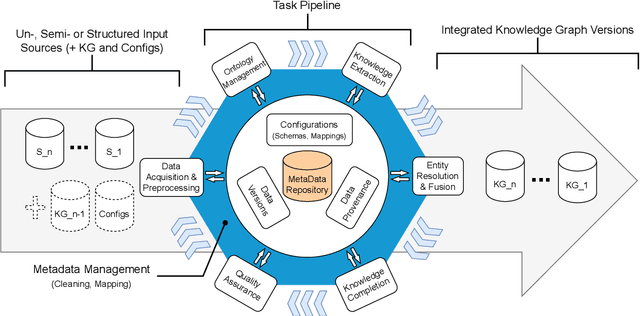
With knowledge graphs (KGs) at the center of numerous applications such as recommender systems and question answering, the need for generalized pipelines to construct and continuously update such KGs is increasing. While the individual steps that are necessary to create KGs from unstructured (e.g. text) and structured data sources (e.g. databases) are mostly well-researched for their one-shot execution, their adoption for incremental KG updates and the interplay of the individual steps have hardly been investigated in a systematic manner so far. In this work, we first discuss the main graph models for KGs and introduce the major requirement for future KG construction pipelines. Next, we provide an overview of the necessary steps to build high-quality KGs, including cross-cutting topics such as metadata management, ontology development, and quality assurance. We then evaluate the state of the art of KG construction w.r.t the introduced requirements for specific popular KGs as well as some recent tools and strategies for KG construction. Finally, we identify areas in need of further research and improvement.