 Add to Chrome
 Add to Firefox
 Add to Edge
From Raw Segmentations to Simulation-Ready Cardiac Meshes: An Automated Framework for Anatomical Reconstruction and Virtual Cohort Generation
Jun 29, 2026
Computational models of the human heart are widely used to study electromechanical and fluid-dynamical cardiac function and to support applications such as in silico clinical trials. However, most studies remain limited to single or patient-specific anatomies, restricting the inclusion of population-level variability required for uncertainty quantification. A key challenge is translating medical-image segmentations, which may contain artifacts, mesh defects or disjoint domains, into topologically coherent geometries suitable for multiphysics simulations. In this work, we present a semi-automatic pipeline that converts CT-based segmentations into simulation-ready cardiac meshes within a few minutes while preserving anatomical and topological consistency. Building on modern deep learning segmentation methods, the framework incorporates a template-based registration stage to regularize artifacts and enforce mesh-quality constraints. A Chamfer-distance morphing strategy deforms a high-quality template toward each segmented heart, matching individual chambers while preserving topology. The resulting meshes are watertight, isotopological, and endowed with consistent point-to-point correspondence. The pipeline is validated on 58 healthy cardiac CT scans, including all cardiac chambers and proximal vessel segments. The resulting meshes can be represented in a unified shape space, enabling the construction of a statistical shape model of the heart and major vessels. Principal Component Analysis shows that a low-dimensional latent space efficiently captures population variability, while Gaussian Mixture Modeling enables synthetic anatomy generation. Overall, the proposed framework (released open-source) provides a pathway from raw segmentations to simulation-ready cardiac geometries, enabling anatomically consistent virtual cohorts for large-scale in silico studies.

Graph-Convolution-Beta-VAE for Synthetic Abdominal Aorta Aneurysm Generation
Jun 16, 2025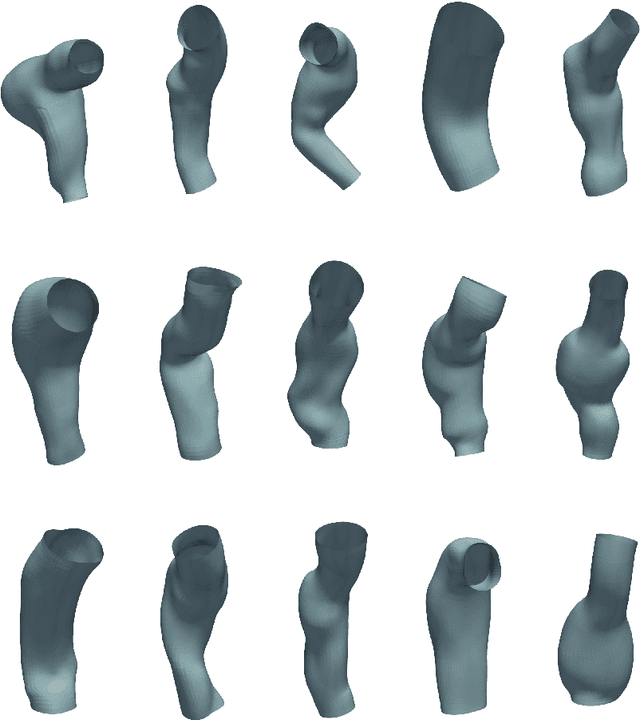
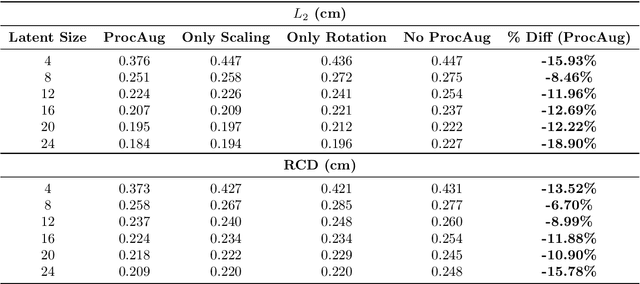

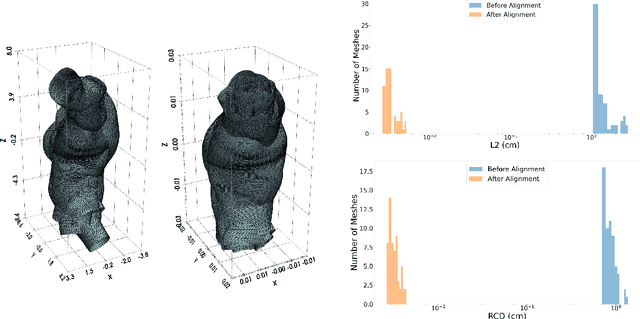
Synthetic data generation plays a crucial role in medical research by mitigating privacy concerns and enabling large-scale patient data analysis. This study presents a beta-Variational Autoencoder Graph Convolutional Neural Network framework for generating synthetic Abdominal Aorta Aneurysms (AAA). Using a small real-world dataset, our approach extracts key anatomical features and captures complex statistical relationships within a compact disentangled latent space. To address data limitations, low-impact data augmentation based on Procrustes analysis was employed, preserving anatomical integrity. The generation strategies, both deterministic and stochastic, manage to enhance data diversity while ensuring realism. Compared to PCA-based approaches, our model performs more robustly on unseen data by capturing complex, nonlinear anatomical variations. This enables more comprehensive clinical and statistical analyses than the original dataset alone. The resulting synthetic AAA dataset preserves patient privacy while providing a scalable foundation for medical research, device testing, and computational modeling.
Synthetic Lagrangian Turbulence by Generative Diffusion Models
Jul 17, 2023Lagrangian turbulence lies at the core of numerous applied and fundamental problems related to the physics of dispersion and mixing in engineering, bio-fluids, atmosphere, oceans, and astrophysics. Despite exceptional theoretical, numerical, and experimental efforts conducted over the past thirty years, no existing models are capable of faithfully reproducing statistical and topological properties exhibited by particle trajectories in turbulence. We propose a machine learning approach, based on a state-of-the-art Diffusion Model, to generate single-particle trajectories in three-dimensional turbulence at high Reynolds numbers, thereby bypassing the need for direct numerical simulations or experiments to obtain reliable Lagrangian data. Our model demonstrates the ability to quantitatively reproduce all relevant statistical benchmarks over the entire range of time scales, including the presence of fat tails distribution for the velocity increments, anomalous power law, and enhancement of intermittency around the dissipative scale. The model exhibits good generalizability for extreme events, achieving unprecedented intensity and rarity. This paves the way for producing synthetic high-quality datasets for pre-training various downstream applications of Lagrangian turbulence.