 Add to Chrome
 Add to Firefox
 Add to Edge
Unsupervised Approaches for Global Prosodic Embedding Extraction
Jun 12, 2026
Prosody is central to oral communication, conveying information like the emotional state of the speaker and cues needed for meaning disambiguation. Many self-supervised models of speech produce embeddings that encode prosodic as well as linguistic, and speaker information. This entanglement of information is problematic in scenarios where prosody is the main distinguishing factor while other factors may vary between training and deployment; in such cases, a purely prosodic representation would be more robust. Such representation could also be used for analyzing the role of prosody in a given task or as input to speech synthesis systems. In this work, we propose a variety of approaches for producing global prosodic embeddings based on auto-encoder models of pitch and energy. We develop a benchmark for assessing the performance of these representations, showing that our embeddings provide competitive or superior performance under challenging conditions, compared to various alternatives.

Benchmarking Time-localized Explanations for Audio Classification Models
Jun 04, 2025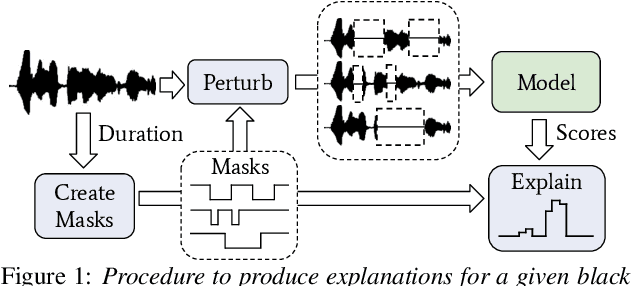
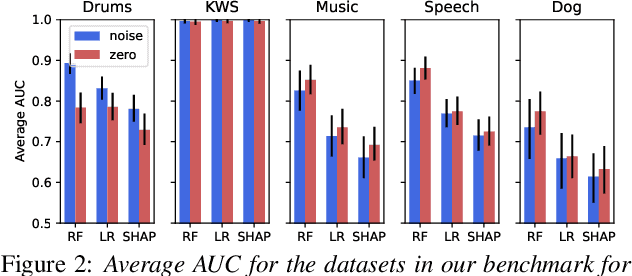
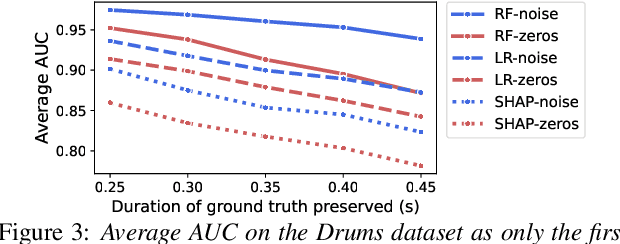
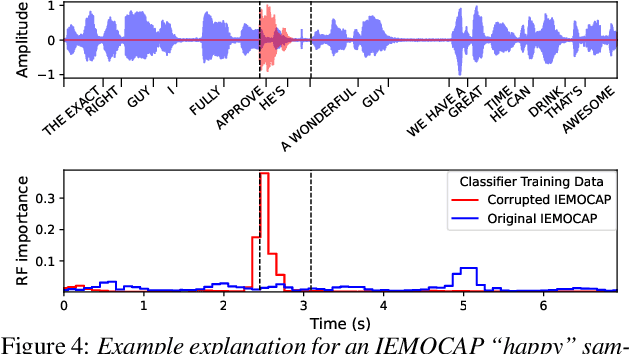
Most modern approaches for audio processing are opaque, in the sense that they do not provide an explanation for their decisions. For this reason, various methods have been proposed to explain the outputs generated by these models. Good explanations can result in interesting insights about the data or the model, as well as increase trust in the system. Unfortunately, evaluating the quality of explanations is far from trivial since, for most tasks, there is no clear ground truth explanation to use as reference. In this work, we propose a benchmark for time-localized explanations for audio classification models that uses time annotations of target events as a proxy for ground truth explanations. We use this benchmark to systematically optimize and compare various approaches for model-agnostic post-hoc explanation, obtaining, in some cases, close to perfect explanations. Finally, we illustrate the utility of the explanations for uncovering spurious correlations.