 Add to Chrome
 Add to Firefox
 Add to Edge
The Free-Market Algorithm: Self-Organizing Optimization for Open-Ended Complex Systems
Mar 25, 2026
We introduce the Free-Market Algorithm (FMA), a novel metaheuristic inspired by free-market economics. Unlike Genetic Algorithms, Particle Swarm Optimization, and Simulated Annealing -- which require prescribed fitness functions and fixed search spaces -- FMA uses distributed supply-and-demand dynamics where fitness is emergent, the search space is open-ended, and solutions take the form of hierarchical pathway networks. Autonomous agents discover rules, trade goods, open and close firms, and compete for demand with no centralized controller. FMA operates through a three-layer architecture: a universal market mechanism (supply, demand, competition, selection), pluggable domain-specific behavioral rules, and domain-specific observation. The market mechanism is identical across applications; only the behavioral rules change. Validated in two unrelated domains. In prebiotic chemistry, starting from 900 bare atoms (C, H, O, N), FMA discovers all 12 feasible amino acid formulas, all 5 nucleobases, the formose sugar chain, and Krebs cycle intermediates in under 5 minutes on a laptop -- with up to 240 independent synthesis routes per product. In macroeconomic forecasting, reading a single input-output table with zero estimated parameters, FMA achieves Mean Absolute Error of 0.42 percentage points for non-crisis GDP prediction, comparable to professional forecasters, portable to 33 countries. Assembly Theory alignment shows that FMA provides the first explicit, tunable mechanism for the selection signatures described by Sharma et al. (Nature, 2023). The event-driven assembly dynamics resonate with foundational programs in physics -- causal set theory, relational quantum mechanics, constructor theory -- suggesting that Darwinian market dynamics may reflect a deeper organizational principle that lead to the unfolding of Nature itself.

Ants, robots, humans: a self-organizing, complex systems modeling approach
Oct 16, 2020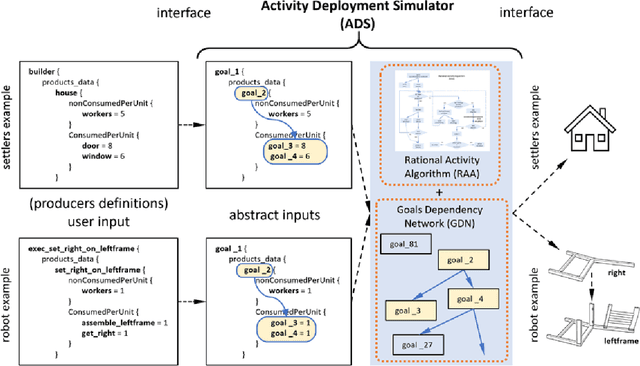
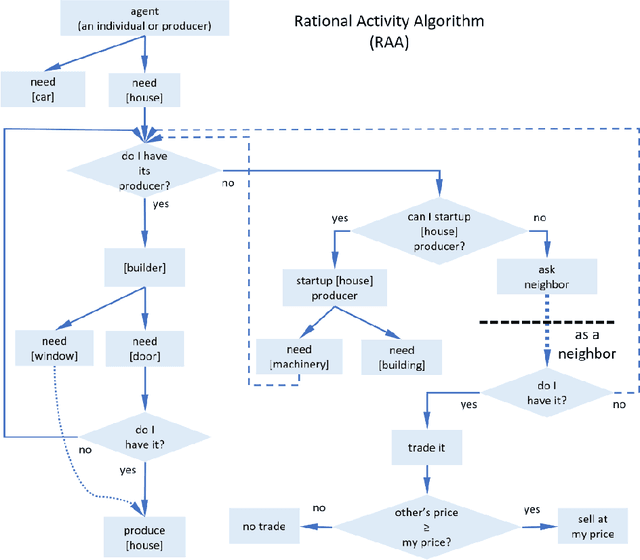

Most of the grand challenges of humanity today involve complex agent-based systems, such as epidemiology, economics or ecology. However, remains as a pending task the challenge of identifying the general principles underlying their self-organizing capabilities. This article presents a novel modeling approach, capable to self-deploy both the system structure and the activities for goal-driven agents that can take appropriate actions to achieve their goals. Humans, robots, and animals are all endowed with this type of behavior. Self-organization is shown to emerge from the decisions of a common rational activity algorithm, based on the information of a system-specific goals dependency network. The unique self-deployment feature of this approach, that can also be applied to non-goal-driven agents, can boost considerably the range and depth of application of agent-based modeling.