 Add to Chrome
 Add to Firefox
 Add to Edge
Learning Complementary Action Modeling from Automotive Maintenance Instructions
Jun 26, 2026
A minute lexical variation can reverse the procedural meaning of an instruction even when the rest of the sentence remains unchanged. In automotive maintenance instructions, this pattern often appears when an action phrase turns an instruction into its procedural counterpart. The entities, modifiers, and surrounding context remain largely invariant, while the action phrase determines the procedural relation. We define this task as Complementary Action Modeling (CAM). Given a maintenance instruction, the goal is to identify or generate its procedural counterpart by modifying the action phrase while preserving the remaining sentence context. This task focuses on three aspects: distinguishing complementarity from surface similarity, controlling generation at the action-phrase level, and evaluating relational correctness using retrieval, overlap-based, and human evaluation. Using a German automotive maintenance dataset, we examine these questions through candidate matching and controlled Seq2Seq generation. The results show that complementary maintenance instructions are best modeled as procedural associations grounded in subtle lexical cues. They should therefore not be treated as ordinary cases of sentence similarity or synonym-based paraphrasing.

Distributional Ground Truth: Non-Redundant Crowdsourcing Data Quality Control in UI Labeling Tasks
Dec 25, 2020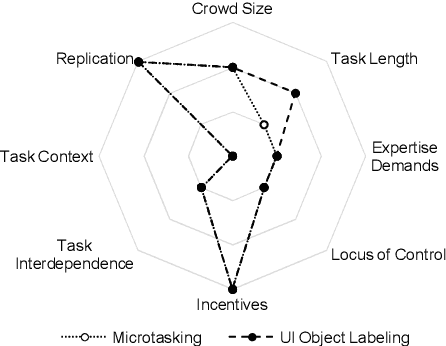
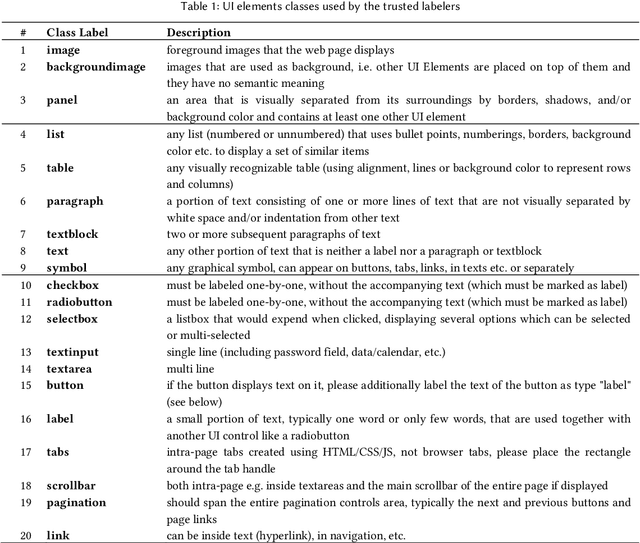
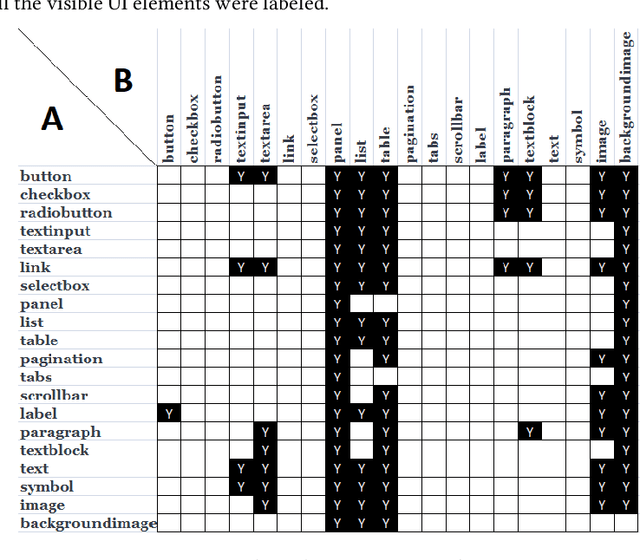
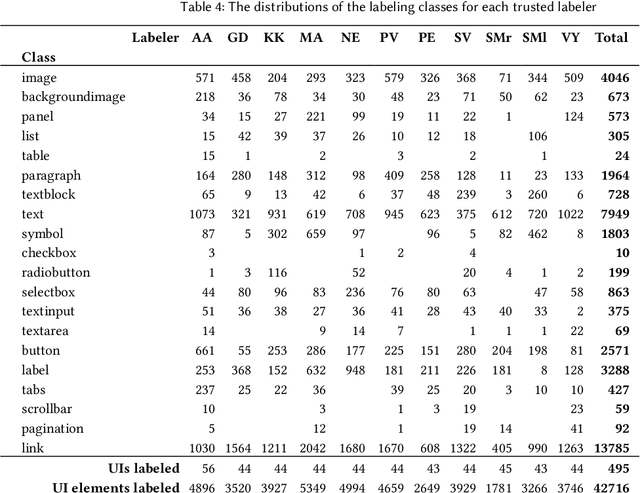
HCI increasingly employs Machine Learning and Image Recognition, in particular for visual analysis of user interfaces (UIs). A popular way for obtaining human-labeled training data is Crowdsourcing, typically using the quality control methods ground truth and majority consensus, which necessitate redundancy in the outcome. In our paper we propose a non-redundant method for prediction of crowdworkers' output quality in web UI labeling tasks, based on homogeneity of distributions assessed with two-sample Kolmogorov-Smirnov test. Using a dataset of about 500 screenshots with over 74,000 UI elements located and classified by 11 trusted labelers and 298 Amazon Mechanical Turk crowdworkers, we demonstrate the advantage of our approach over the baseline model based on mean Time-on-Task. Exploring different dataset partitions, we show that with the trusted set size of 17-27% UIs our "distributional ground truth" model can achieve R2s of over 0.8 and help to obviate the ancillary work effort and expenses.