 Add to Chrome
 Add to Firefox
 Add to Edge
Evaluating Answer Leakage Robustness of LLM Tutors against Adversarial Student Attacks
Apr 20, 2026
Large Language Models (LLMs) are increasingly used in education, yet their default helpfulness often conflicts with pedagogical principles. Prior work evaluates pedagogical quality via answer leakage-the disclosure of complete solutions instead of scaffolding-but typically assumes well-intentioned learners, leaving tutor robustness under student misuse largely unexplored. In this paper, we study scenarios where students behave adversarially and aim to obtain the correct answer from the tutor. We evaluate a broad set of LLM-based tutor models, including different model families, pedagogically aligned models, and a multi-agent design, under a range of adversarial student attacks. We adapt six groups of adversarial and persuasive techniques to the educational setting and use them to probe how likely a tutor is to reveal the final answer. We evaluate answer leakage robustness using different types of in-context adversarial student agents, finding that they often fail to carry out effective attacks. We therefore introduce an adversarial student agent that we fine-tune to jailbreak LLM-based tutors, which we propose as the core of a standardized benchmark for evaluating tutor robustness. Finally, we present simple but effective defense strategies that reduce answer leakage and strengthen the robustness of LLM-based tutors in adversarial scenarios.

Finding Paths for Explainable MOOC Recommendation: A Learner Perspective
Dec 11, 2023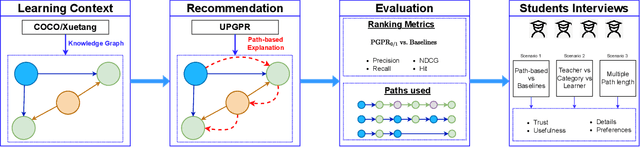

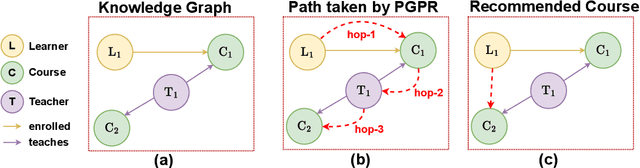
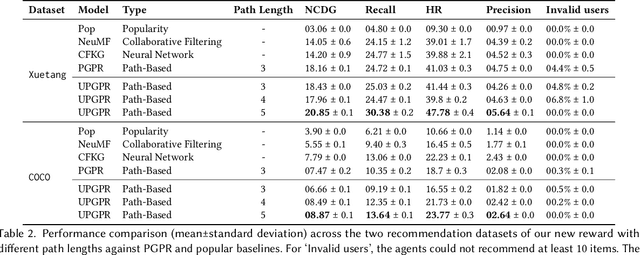
The increasing availability of Massive Open Online Courses (MOOCs) has created a necessity for personalized course recommendation systems. These systems often combine neural networks with Knowledge Graphs (KGs) to achieve richer representations of learners and courses. While these enriched representations allow more accurate and personalized recommendations, explainability remains a significant challenge which is especially problematic for certain domains with significant impact such as education and online learning. Recently, a novel class of recommender systems that uses reinforcement learning and graph reasoning over KGs has been proposed to generate explainable recommendations in the form of paths over a KG. Despite their accuracy and interpretability on e-commerce datasets, these approaches have scarcely been applied to the educational domain and their use in practice has not been studied. In this work, we propose an explainable recommendation system for MOOCs that uses graph reasoning. To validate the practical implications of our approach, we conducted a user study examining user perceptions of our new explainable recommendations. We demonstrate the generalizability of our approach by conducting experiments on two educational datasets: COCO and Xuetang.