 Add to Chrome
 Add to Firefox
 Add to Edge
A canonical generalization of OBDD
Apr 07, 2026
We introduce Tree Decision Diagrams (TDD) as a model for Boolean functions that generalizes OBDD. They can be seen as a restriction of structured d-DNNF; that is, d-DNNF that respect a vtree $T$. We show that TDDs enjoy the same tractability properties as OBDD, such as model counting, enumeration, conditioning, and apply, and are more succinct. In particular, we show that CNF formulas of treewidth $k$ can be represented by TDDs of FPT size, which is known to be impossible for OBDD. We study the complexity of compiling CNF formulas into deterministic TDDs via bottom-up compilation and relate the complexity of this approach with the notion of factor width introduced by Bova and Szeider.

Active Learning of Symbolic Automata Over Rational Numbers
Nov 15, 2025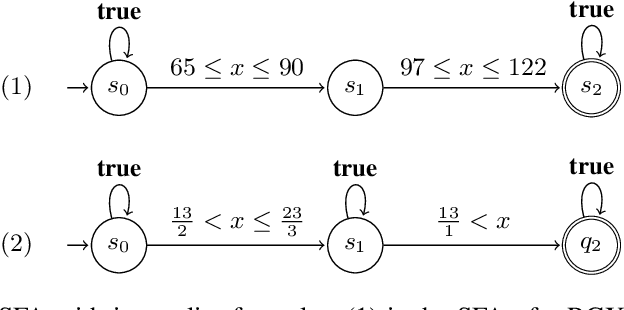
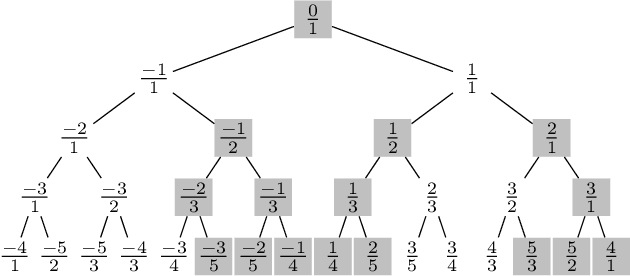
Automata learning has many applications in artificial intelligence and software engineering. Central to these applications is the $L^*$ algorithm, introduced by Angluin. The $L^*$ algorithm learns deterministic finite-state automata (DFAs) in polynomial time when provided with a minimally adequate teacher. Unfortunately, the $L^*$ algorithm can only learn DFAs over finite alphabets, which limits its applicability. In this paper, we extend $L^*$ to learn symbolic automata whose transitions use predicates over rational numbers, i.e., over infinite and dense alphabets. Our result makes the $L^*$ algorithm applicable to new settings like (real) RGX, and time series. Furthermore, our proposed algorithm is optimal in the sense that it asks a number of queries to the teacher that is at most linear with respect to the number of transitions, and to the representation size of the predicates.