 Add to Chrome
 Add to Firefox
 Add to Edge
Consistent and Distinctive: LLM Benchmark Efficiency via Maximum Independent Set Prompt Selection on Similarity Graphs
May 31, 2026
Evaluating large language models (LLMs) across comprehensive benchmarks is expensive and time-consuming. We propose a graph-based prompt selection framework that models each benchmark as a similarity graph -- nodes are prompts connected if their embedding-space distance falls above a configurable threshold -- and applies Maximum Independent Set (MIS) algorithms to select a maximally diverse, non-redundant subset. We evaluate four MIS solvers (CPLEX, GREEDY, Online-MIS, ReduMIS) across six embedding models, three distance measures, six percentile thresholds, and four benchmarks (GPQA, IFEval, MMLU-Pro, Omni-MATH) covering 66 LLMs. Our central hypothesis -- that repeated selection under different random seeds yields consistent LLM rankings that may also differ from the full-benchmark baseline -- is strongly confirmed: Kendall's $W \geq 0.90$ in 99.2\% of stochastic configurations (mean $W = 0.997 \pm 0.008$), while at higher percentile thresholds selected subsets achieve 25--48\% prompt reduction on average. Ranking divergence from the full benchmark ($ρ< 0.95$) occurs in only 15.95\% of configurations, concentrated at low thresholds ($p_{10}$--$p_{20}$) and benchmarks (GPQA, IFEval), identifying overly dense graphs as the primary failure mode.

On Solving the Multiple Variable Gapped Longest Common Subsequence Problem
Apr 19, 2026This paper addresses the Variable Gapped Longest Common Subsequence (VGLCS) problem, a generalization of the classical LCS problem involving flexible gap constraints between consecutive solutions' characters. The problem arises in molecular sequence comparison, where structural distance constraints between residues must be respected, and in time-series analysis where events are required to occur within specified temporal delays. We propose a search framework based on the root-based state graph representation, in which the state space comprises a generally large number of rooted state subgraphs. To cope with the resulting combinatorial explosion, an iterative beam search strategy is employed, dynamically maintaining a global pool of promising candidate root nodes, enabling effective control of diversification across iterations. To exploit the search for high-quality solutions, several known heuristics from the LCS literature are utilized into the standalone beam search procedure. To the best of our knowledge, this is the first comprehensive computational study on the VGLCS problem comprising 320 synthetic instances with up to 10 input sequences and up to 500 characters. Experimental results show robustness of the designed approach over the baseline beam search in comparable runtimes.
A Learning Search Algorithm for the Restricted Longest Common Subsequence Problem
Oct 15, 2024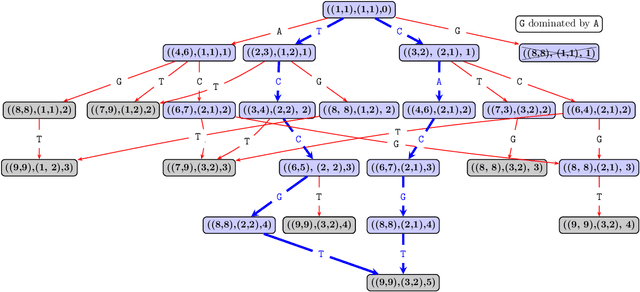
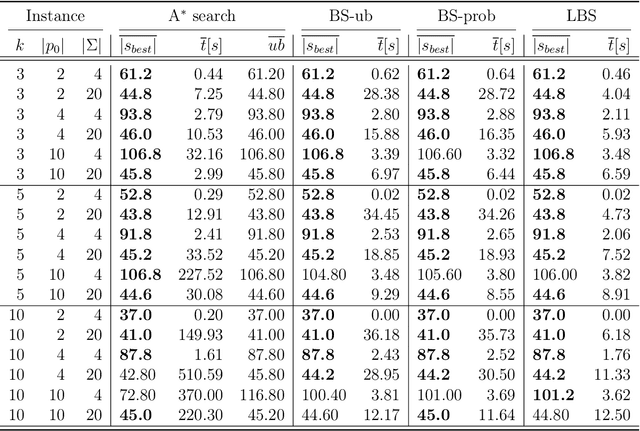
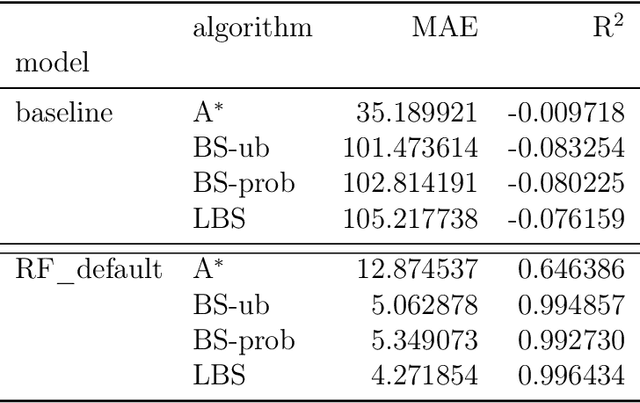
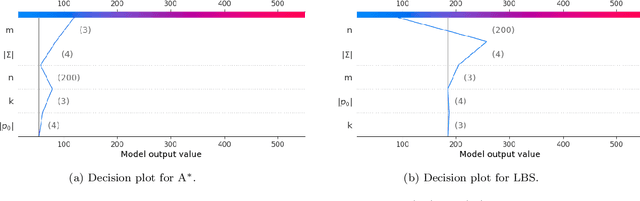
This paper addresses the Restricted Longest Common Subsequence (RLCS) problem, an extension of the well-known Longest Common Subsequence (LCS) problem. This problem has significant applications in bioinformatics, particularly for identifying similarities and discovering mutual patterns and important motifs among DNA, RNA, and protein sequences. Building on recent advancements in solving this problem through a general search framework, this paper introduces two novel heuristic approaches designed to enhance the search process by steering it towards promising regions in the search space. The first heuristic employs a probabilistic model to evaluate partial solutions during the search process. The second heuristic is based on a neural network model trained offline using a genetic algorithm. A key aspect of this approach is extracting problem-specific features of partial solutions and the complete problem instance. An effective hybrid method, referred to as the learning beam search, is developed by combining the trained neural network model with a beam search framework. An important contribution of this paper is found in the generation of real-world instances where scientific abstracts serve as input strings, and a set of frequently occurring academic words from the literature are used as restricted patterns. Comprehensive experimental evaluations demonstrate the effectiveness of the proposed approaches in solving the RLCS problem. Finally, an empirical explainability analysis is applied to the obtained results. In this way, key feature combinations and their respective contributions to the success or failure of the algorithms across different problem types are identified.