 Add to Chrome
 Add to Firefox
 Add to Edge
Cross-Correlation Periodograms with Decaying Noise Floor for Power Spectral Density Estimation
Mar 21, 2026
We present a statistical analysis of a variant of the periodogram method that forms power spectral density estimates by cross-correlating the discrete Fourier transforms of adjacent time windows. The proposed estimator is closely related to cross-power spectral methods and to a technique introduced by Nelson, which has been observed empirically to improve detection of sinusoidal components in noise. We show that, under a white Gaussian noise model, the expected contribution of noise to the proposed estimator is zero and that the estimator is unbiased under certain window alignment conditions. This contrasts with classical estimators where averaging reduces variance but not expected noise. Moreover, we derive closed-form expressions for the variance and prove an upper bound on the expected magnitude of the estimator that decreases as the number of windows increases. This establishes that the proposed method achieves a noise floor that decays with averaging, unlike standard nonparametric spectral estimators. We further analyze the effect of taking the absolute value to enforce nonnegativity, providing bounds on the resulting bias, and show that this bias also decreases with the number of windows. Theoretical results are validated through numerical simulations. We demonstrate the potential sensitivity to phase misalignment and methods of realignment. We also provide empirical evidence that the estimator is robust to other types of noise.

A Nonlinear Sum of Squares Search for CAZAC Sequences
Nov 02, 2022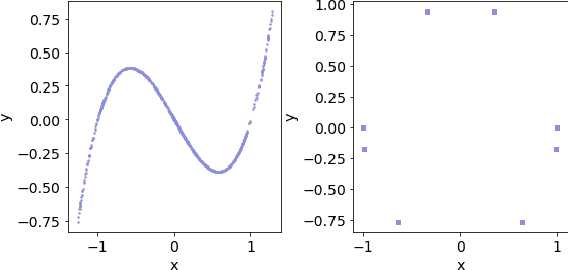
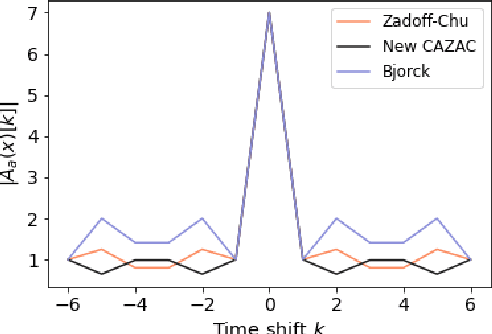
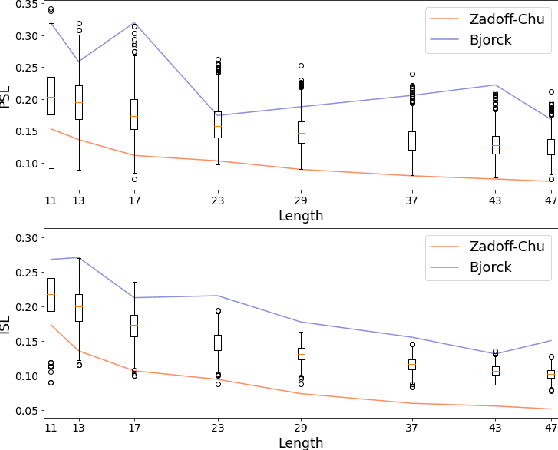
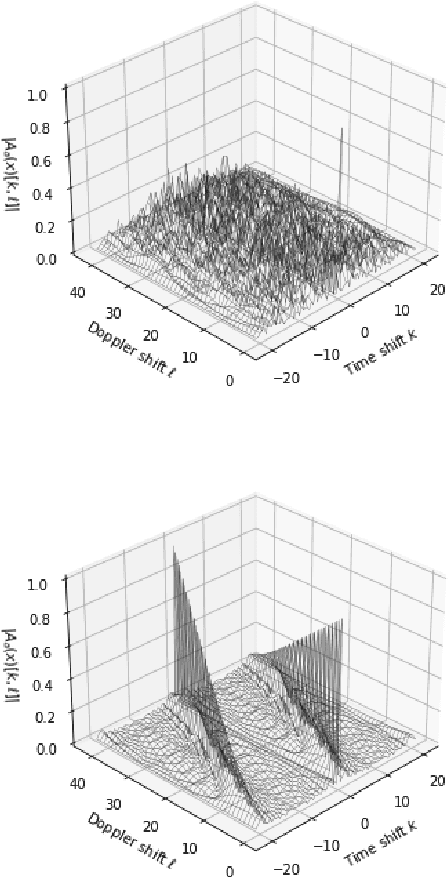
We report on a search for CAZAC sequences by using nonlinear sum of squares optimization. Up to equivalence, we found all length 7 CAZAC sequences. We obtained evidence suggesting there are finitely many length 10 CAZAC sequences with a total of 3040 sequences. Last, we compute longer sequences and compare their aperiodic autocorrelation properties to known sequences. The code and results of this search are publicly available through GitHub.