 Add to Chrome
 Add to Firefox
 Add to Edge
Ufil: A Unified Framework for Infrastructure-based Localization
Apr 23, 2026
Infrastructure-based localization enhances road safety and traffic management by providing state estimates of road users. Development is hindered by fragmented, application-specific stacks that tightly couple perception, tracking, and middleware. We introduce Ufil, a Unified Framework for Infrastructure-Based Localization with a standardized object model and reusable multi-object tracking components. Ufil offers interfaces and reference implementations for prediction, detection, association, state update, and track management, allowing researchers to improve components without reimplementing the pipeline. Ufil is open-source C++/ROS 2 software with documentation and executable examples. We demonstrate Ufil by integrating three heterogeneous data sources into a single localization pipeline combining (i) vehicle onboard units broadcasting ETSI ITS-G5 Cooperative Awareness Messages, (ii) a lidar-based roadside sensor node, and (iii) an in-road sensitive surface layer. The pipeline runs unchanged in the CARLA simulator and a small-scale CAV testbed, demonstrating Ufil's scale-independent execution model. In a three-lane highway scenario with 423 and 355 vehicles in simulation and testbed, respectively, the fused system achieves lane-level lateral accuracy with mean lateral position RMSEs of 0.31 m in CARLA and 0.29 m in the CPM Lab, and mean absolute orientation errors around 2.2°. Median end-to-end latencies from sensing to fused output remain below 100 ms across all modalities in both environments.

Modern Middlewares for Automated Vehicles: A Tutorial
Dec 10, 2024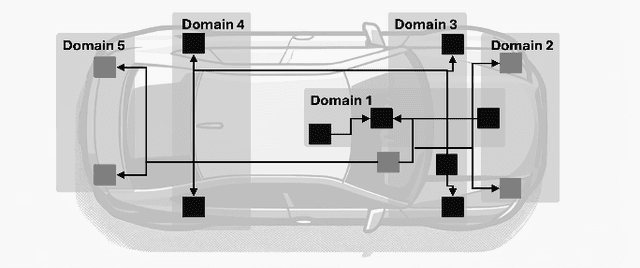
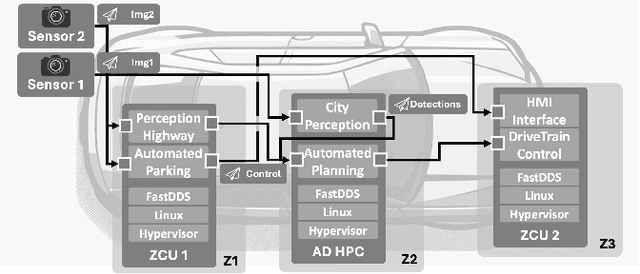
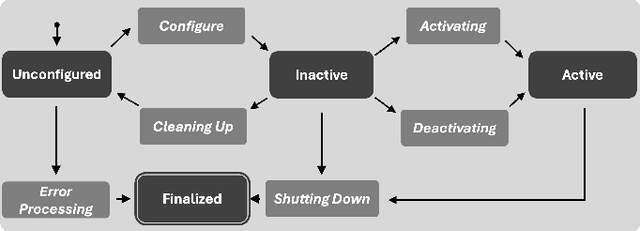
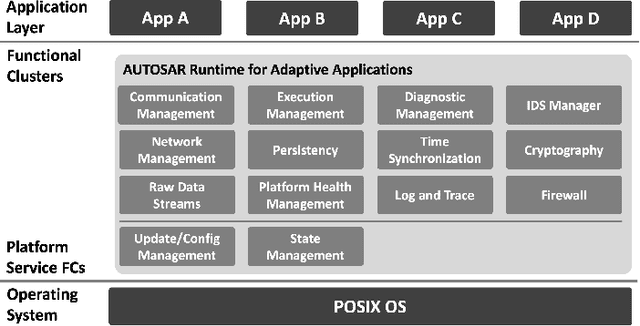
This paper offers a tutorial on current middlewares in automated vehicles. Our aim is to provide the reader with an overview of current middlewares and to identify open challenges in this field. We start by explaining the fundamentals of software architecture in distributed systems and the distinguishing requirements of Automated Vehicles. We then distinguish between communication middlewares and architecture platforms and highlight their key principles and differences. Next, we present five state-of-the-art middlewares as well as their capabilities and functions. We explore how these middlewares could be applied in the design of future vehicle software and their role in the automotive domain. Finally, we compare the five middlewares presented and discuss open research challenges.