 Add to Chrome
 Add to Firefox
 Add to Edge
A Fair and Transparent Framework for Speech-Based Depression Detection: Balancing Interpretability and Performance
Jun 30, 2026
While speech provides rich, non-invasive biomarkers for mental-health assessment, clinical adoption is limited by opaque models and potential demographic bias. In this work we propose a methodological framework to evaluate robustness and interpretability for automated depression detection on the extended DAIC-WOZ dataset using low-complexity machine learning baselines (RF, SVM, and MLP) chosen to mitigate overfitting and enhance generalization in combination with human-understandable acoustic features (MFCCs, eGeMAPS). To balance accuracy with clinical trust, we leverage explainability methods (LIME and SHAP) for feature selection, validating our findings with statistical significance tests and demographic fairness analyses to mitigate spurious, artifact-driven correlations. Empirical results demonstrate that an optimized subset of explainable AI (XAI)-selected features combined with an MLP architecture achieves a state-of-the-art test accuracy of 82\%. Ultimately, this work provides a transparent framework for robust and ethical assistive technologies that can be applied to any other binary task.

Beyond Global Metrics: A Fairness Analysis for Interpretable Voice Disorder Detection Systems
Apr 11, 2025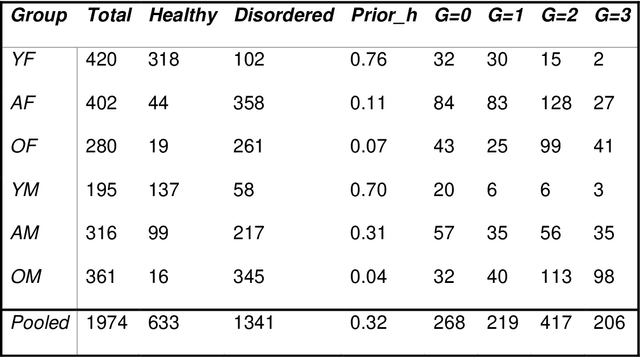
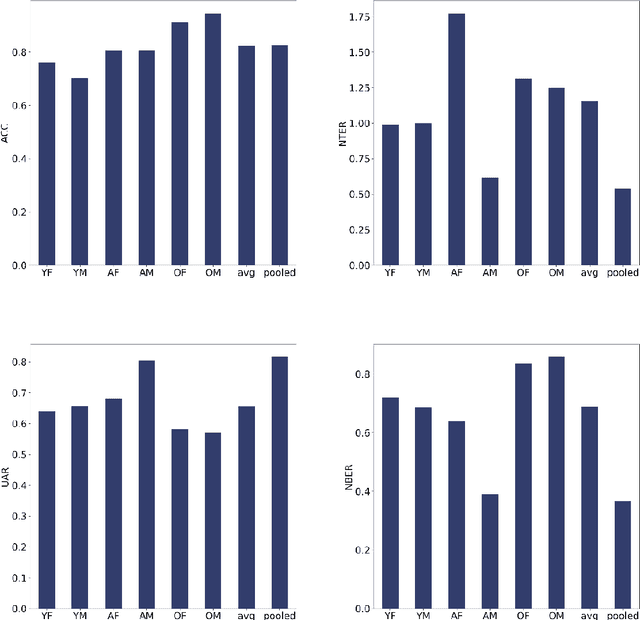
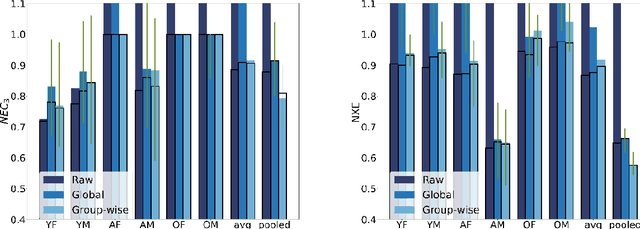
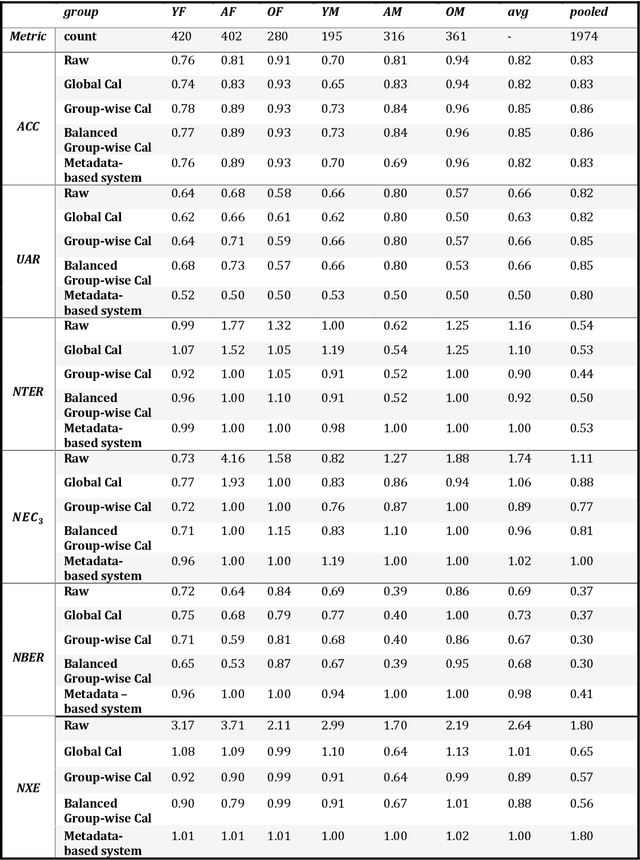
We conducted a comprehensive analysis of an Automatic Voice Disorders Detection (AVDD) system using existing voice disorder datasets with available demographic metadata. The study involved analysing system performance across various demographic groups, particularly focusing on gender and age-based cohorts. Performance evaluation was based on multiple metrics, including normalised costs and cross-entropy. We employed calibration techniques trained separately on predefined demographic groups to address group-dependent miscalibration. Analysis revealed significant performance disparities across groups despite strong global metrics. The system showed systematic biases, misclassifying healthy speakers over 55 as having a voice disorder and speakers with disorders aged 14-30 as healthy. Group-specific calibration improved posterior probability quality, reducing overconfidence. For young disordered speakers, low severity scores were identified as contributing to poor system performance. For older speakers, age-related voice characteristics and potential limitations in the pretrained Hubert model used as feature extractor likely affected results. The study demonstrates that global performance metrics are insufficient for evaluating AVDD system performance. Group-specific analysis may unmask problems in system performance which are hidden within global metrics. Further, group-dependent calibration strategies help mitigate biases, resulting in a more reliable indication of system confidence. These findings emphasize the need for demographic-specific evaluation and calibration in voice disorder detection systems, while providing a methodological framework applicable to broader biomedical classification tasks where demographic metadata is available.
Study on the Fairness of Speaker Verification Systems on Underrepresented Accents in English
Apr 27, 2022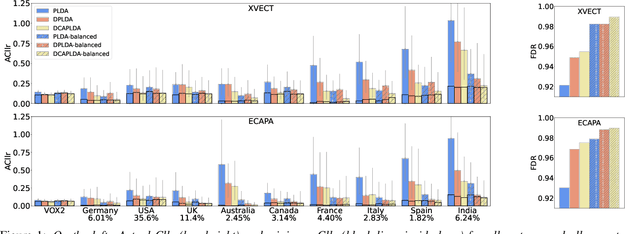
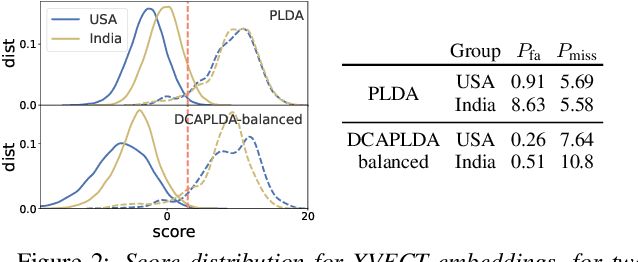
Speaker verification (SV) systems are currently being used to make sensitive decisions like giving access to bank accounts or deciding whether the voice of a suspect coincides with that of the perpetrator of a crime. Ensuring that these systems are fair and do not disfavor any particular group is crucial. In this work, we analyze the performance of several state-of-the-art SV systems across groups defined by the accent of the speakers when speaking English. To this end, we curated a new dataset based on the VoxCeleb corpus where we carefully selected samples from speakers with accents from different countries. We use this dataset to evaluate system performance for several SV systems trained with VoxCeleb data. We show that, while discrimination performance is reasonably robust across accent groups, calibration performance degrades dramatically on some accents that are not well represented in the training data. Finally, we show that a simple data balancing approach mitigates this undesirable bias, being particularly effective when applied to our recently-proposed discriminative condition-aware backend.