 Add to Chrome
 Add to Firefox
 Add to Edge
LOTUSim: Multi-Domain Simulator for Marine Robotics
Jul 03, 2026
Simulation is essential for maritime robotics, supporting operator training, mission rehearsal, and human-vehicle interaction in environments where real-world testing is costly or hazardous. Existing simulators focus primarily on autonomy systems and often lack human-in-the-loop interaction and realistic environmental physics. This paper introduces LOTUSim, an open-source, real-time maritime simulator supporting multi-user interaction across aerial, surface, and underwater robotic systems for coordinated naval-style operations. The first contribution of this work is enabling real-time interactive performance for users while ensuring scalability to large fleets operating within a shared interactive simulation environment. Validation demonstrates robust human-in-the-loop performance, maintaining strict real-time execution and high visual fidelity while scaling to large heterogeneous maritime drone swarms. The second contribution is a computationally efficient, Ekman-inspired layered, underwater current model that captures wind-driven, depth-dependent flow dynamics with sufficient physical fidelity for large-scale simulations. Validation against ocean reanalysis data demonstrates substantially improved accuracy compared to commonly used stochastic Gauss-Markov current models. These results confirm LOTUSim's suitability as a simulation platform for operatorin-the-loop maritime robotics research.

Hybrid Navigation Acceptability and Safety
Apr 18, 2024
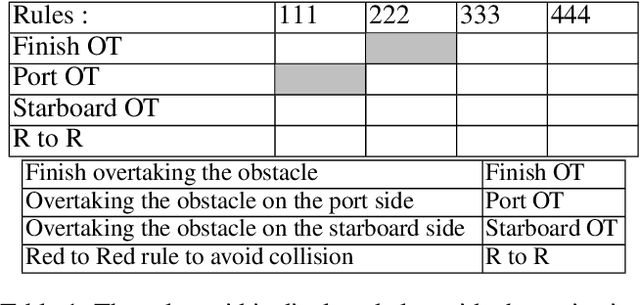
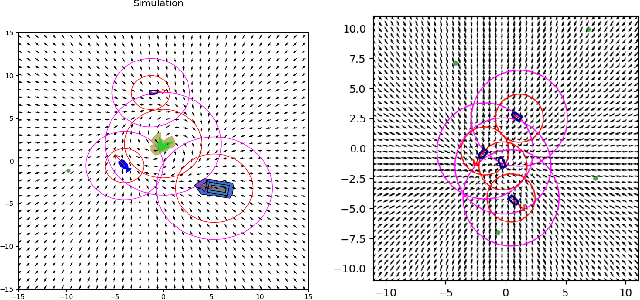

Autonomous vessels have emerged as a prominent and accepted solution, particularly in the naval defence sector. However, achieving full autonomy for marine vessels demands the development of robust and reliable control and guidance systems that can handle various encounters with manned and unmanned vessels while operating effectively under diverse weather and sea conditions. A significant challenge in this pursuit is ensuring the autonomous vessels' compliance with the International Regulations for Preventing Collisions at Sea (COLREGs). These regulations present a formidable hurdle for the human-level understanding by autonomous systems as they were originally designed from common navigation practices created since the mid-19th century. Their ambiguous language assumes experienced sailors' interpretation and execution, and therefore demands a high-level (cognitive) understanding of language and agent intentions. These capabilities surpass the current state-of-the-art in intelligent systems. This position paper highlights the critical requirements for a trustworthy control and guidance system, exploring the complexity of adapting COLREGs for safe vessel-on-vessel encounters considering autonomous maritime technology competing and/or cooperating with manned vessels.