 Add to Chrome
 Add to Firefox
 Add to Edge
Knowledge Knows, Verbalization Tells: Disentangling Latent Directions for Mathematical Solvability in LLMs
Jul 06, 2026
Although LLMs have made significant progress in mathematical reasoning, determining whether a mathematical problem is solvable remains a fundamental yet challenging capability. While recent studies have probed internal representations of model solvability beliefs, verbalization has primarily been studied behaviorally rather than as an internal representation, limiting its analysis and manipulation. We address this gap by separately probing representations of solvability knowledge and verbalization, allowing us to disentangle the two within model hidden states. Across multiple LLMs, we show that knowledge and verbalization are encoded as distinct, linearly decodable representations and that fabrication is primarily associated with changes in verbalization rather than the underlying knowledge. Prompting with unsolvability cues reduces fabrication primarily by shifting verbalization, while activation steering demonstrates that these representations can be echanistically manipulated to improve model abstention.

BloomWise: Enhancing Problem-Solving capabilities of Large Language Models using Bloom's-Taxonomy-Inspired Prompts
Oct 05, 2024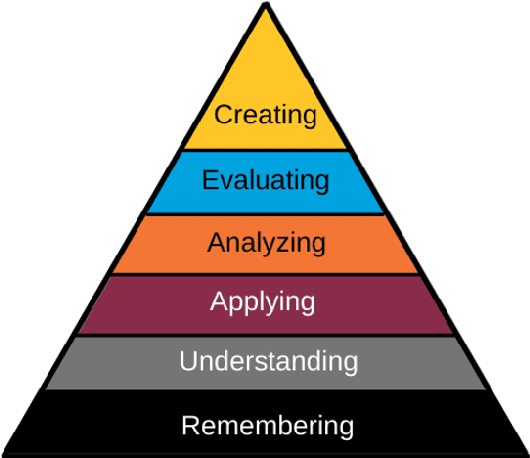

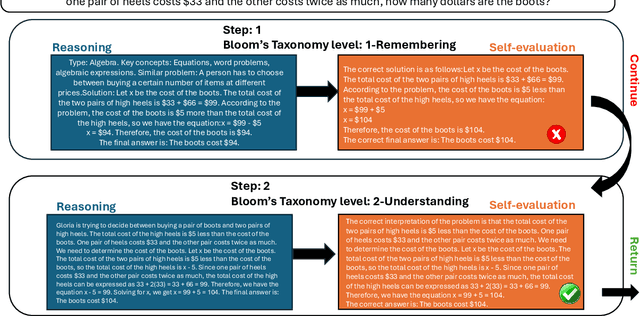

Despite the continuous progress of Large Language Models (LLMs) across various tasks, their performance on mathematical problems and reasoning tasks remains limited. This limitation can be attributed, among other factors, to the inherent difficulty of these problems and the fact that solutions often consist of multiple steps, potentially of varying nature, making it challenging for a single prompting technique to execute all required steps. To address this, we introduce BloomWise, a new prompting technique, inspired by Bloom's Taxonomy, aiming to improve LLMs' performance in solving such problems by encouraging them to approach the problem starting from simple, i.e., remembering, and progressing to higher cognitive skills, i.e., analyzing, until the correct solution is reached. The decision regarding the need to employ more sophisticated cognitive skills is based on self-evaluation performed by the LLM. Thus, we encourage the LLM to deploy the appropriate cognitive processes. In extensive experiments across 4 popular math reasoning datasets, we have demonstrated the effectiveness of our proposed approach. We also present extensive ablations, analyzing the strengths of each module within our system.