 Add to Chrome
 Add to Firefox
 Add to Edge
Subject-Level Unknown-Identity Identification from Leap Motion Controller 2 Hand Landmarks
Jun 22, 2026
This work studies subject recognition from Leap Motion Controller 2 (LMC2) hand landmark data under a subject-level unknown-identity identification protocol on the Multi View Leap2 Hand Pose (ML2HP) dataset. Using only the landmark modality, we retain the original geometric representation and enrich it with fingertip-to-palm distances and palm-normalized inter-finger angular descriptors. Evaluation is performed under a Leave-One-Subject-Out (LOSO) protocol in which, for each outer fold, one subject is excluded from the enrolled set and treated as unknown at test time. To avoid tuning on the true outer unknown subject, the unknown-rejection threshold is selected in an inner validation step by temporarily withholding one enrolled subject from the inner gallery and using it only for threshold estimation. We compare a tree ensemble baseline with two neural alternatives: a learned embedding baseline based on centroid matching and cosine-similarity-based rejection, and an MLP+OpenMax model, which represents a more established open-set recognition approach. Under this evaluation setup, Extra Trees remains the strongest overall method, indicating that the main challenge on this benchmark is not enrolled-subject discrimination alone, but robust score separation between known and unknown probes. The results support the feasibility of compact, interpretable landmark-based descriptors for contactless hand-based unknown-subject rejection and identification on a small-cohort dataset.

Beyond Humans: Multispecies Animal Face Recognition Using Transfer Learning
Jun 08, 2026Individual animal recognition can be useful in the search for lost or stolen pets, the tracking of individuals of endangered species, and the recognition of animals in crowded farms. Present recognition techniques mostly use physical devices, e.g., microchips, often impractical and difficult to apply. These could be replaced by remote recognition via the animal's face; if accurate enough, it provides several advantages: it is non-invasive, can work at a distance, and is difficult to counterfeit, as, for instance, in the case of substituting sick animals for healthy ones in the food industry. The few existing datasets with sufficient per-subject images annotated with a single animal identity are not large enough to train current deep learning architectures. We rather investigate the possibility of transfer learning, exploiting pre-trained network models as backbones. Our experiments compared FaceNet, which is specifically trained on large databases of human faces, with the Vision Transformer (ViT) pre-trained on ImageNet, i.e., on object categories. We used three face datasets of very different animals: dogs, primates (lemurs, golden monkeys, and chimpanzees), and cattle. We report the results and, for each dataset, compare them with the state of the art (SOTA) ad hoc-trained deep networks. The capture conditions differ among the three datasets. Image quality (resolution, motion blur, diverse poses, etc.) decreases from dogs to cattle to primates. The best performance was achieved with dogs, where ViT reached a mean verification accuracy of 96.85% and a Rank-1 Identification Rate of 84.34%. The results for endangered primates are still encouraging, but performance varies across animal classes and tasks (verification or identification), and does not always outperform SOTA. For cattle, the ViT results outperform SOTA, while FaceNet is still competitive.
Visual Question Answering: which investigated applications?
Mar 04, 2021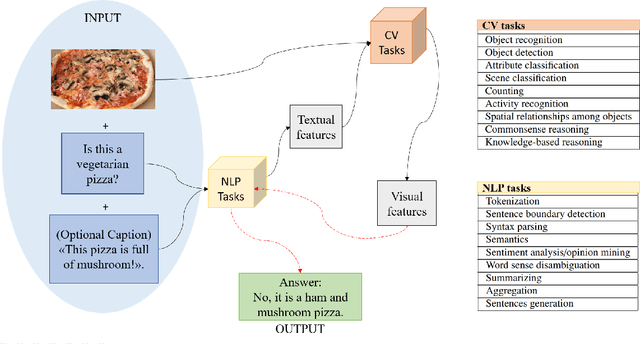
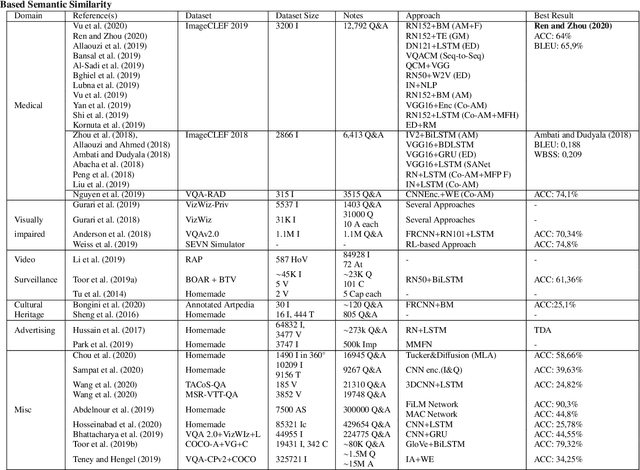
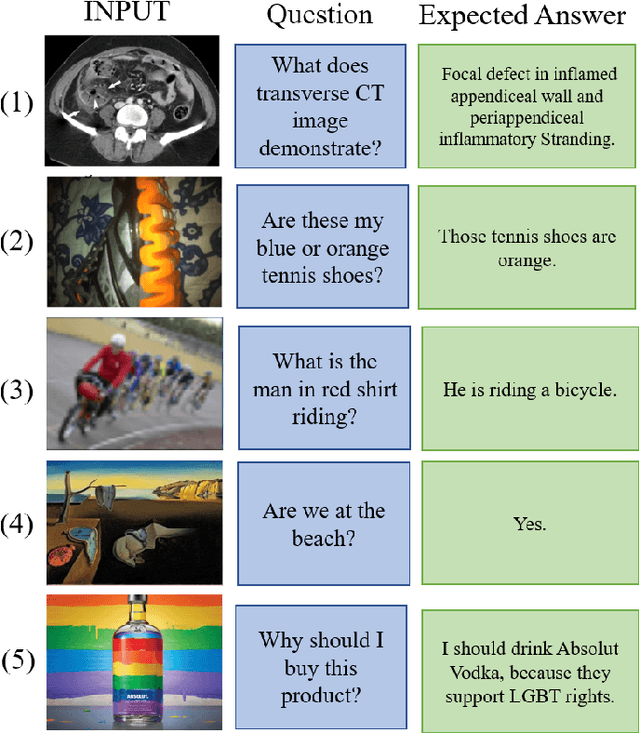
Visual Question Answering (VQA) is an extremely stimulating and challenging research area where Computer Vision (CV) and Natural Language Processig (NLP) have recently met. In image captioning and video summarization, the semantic information is completely contained in still images or video dynamics, and it has only to be mined and expressed in a human-consistent way. Differently from this, in VQA semantic information in the same media must be compared with the semantics implied by a question expressed in natural language, doubling the artificial intelligence-related effort. Some recent surveys about VQA approaches have focused on methods underlying either the image-related processing or the verbal-related one, or on the way to consistently fuse the conveyed information. Possible applications are only suggested, and, in fact, most cited works rely on general-purpose datasets that are used to assess the building blocks of a VQA system. This paper rather considers the proposals that focus on real-world applications, possibly using as benchmarks suitable data bound to the application domain. The paper also reports about some recent challenges in VQA research.