 Add to Chrome
 Add to Firefox
 Add to Edge
Quantum-Inspired Robust and Scalable SAR Object Classification
Apr 28, 2026
SAR image classification naturally has to deal with huge noise and a high dynamic range particularly requiring robust classification models. Additionally, the deployment of these models on edge devices, such as drones and military aircraft, requires a careful balance between model size and classification accuracy. This study explores the potential of tensor networks to meet these robustness requirements, specifically evaluating their resilience to data poisoning. Unlike previous works that concentrated on conventional neural networks for SAR object detection, this research focuses on the robustness and model reduction capabilities of tensor networks in object classification. Our findings indicate that tensor networks are adept at addressing both the challenges of robustness and the need for model efficiency, thereby contributing valuable insights to the ongoing discourse in radar applications and deep learning methodologies in general.

Ultra-low latency quantum-inspired machine learning predictors implemented on FPGA
Sep 25, 2024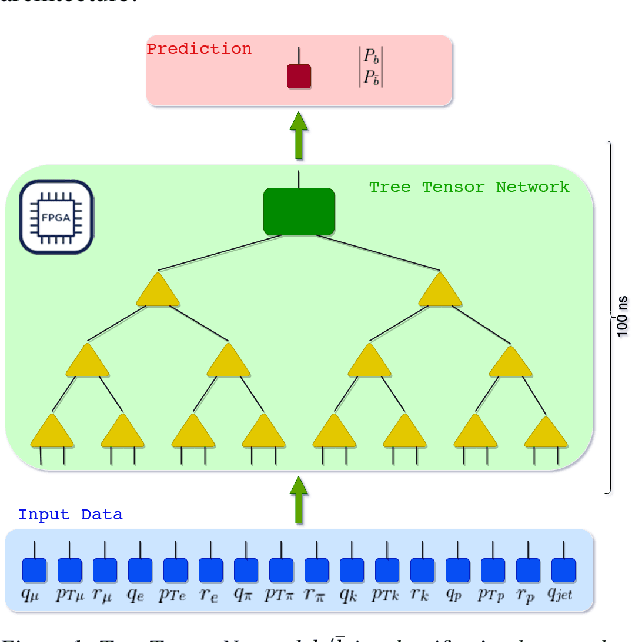
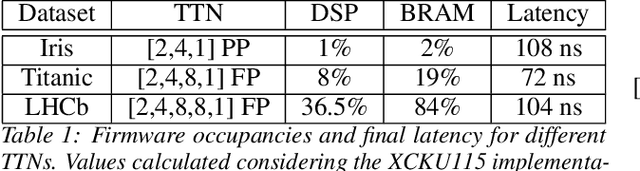
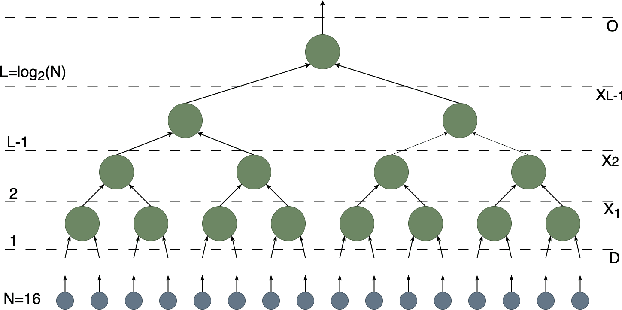
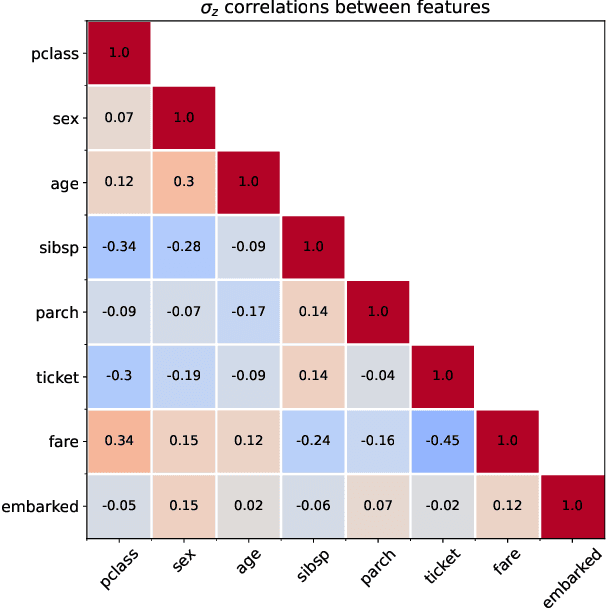
Tensor Networks (TNs) are a computational paradigm used for representing quantum many-body systems. Recent works have shown how TNs can also be applied to perform Machine Learning (ML) tasks, yielding comparable results to standard supervised learning techniques. In this work, we study the use of Tree Tensor Networks (TTNs) in high-frequency real-time applications by exploiting the low-latency hardware of the Field-Programmable Gate Array (FPGA) technology. We present different implementations of TTN classifiers, capable of performing inference on classical ML datasets as well as on complex physics data. A preparatory analysis of bond dimensions and weight quantization is realized in the training phase, together with entanglement entropy and correlation measurements, that help setting the choice of the TTN architecture. The generated TTNs are then deployed on a hardware accelerator; using an FPGA integrated into a server, the inference of the TTN is completely offloaded. Eventually, a classifier for High Energy Physics (HEP) applications is implemented and executed fully pipelined with sub-microsecond latency.
Quantum-inspired Machine Learning on high-energy physics data
Apr 28, 2020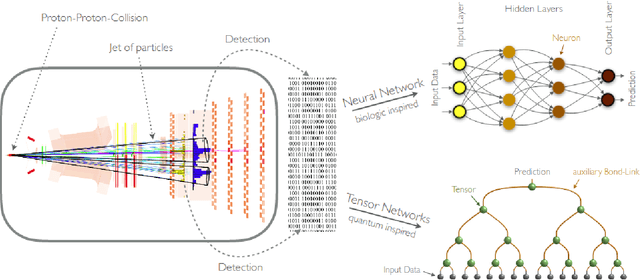
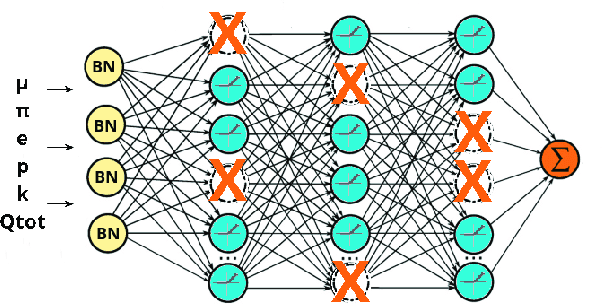
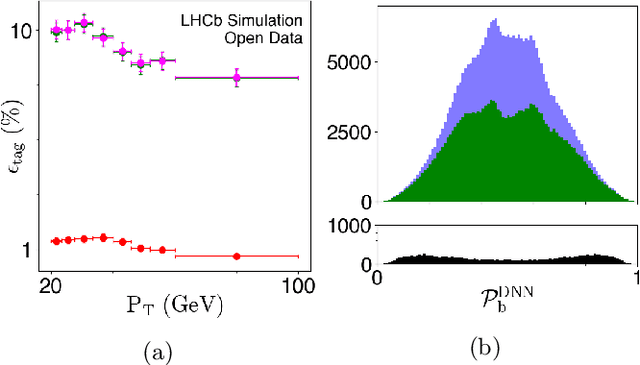
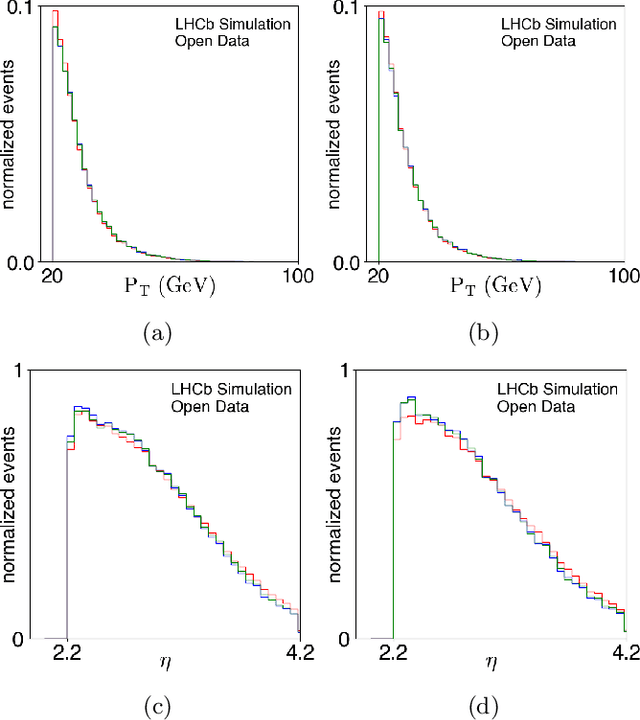
One of the most challenging big data problems in high energy physics is the analysis and classification of the data produced by the Large Hadron Collider at CERN. Recently, machine learning techniques have been employed to tackle such challenges, which, despite being very effective, rely on classification schemes that are hard to interpret. Here, we introduce and apply a quantum-inspired machine learning technique and, exploiting tree tensor networks, we show how to efficiently classify b-jet events in proton-proton collisions at LHCb and to interpret the classification results. In particular, we show how to select important features and adapt the network geometry based on information acquired in the learning process. Moreover, the tree tensor network can be adapted for optimal precision or fast response in time without the need for repeating the learning process. This paves the way to high-frequency real-time applications as needed for current and future LHC event classification to trigger events at the tens of MHz scale.