 Add to Chrome
 Add to Firefox
 Add to Edge
MeltwaterBench: Deep learning for spatiotemporal downscaling of surface meltwater
Dec 13, 2025
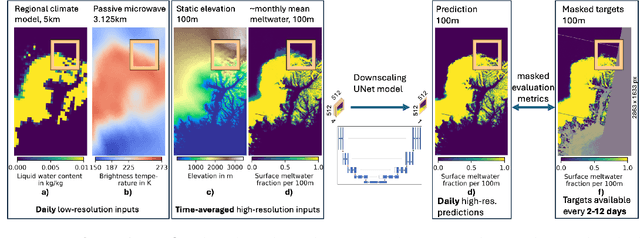
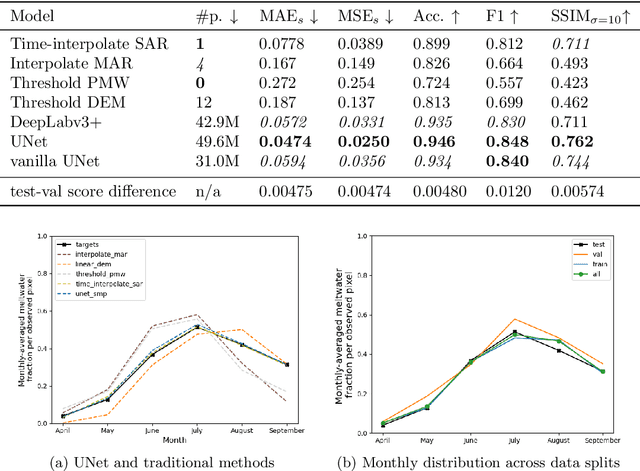
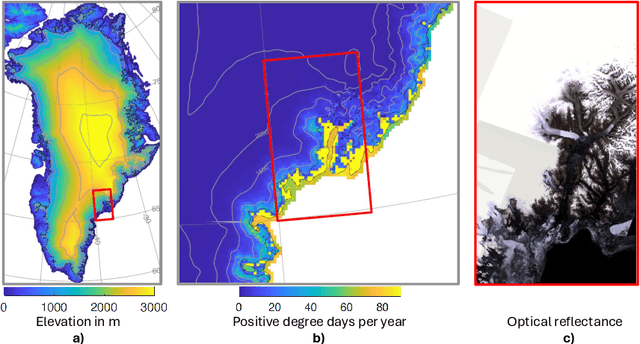
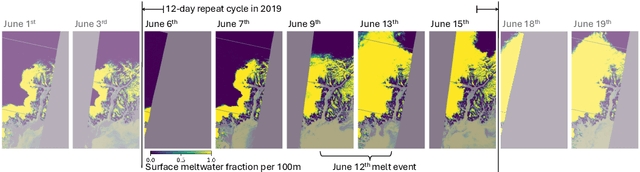
The Greenland ice sheet is melting at an accelerated rate due to processes that are not fully understood and hard to measure. The distribution of surface meltwater can help understand these processes and is observable through remote sensing, but current maps of meltwater face a trade-off: They are either high-resolution in time or space, but not both. We develop a deep learning model that creates gridded surface meltwater maps at daily 100m resolution by fusing data streams from remote sensing observations and physics-based models. In particular, we spatiotemporally downscale regional climate model (RCM) outputs using synthetic aperture radar (SAR), passive microwave (PMW), and a digital elevation model (DEM) over the Helheim Glacier in Eastern Greenland from 2017-2023. Using SAR-derived meltwater as "ground truth", we show that a deep learning-based method that fuses all data streams is over 10 percentage points more accurate over our study area than existing non deep learning-based approaches that only rely on a regional climate model (83% vs. 95% Acc.) or passive microwave observations (72% vs. 95% Acc.). Alternatively, creating a gridded product through a running window calculation with SAR data underestimates extreme melt events, but also achieves notable accuracy (90%) and does not rely on deep learning. We evaluate standard deep learning methods (UNet and DeepLabv3+), and publish our spatiotemporally aligned dataset as a benchmark, MeltwaterBench, for intercomparisons with more complex data-driven downscaling methods. The code and data are available at $\href{https://github.com/blutjens/hrmelt}{github.com/blutjens/hrmelt}$.

Flood Event Extraction from News Media to Support Satellite-Based Flood Insurance
Dec 05, 2023Floods cause large losses to property, life, and livelihoods across the world every year, hindering sustainable development. Safety nets to help absorb financial shocks in disasters, such as insurance, are often unavailable in regions of the world most vulnerable to floods, like Bangladesh. Index-based insurance has emerged as an affordable solution, which considers weather data or information from satellites to create a "flood index" that should correlate with the damage insured. However, existing flood event databases are often incomplete, and satellite sensors are not reliable under extreme weather conditions (e.g., because of clouds), which limits the spatial and temporal resolution of current approaches for index-based insurance. In this work, we explore a novel approach for supporting satellite-based flood index insurance by extracting high-resolution spatio-temporal information from news media. First, we publish a dataset consisting of 40,000 news articles covering flood events in Bangladesh by 10 prominent news sources, and inundated area estimates for each division in Bangladesh collected from a satellite radar sensor. Second, we show that keyword-based models are not adequate for this novel application, while context-based classifiers cover complex and implicit flood related patterns. Third, we show that time series extracted from news media have substantial correlation Spearman's rho$=0.70 with satellite estimates of inundated area. Our work demonstrates that news media is a promising source for improving the temporal resolution and expanding the spatial coverage of the available flood damage data.