 Add to Chrome
 Add to Firefox
 Add to Edge
SchemaLink: An Intelligent Web Editor for LinkML Schema Curation
Aug 12, 2026
Motivation: LinkML is a suitable language for the representation of the structural and content constraints of different kinds of biomedical data. Even if it is a quite recent proposal, it has been applied in several biomedical contexts. Developing and maintaining LinkML schemas presents several challenges, particularly for novice curators. Non-expert bio-curators may struggle with LinkML syntax and best practices, requiring significant time and effort to develop well-structured schemas. Results: In this paper we propose SchemaLink, a web-based environment for the graphical construction and enhancement of LinkML schemas that address the following requirements: $(i)$ introduce a graphical language for the specification of LinkML schemas, $(ii)$ make uniform the specification of schemas in similar contexts, $(iii)$ simplify the design and curation processes by exploiting a RAG-based approach to assist curators in creating new schemas from scratch and editing already developed ones. Several experimental analyses show the quality of the produced LinkML schemas through the AI-based editing facilities. Availability and Implementation: SchemaLink is available online at: https://SchemaLink.biodata.di.unimi.it. SchemaLink code and testing data are available as open-source on GitHub at: https://github.com/AnacletoLAB/{schemalink-webapp,schemalink-api}.

Plausibility-Driven Prioritization of Candidate Biomedical Annotations
Jul 22, 2026The rapid growth of biomedical knowledge has made the validation of automatically generated biological annotations a major bottleneck in biomedical curation. While computational methods can rapidly produce large numbers of candidate annotations, determining which are biologically valid still requires costly expert review. Prioritizing these candidates before manual curation has therefore become a fundamental challenge. Machine learning techniques can support this process by exploiting biomedical knowledge graphs (bioKGs), which capture biological entities and their functional associations. In this work, we propose a framework that leverages bioKGs to estimate the plausibility of candidate annotations and guide expert curation. Starting from knowledge graph embeddings, we train relation-specific binary classifiers using a community-based negative sampling strategy to obtain reliable confidence estimates. We then introduce a family of plausibility measures that combine classifier confidence, classifier reliability, and the semantic context provided by alternative relationships involving the same pair of biological entities. Unlike conventional confidence estimation, the proposed approach explicitly accounts for multiple biologically meaningful relations that may coexist between the same entities. Experimental results on five large bioKGs demonstrate that the proposed negative sampling strategy consistently improves classifier robustness, increasing balanced accuracy by an average of 5.8%. Moreover, the plausibility measures outperform classifier confidence alone, enabling more effective prioritization of candidate annotations for expert review. Overall, our results show that the use of bioKGs improves the efficiency of AI-assisted biomedical curation while preserving expert control over the final annotation assessment.
RNA-KG: An ontology-based knowledge graph for representing interactions involving RNA molecules
Nov 30, 2023The "RNA world" represents a novel frontier for the study of fundamental biological processes and human diseases and is paving the way for the development of new drugs tailored to the patient's biomolecular characteristics. Although scientific data about coding and non-coding RNA molecules are continuously produced and available from public repositories, they are scattered across different databases and a centralized, uniform, and semantically consistent representation of the "RNA world" is still lacking. We propose RNA-KG, a knowledge graph encompassing biological knowledge about RNAs gathered from more than 50 public databases, integrating functional relationships with genes, proteins, and chemicals and ontologically grounded biomedical concepts. To develop RNA-KG, we first identified, pre-processed, and characterized each data source; next, we built a meta-graph that provides an ontological description of the KG by representing all the bio-molecular entities and medical concepts of interest in this domain, as well as the types of interactions connecting them. Finally, we leveraged an instance-based semantically abstracted knowledge model to specify the ontological alignment according to which RNA-KG was generated. RNA-KG can be downloaded in different formats and also queried by a SPARQL endpoint. A thorough topological analysis of the resulting heterogeneous graph provides further insights into the characteristics of the "RNA world". RNA-KG can be both directly explored and visualized, and/or analyzed by applying computational methods to infer bio-medical knowledge from its heterogeneous nodes and edges. The resource can be easily updated with new experimental data, and specific views of the overall KG can be extracted according to the bio-medical problem to be studied.
An Open-Source Knowledge Graph Ecosystem for the Life Sciences
Jul 11, 2023


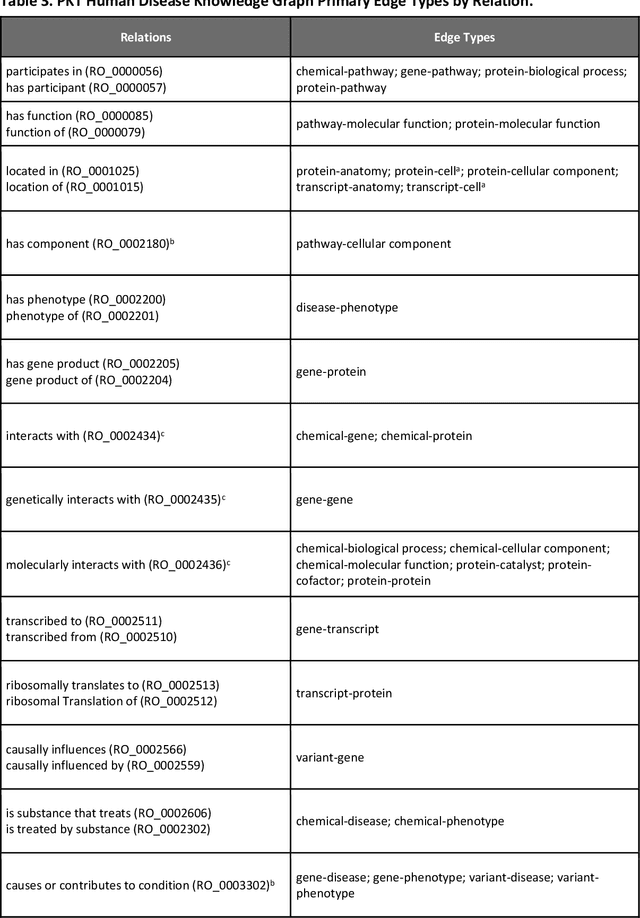
Translational research requires data at multiple scales of biological organization. Advancements in sequencing and multi-omics technologies have increased the availability of these data but researchers face significant integration challenges. Knowledge graphs (KGs) are used to model complex phenomena, and methods exist to automatically construct them. However, tackling complex biomedical integration problems requires flexibility in the way knowledge is modeled. Moreover, existing KG construction methods provide robust tooling at the cost of fixed or limited choices among knowledge representation models. PheKnowLator (Phenotype Knowledge Translator) is a semantic ecosystem for automating the FAIR (Findable, Accessible, Interoperable, and Reusable) construction of ontologically grounded KGs with fully customizable knowledge representation. The ecosystem includes KG construction resources (e.g., data preparation APIs), analysis tools (e.g., SPARQL endpoints and abstraction algorithms), and benchmarks (e.g., prebuilt KGs and embeddings). We evaluate the ecosystem by surveying open-source KG construction methods and analyzing its computational performance when constructing 12 large-scale KGs. With flexible knowledge representation, PheKnowLator enables fully customizable KGs without compromising performance or usability.