 Add to Chrome
 Add to Firefox
 Add to Edge
A Unified Maximum-Likelihood Framework for 3D InISAR Phase Unwrapping with Outlier Rejection
May 27, 2026
This paper presents a novel mathematical framework for phase unwrapping in three-dimensional interferometric ISAR (3D InISAR) imaging. The approach works on a scatterer-by-scatterer basis and does not rely on any spatial continuity assumptions, making it suitable for sparse point clouds. The formulation is derived from the Mixed-Integer Least Squares (MILS) theory, an optimal maximum-likelihood framework for joint estimation of integer and real unknowns in the presence of Gaussian noise. This provides a unified way to handle generic sensor geometries, multi-baseline, multi-frequency, or hybrid setups. The method also produces a natural a posteriori quality metric for each unwrapped phase, which can be used to build a statistical test to reject outliers. The algorithm is simple to implement and has a computational cost suitable for operational systems. This paper presents the theoretical foundations of the framework and a first validation study on a standard L-shaped dual-frequency setup using Monte Carlo simulations. Results show that the proposed framework enables reliable 3D reconstruction in challenging ambiguity conditions.

A Comprehensive Survey of Machine Learning Applied to Radar Signal Processing
Sep 29, 2020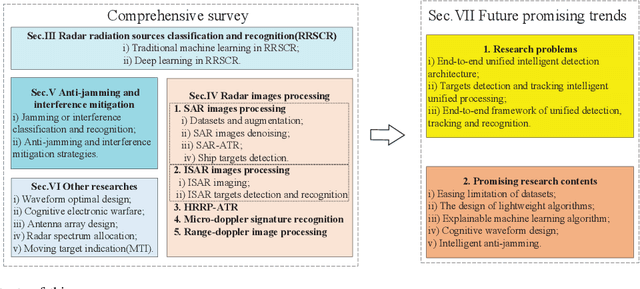
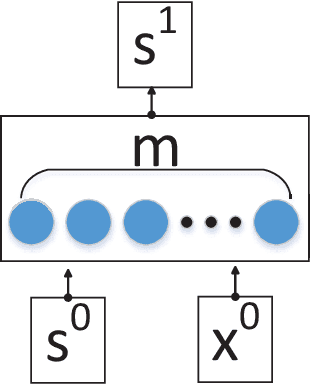
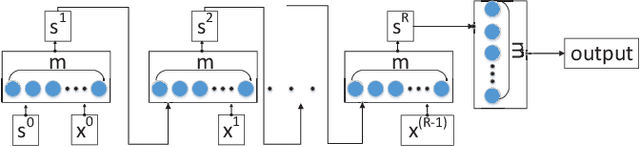
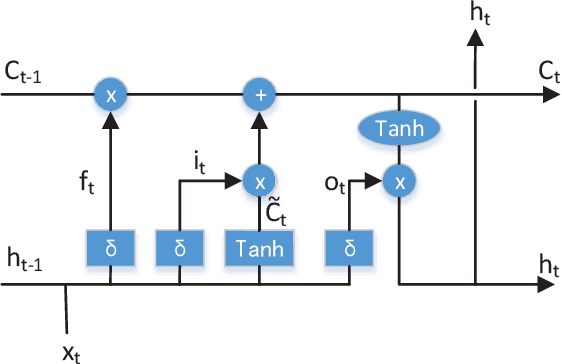
Modern radar systems have high requirements in terms of accuracy, robustness and real-time capability when operating on increasingly complex electromagnetic environments. Traditional radar signal processing (RSP) methods have shown some limitations when meeting such requirements, particularly in matters of target classification. With the rapid development of machine learning (ML), especially deep learning, radar researchers have started integrating these new methods when solving RSP-related problems. This paper aims at helping researchers and practitioners to better understand the application of ML techniques to RSP-related problems by providing a comprehensive, structured and reasoned literature overview of ML-based RSP techniques. This work is amply introduced by providing general elements of ML-based RSP and by stating the motivations behind them. The main applications of ML-based RSP are then analysed and structured based on the application field. This paper then concludes with a series of open questions and proposed research directions, in order to indicate current gaps and potential future solutions and trends.