 Add to Chrome
 Add to Firefox
 Add to Edge
Dynamic Accuracy Estimation in a Wi-Fi-based Positioning System
Jan 02, 2026
The paper presents a concept of a dynamic accuracy estimation method, in which the localization errors are derived based on the measurement results used by the positioning algorithm. The concept was verified experimentally in a Wi\nobreakdash-Fi based indoor positioning system, where several regression methods were tested (linear regression, random forest, k-nearest neighbors, and neural networks). The highest positioning error estimation accuracy was achieved for random forest regression, with a mean absolute error of 0.72 m.
* Originally presented at 2025 33rd Telecommunications Forum (TELFOR), Belgrade, Serbia

ML-based Short Physical Performance Battery future score prediction based on questionnaire data
Aug 07, 2025Effective slowing down of older adults\' physical capacity deterioration requires intervention as soon as the first symptoms surface. In this paper, we analyze the possibility of predicting the Short Physical Performance Battery (SPPB) score at a four-year horizon based on questionnaire data. The ML algorithms tested included Random Forest, XGBoost, Linear Regression, dense and TabNet neural networks. The best results were achieved for the XGBoost (mean absolute error of 0.79 points). Based on the Shapley values analysis, we selected smaller subsets of features (from 10 to 20) and retrained the XGBoost regressor, achieving a mean absolute error of 0.82.
The Use of MEMS Accelerometers for Remote Activity and Living Parameters Monitoring
Apr 07, 2024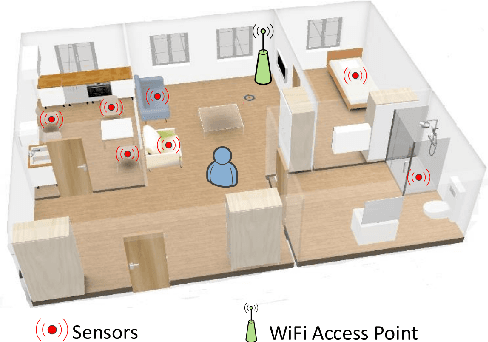
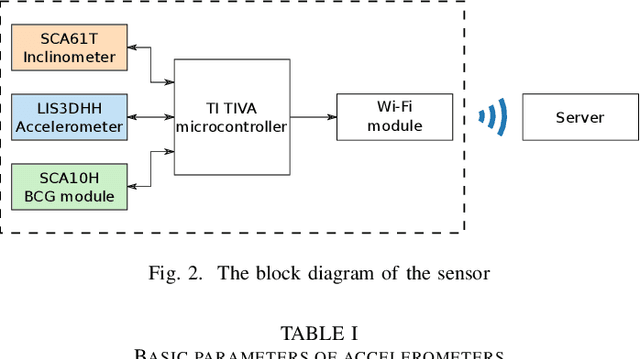
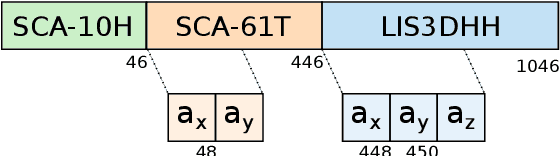

In the paper a ballistocardiographic sensor for remote monitoring of activity and vital parameters is presented. The sensor is mainly intended for use in monitoring systems supporting care of older people. It allows to detect occupancy of a piece of furniture, to which it is attached and to estimate basic vital parameters (heart and respiration rates) of the monitored person. The presented device includes three inertial sensors: two accelerometers of different parameters and prices and one reference BCG module. The device sends the measurement results to the external server over WiFi. The vital parameters are estimated based on the Continuous Wavelet Transform of the registered acceleration signals. User's presence is detected by tracking changes in acceleration measured in axes parallel to the ground.
Adaptive Anchor Pairs Selection in a TDOA-based System Through Robot Localization Error Minimization
Apr 07, 2024The following paper presents an adaptive anchor pairs selection method for ultra-wideband (UWB) Time Difference of Arrival (TDOA) based positioning systems. The method divides the area covered by the system into several zones and assigns them anchor pair sets. The pair sets are determined during calibration based on localization root mean square error (RMSE). The calibration assumes driving a mobile platform equipped with a LiDAR sensor and a UWB tag through the specified zones. The robot is localized separately based on a large set of different TDOA pairs and using a LiDAR, which acts as the reference. For each zone, the TDOA pairs set for which the registered RMSE is lowest is selected and used for localization in the routine system work. The proposed method has been tested with simulations and experiments. The results for both simulated static and experimental dynamic scenarios have proven that the adaptive selection of the anchor nodes leads to an increase in localization accuracy. In the experiment, the median trajectory error for a moving person localization was at a level of 25 cm.
Comparison of Extended and Unscented Kalman Filters Performance in a Hybrid BLE-UWB Localization System
Apr 03, 2024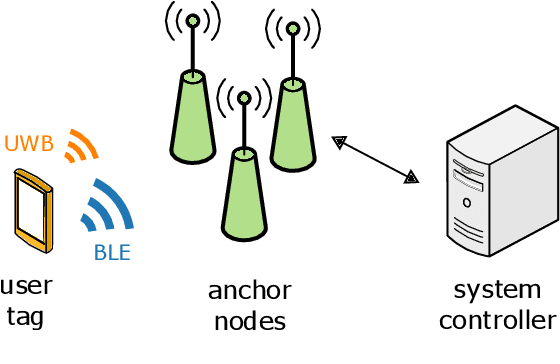

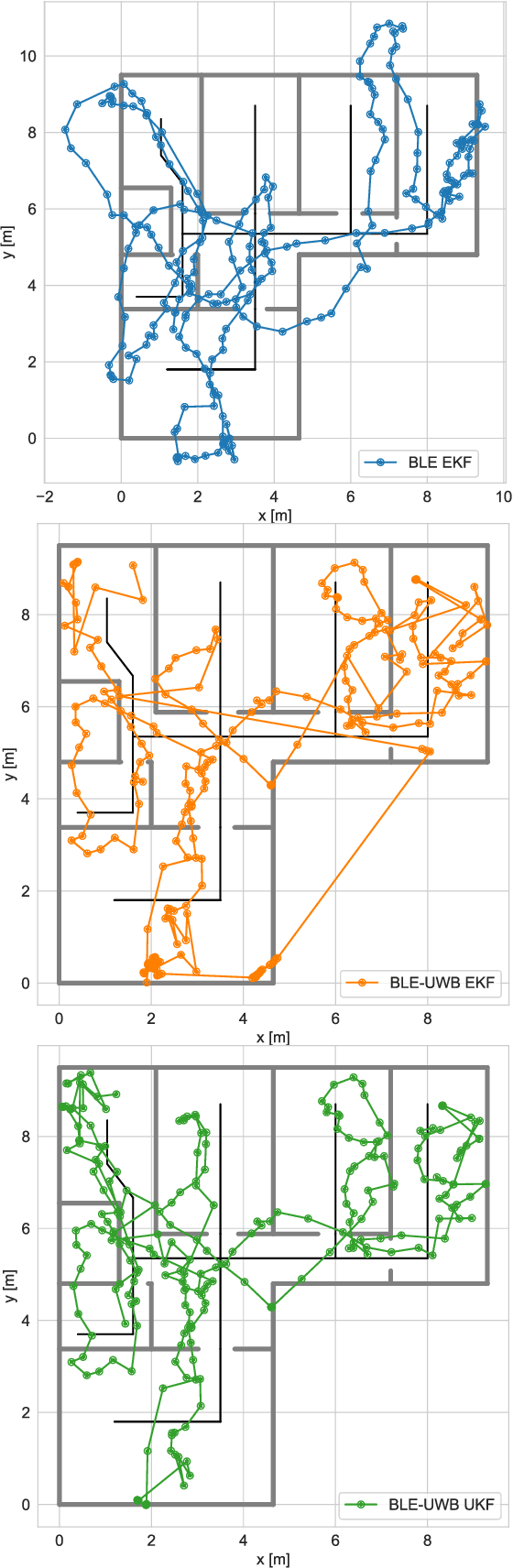
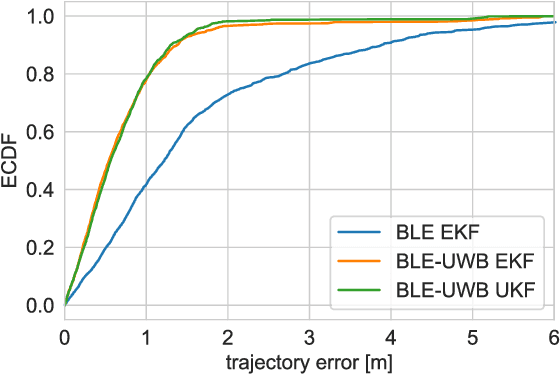
The paper presents a comparison of performance of two Kalman Filters: extended Kalman filter (EKF) and unscented Kalman filter (UKF) in a hybrid Bluetooth-Low-Energy-ultra-wideband (BLE-UWB) based localization system. In the system, the user is localized primarily based on Received Signal Strength (RSS) measurements of BLE signals. The UWB part of the system is periodically used to improve localization accuracy by supplying the algorithm with measured UWB packets time difference of arrival (TDOA). The proposed scheme was experimentally validated using two algorithms: the EKF and the UKF. The localization accuracy of both algorithms is compared.
A Hybrid BLE/UWB Localization Technique with Automatic Radio Map Creation
Apr 03, 2024Localization systems intended for home use by people with mild cognitive impairment should comply with specific requirements. They should provide the users with sub-meter accuracy allowing for analyzing patient's movement trajectory and be energy effective, so the devices do not need frequent charging. Such requirements could be satisfied by employing a hybrid positioning system combining accurate UWB with energy efficient Bluetooth Low Energy (BLE) technology. In the paper, such a solution is presented and experimentally verified. In the proposed system, user's location is derived using BLE based fingerprinting. A radio map utilized by the algorithm is created automatically during system operation with the support of UWB subsystem. Such an approach allows the users to repeat system calibration as often as possible, which raises systems resistance to environmental changes.
Kalman filter based localization in hybrid BLE-UWB positioning system
Apr 02, 2024In this paper a concept of hybrid Bluetooth Low Energy (BLE) Ultra-wideband (UWB) positioning system is presented. The system is intended to be energy efficient. Low energy BLE unit is used as a primary source of measurement data and for most of the time localization is calculated based on received signal strength (RSS). UWB technology is used less often. Time difference of arrival (TDOA) values measured with UWB radios are periodically used to improve RSS based localization. The paper contains a description of proposed hybrid positioning algorithm. Results of simulations and experiments confirming algorithm's efficiency are also included.
Utilizing acceleration measurements to improve TDOA based localization
Mar 28, 2024In this paper localization using UWB positioning system and an inertial unit containing a single accelerometer is considered. The main part of the paper describes a novel algorithm for person localization. The algorithm is based on modified Extended Kalman Filter and utilizes TDOA (Time Difference of Arrival) results obtained from UWB system and results of acceleration measurement performed by the localized tag device. The proposed algorithm has been experimentally investigated through simulation and experiments. The results are included in the paper.
* Originally presented at 2017 Signal Processing Symposium (SPSympo), Jachranka, Poland
Monitoring Wandering Behavior of Persons Suffering from Dementia Using BLE Based Localization System
Mar 22, 2024With the aging of our populations, dementia will become a problem which would directly or indirectly affect a large number of people. One of the most dangerous dementia symptoms is wandering. It consists in aimless walking and spatial disorientation, which might lead to various unpleasant situations like falling down accidents at home to leaving the living place and going missing. Therefore, in order to ensure elderly people's safety it is crucial to detect and alarm the caregivers in case of such incidents. It can be done by tracking the sufferers movements and detecting signs of repetitiveness. The paper presents the results of the study, in which the wandering behavior of people suffering from dementia was monitored using a Bluetooth Low Energy based positioning system. The paper includes the description of the system used for patients localization and the results of the tests performed in a long term care facility.
Improving BLE Based Localization Accuracy Using Proximity Sensors
Mar 22, 2024Bluetooth Low Energy systems are one of the most popular solutions used for indoor localization. Unfortunately their accuracy might not be sufficient for some of the applications. One way to reduce localization errors is hybrid positioning, which combines measurement results obtained with different techniques. The paper describes a concept of a hybrid localization system in which Bluetooth Low Energy technology is supported with the use of laser proximity sensors. Results from both system parts are fused using a novel, simple positioning algorithm. The proposed system concept was tested using BLE and proximity sensors evaluation boards.
* Originally presented at 2018 26th Telecommunication Forum (TELFOR), Belgrade, Serbia. An extended version of the article was published in MDPI Applied Sciences https://doi.org/10.3390/app9194081