 Add to Chrome
 Add to Firefox
 Add to Edge
A Case Study on the Acceptance of a Humanoid Robotic Head Employed in Three Public Spaces
Jul 27, 2026
Previous research has shown that a human-like robot's acceptance heavily depends on the setting in which it operates and its ability to perform relevant tasks. This paper, first, reports on how our robot processes natural language to generate a multimodal, verbal response integrating emotional expressions based on an emotion simulation backend. Then, it describes how visitors were invited to speak with our robot in their own language at three different, public locations, where the robot was running continuously for several days. The TAM2 questionnaire results reveal that on average users were motivated to use the robot and found it rather useful and easy to use regardless of the specific location. However, public spaces like the tourist information and the city library seem to be a better fit for our interactive, robotic head than an office environment such as the building authority, where the willingness to interact was lower. Overall, the robot's multi-lingual responses were very much appreciated, but every fifth user found the response time too slow impeding the dialog flow, which remains to be improved in future work.

Not Forgotten: Implementation and Evaluation of a Personalized Episodic Memory for the Humanoid Robot Head Kim
Jul 27, 2026Social robots that rely on large language models for conversation are unable to retain information across sessions. This absence of memory violates social expectations, potentially preventing the formation of persistent relationships. This paper presents a lightweight episodic memory module that integrates vector-based semantic retrieval with an LLM-controlled dialog system, deployed on the humanoid robot head Kim. The module employs a hybrid scoring function combining cosine similarity with a memory strength metric to retrieve contextually relevant past interactions and inject them into the generation prompt. The system was evaluated in a within-subjects video-based online study (N = 43) using the Human-Robot Interaction Evaluation Scale (HRIES). Results show that episodic memory significantly increased perceived sociability (d = 0.60, p < .001), with the strongest effects on perceived trustworthiness (d = 0.62) and warmth (d = 0.56). Perceived disturbance remained unchanged (d = 0.00), indicating that the implemented approach to personalized recall did not trigger privacy-related discomfort or uncanny valley effects. These findings suggest that episodic memory serves as a social lubricant in embodied Human-Robot Interaction, enhancing relational quality without eliciting negative affective responses.
Back to the museum: Investigation of the acceptance of Android Andrea with and without emotion simulation in a museum
Jul 17, 2026For a second time, the android robot Andrea was set up at a public museum in Germany for six consecutive days to have conversations with visitors, fully autonomously. Building on previously gathered qualitative results, the robot was now capable of engaging in multi-lingual conversation with the visitors about the museum context. The robot was prepared with context information about the museum in general and its surrounding exhibits this time. The robot featured a slightly artificial sounding voice that was previously evaluated as congruent with its gender-ambiguous but very humanlike design. Three experimental conditions were implemented, in which either (1) the robot simulated no emotions, (2) the robots emotions were determined by ChatGPT 4.1, or (3) the WASABI emotion simulation architecture simulated the robot's emotion dynamics. An extended version of the TAM2 questionnaire was employed to let 73 visitors report on several factors of their opinion about the android robot Andrea after having experienced it. In result, the statistical analysis suggests that these first two approaches to implementing emotions into the chat architecture of our android robot Andrea did not yield any positive effects on the subjective evaluations by the visitors and were not detectable on a conscious level.
Learning to Control an Android Robot Head for Facial Animation
Dec 18, 2024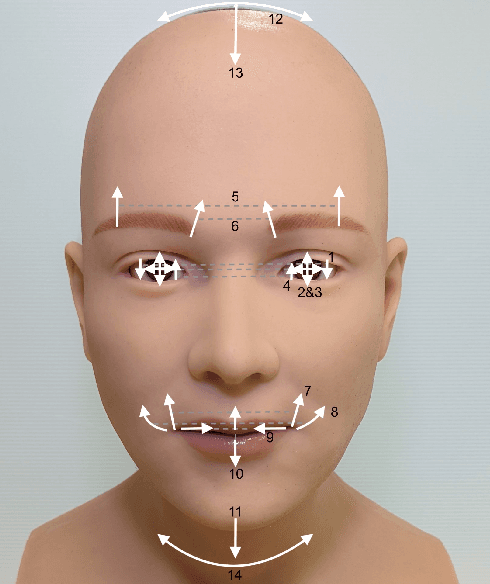
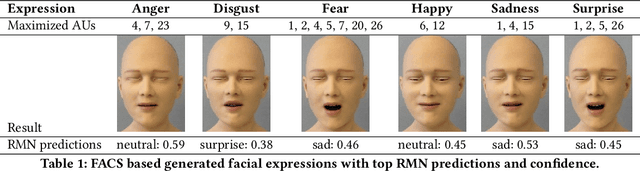

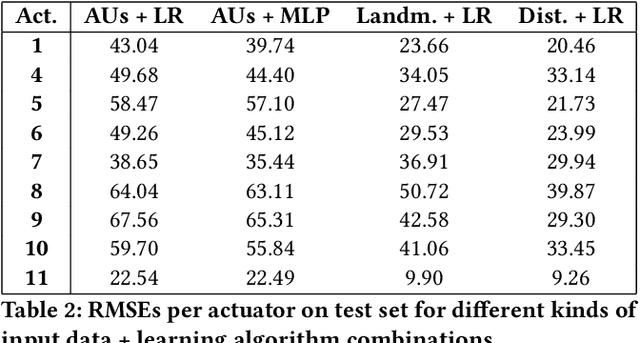
The ability to display rich facial expressions is crucial for human-like robotic heads. While manually defining such expressions is intricate, there already exist approaches to automatically learn them. In this work one such approach is applied to evaluate and control a robot head different from the one in the original study. To improve the mapping of facial expressions from human actors onto a robot head, it is proposed to use 3D landmarks and their pairwise distances as input to the learning algorithm instead of the previously used facial action units. Participants of an online survey preferred mappings from our proposed approach in most cases, though there are still further improvements required.
An Android Robot Head as Embodied Conversational Agent
May 18, 2023This paper describes, how current Machine Learning (ML) techniques combined with simple rule-based animation routines make an android robot head an embodied conversational agent with ChatGPT as its core component. The android robot head is described, technical details are given of how lip-sync animation is being achieved, and general software design decisions are presented. A public presentation of the system revealed improvement opportunities that are reported and that lead our iterative implementation approach.