 Add to Chrome
 Add to Firefox
 Add to Edge
Identifying two piecewise linear additive value functions from anonymous preference information
Feb 24, 2026
Eliciting a preference model involves asking a person, named decision-maker, a series of questions. We assume that these preferences can be represented by an additive value function. In this work, we query simultaneously two decision-makers in the aim to elicit their respective value functions. For each query we receive two answers, without noise, but without knowing which answer corresponds to which decision-maker.We propose an elicitation procedure that identifies the two preference models when the marginal value functions are piecewise linear with known breaking points.

UTA-poly and UTA-splines: additive value functions with polynomial marginals
Oct 21, 2016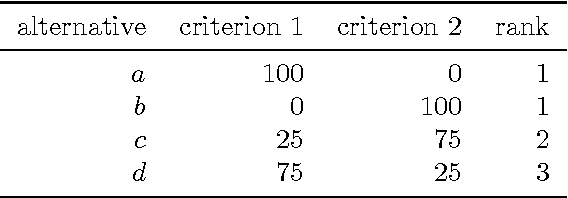
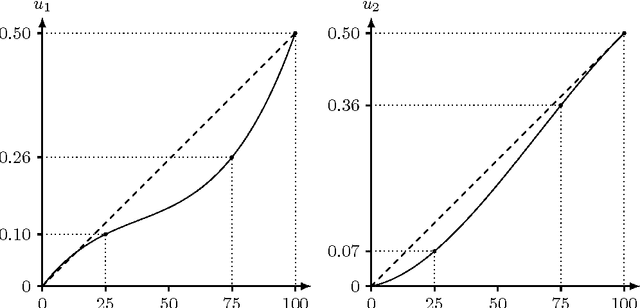
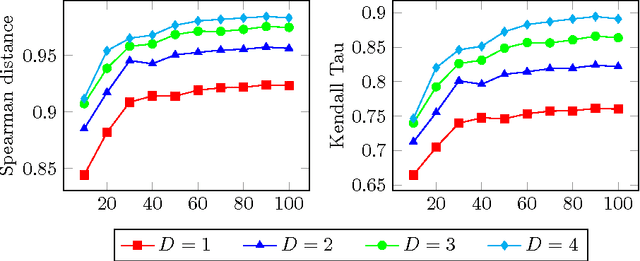
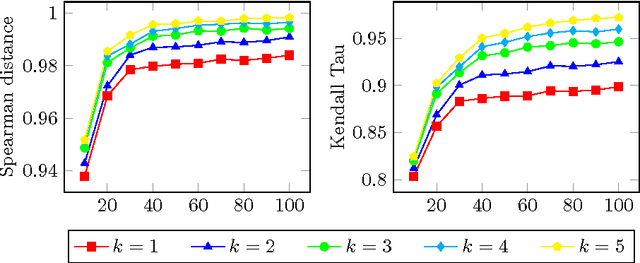
Additive utility function models are widely used in multiple criteria decision analysis. In such models, a numerical value is associated to each alternative involved in the decision problem. It is computed by aggregating the scores of the alternative on the different criteria of the decision problem. The score of an alternative is determined by a marginal value function that evolves monotonically as a function of the performance of the alternative on this criterion. Determining the shape of the marginals is not easy for a decision maker. It is easier for him/her to make statements such as "alternative $a$ is preferred to $b$". In order to help the decision maker, UTA disaggregation procedures use linear programming to approximate the marginals by piecewise linear functions based only on such statements. In this paper, we propose to infer polynomials and splines instead of piecewise linear functions for the marginals. In this aim, we use semidefinite programming instead of linear programming. We illustrate this new elicitation method and present some experimental results.
* 30 pages, 16 figures, 4 tables. No major changes since the first version (few typos, adding references, discussions)